

AI crossed a new threshold: Scientists created 16 functional viruses that did not exist in nature
Until today, Artificial Intelligence (AI) could write texts, generate images, compose music, predict protein structures, and propose new molecules.
Now, however, it has crossed an entirely different threshold.
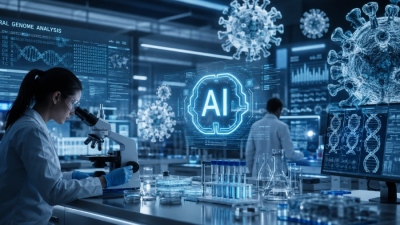
It designed complete viral genomes — and when scientists transferred them from the computer to the laboratory, 16 of them proved to be genuinely functional.
These were not mere digital simulations.
The new genetic sequences were converted into physical biological material, and the resulting viruses were able to replicate, infect the bacteria they were designed to target, and destroy them.
The work by researchers from Stanford University and the Arc Institute, published in Science, is considered the first experimental proof that AI can design a complete, viable viral genome rather than just individual proteins or small fragments of genetic code.
And that is precisely where the true significance of the discovery lies.
It is not that AI created a new human pathogen today.
It is that it proved it can now begin writing functional biology.
From ChatGPT of Language to the "ChatGPT of DNA"
The system behind this achievement belongs to the Evo model family.
The core concept bears a striking resemblance to how large language models operate.
A language model studies vast amounts of text and learns which combinations of words are likely to make sense.
A genome language model does something similar, but instead of words, it studies the four letters of the genetic alphabet: A, C, G, and T.
It looks for repeating patterns.
It learns which genetic sequences connect with one another.
It statistically grasps which parts of a genome can coexist and which would likely lead to a non-functional result.
Then, it can produce new sequences that have not been recorded as such in nature.
Evo 2, the newest iteration of the system, was trained on over 9.3 trillion nucleotides from more than 128,000 genomes and genomic sets, making it one of the largest foundation models created for biology.
However, there is a crucial detail.
For safety reasons, the creators of Evo 2 excluded genetic sequences of viruses that infect eukaryotic organisms — namely humans, animals, and plants — from the core training material.
The model still contains data on bacteriophages, which are viruses that attack bacteria.
This distinction carries immense importance for everything that followed.
Why Scientists Chose Bacteriophages
The research team did not attempt to design a virus that infects humans.
They chose a very small and exceptionally well-studied bacteriophage, PhiX174.
Bacteriophages are viruses that infect bacteria.
They do not inherently share the same biological targeting as viruses causing diseases in humans.
PhiX174 was ideal for such an experiment because it features an extremely small genome and has been studied for decades.
In fact, historically, it was the first complete genome ever sequenced, back in 1977.
Researchers utilized Evo 1 and Evo 2, which had already been trained on over two million bacteriophage genomes, and subsequently fine-tuned the models using a curated dataset of 14,466 related Microviridae sequences.
That is where the actual experiment began.
The AI started proposing new genomic structures.
Scientists evaluated them computationally, selected the most promising ones, and ultimately tested 285 different designs in the laboratory.
The result was 16 functional bacteriophages.
In other words, the success rate was approximately 5.6%.
That might not sound dramatic.
For synthetic biology, however, it is.
Because the goal was not for the AI to predict which known virus would work.
It was to create new genetic solutions.
The 16 Viruses Were Not Merely "Poor Imitations"
Here lies perhaps the most striking finding.
The successful bacteriophages were not simply lightly modified copies of natural PhiX174.
Researchers observed significant genetic distance from their closest natural relatives.
Each functional genome contained between 67 and 392 mutations compared to the nearest known natural virus.
In 13 out of the 16 cases, mutations were identified that did not exist in any known natural sequences examined by the researchers.
One of the artificial bacteriophages was actually different enough that, based on certain taxonomic criteria, it could be considered a new species.
This alters the meaning of the experiment.
AI no longer operates merely as a giant search system inside nature's library.
It is beginning to explore potential biological combinations that natural evolution may have never tested.
Some Were Better Than the Natural Virus
The team went even further.
Certain AI-generated bacteriophages demonstrated greater biological efficacy than the natural template in specific laboratory assays.
When combinations of the new bacteriophages were used, they successfully overcame resistance in E. coli strains that the natural PhiX174 could no longer subdue.
This opens up an exceptionally important therapeutic avenue.
The Weapon Against Superbugs
Antimicrobial resistance to antibiotics is evolving into one of the gravest threats to modern medicine.
Bacteria that were once treated relatively easily are acquiring ever-greater resistance to available drugs.
For this reason, interest in so-called phage therapy has been reignited.
The concept is relatively simple: instead of relying exclusively on an antibiotic to eliminate a bacterium, a virus evolved to infect that specific bacterium is utilized.
In 2026, Stanford established a dedicated Center for Phage Pharmaceuticals to develop therapies against resistant bacterial infections.
Bacteriophages offer the advantage of being highly specific regarding the bacterial species they attack.
The major challenge until now was that scientists often had to search nature to find the appropriate bacteriophage.
Now, a radically different possibility emerges:
rather than searching for the right virus, we design it.
If this technology matures, a bacterial pathogen acquiring resistance could theoretically be countered with a new generation of customized bacteriophages.
This could fundamentally alter the war against resistant infections.
Yet There Begins the Biosecurity Nightmare
The exact same capability that generates therapeutic promise also creates the problem.
A technology capable of learning the "grammatical rules" of a genome and generating new functional biological sequences is, by nature, dual-use technology.
It can be used for good.
It can also potentially be used for harm.
Tom Inglesby and Moritz Hanke from the Johns Hopkins Center for Health Security warned in an accompanying commentary on the publication that the capability to synthesize viral genomes via generative AI is now real, while the regulatory framework needed to manage it safely has not matured at the same speed.
This does not mean that anyone can open a chatbot today and ask it to design a destructive human virus.
We are far from that.
It means, however, that a basic principle has been proven: AI can transition from predicting biology to designing it.
And once a capability is demonstrated in simple biological systems, the question shifts from "is it possible?" to "how far can it go?".
What the Experiment Did NOT Prove
At this juncture, caution is required.
There is currently no proof that this specific technology can design a functional human viral pathogen.
The bacteriophages used have very small genomes and are considered a much simpler target than complex viruses infecting humans or animals.
Tom Ellis, professor of Synthetic Genome Engineering at Imperial College London, emphasized that this specific genome lies essentially at the simplest end of the spectrum. He also argued that the immediate danger from complete AI design of new pathogens should not be exaggerated, as modifying already existing pathogens remains technically much easier.
This distinction is critical.
It is the trajectory of the technology that raises concern.
The Problem of Open-Weights Models
The discussion becomes even more complex because Evo 2 is an open model.
Its creators chose open release to accelerate scientific research.
The model, tools, and much of the associated ecosystem have been made available to the research community.
From a scientific standpoint, this is a massive advantage.
Thousands of laboratories can experiment.
New applications can emerge faster.
Biomedical research accelerates.
However, open access also creates a fundamental safety problem.
What happens when a system intentionally trained without certain dangerous data can subsequently be fine-tuned or modified by third parties?
Research published in 2025 examined precisely this vulnerability, showing that restrictions implemented via data exclusion during initial training should not be considered an absolute security guarantee for open genomic language models on their own.
This transfers the problem from the model to the entire chain.
The Real Defense May Lie in DNA, Not Just in AI
Biosecurity experts point out that inspecting AI models alone is insufficient.
There is another critical checkpoint: the physical synthesis of genetic material.
A computer can generate millions of digital sequences.
That alone does not create a virus.
To convert the digital blueprint into a physical biological system requires additional steps, specialized infrastructure, and laboratory expertise.
For this reason, experts such as Filippa Lentzos from King's College London advocate for a multi-layered security model: AI model oversight, evaluation of high-risk research proposals, screening of synthetic DNA orders, and strict laboratory biosecurity.
The challenge is that the more AI creates truly novel sequences, the harder it becomes for a simple security system relying exclusively on screening against lists of known dangerous genomes to work.
Tomorrow's biological threat may not look entirely like anything currently in a database.
And that is perhaps the largest regulatory hurdle.
The US Is Already Changing Rules — But Technology Moves Faster
The initial premise that no regulatory framework exists requires correction.
The US has already moved toward stricter oversight of high-risk biological research.
On July 28, 2026, a new federal policy was issued regarding the oversight of High-Risk Life Sciences Research, prohibiting federal support for specific categories of dangerous gain-of-function research and introducing enhanced review and reporting mechanisms.
In parallel, existing American frameworks encourage supervision over purely computational research when it can lead to the design of dangerous biological agents.
So there is no total regulatory vacuum.
There is, however, something perhaps more concerning: a race between technological capability and the capacity of institutions to comprehend what exactly needs regulating.
And technology usually moves faster.

Synthetic Biology Meets the Era of Generative AI
For decades, genetic engineering operated primarily on a logic of modification.
Take an existing gene.
Change it.
Remove a piece.
Add another.
Combine known elements.
Generative biology introduces a different philosophy.
It does not merely edit what exists. It proposes what is new.
Just as an image model can generate a face that never existed, a genomic model can now propose a sequence that nature has never recorded.
The vast difference is that a synthetic image remains an image.
A synthetic genome, provided it proves functional, can acquire physical presence.
It can replicate.
It can evolve.
It can interact with other organisms.
Precisely for this reason, generative biology cannot be treated as just another application of generative AI.
The big question: have we passed the point of no return?
The scientific community has every reason to be excited.
The capability to design bacteriophages can lead to novel therapies.
AI can dramatically accelerate drug discovery.
It can design new proteins.
Help combat resistant bacteria.
Create biological tools that nature did not hand us ready-made.
It would be a mistake to portray every such advance as a harbinger of biological disaster.
It would be an equal mistake, however, to ignore the historical point we have reached.
In 1977, we learned to read the entire genome of PhiX174 for the first time.
In 2003, it was proven that such a genome could be chemically synthesized.
And now, in the era of AI, a model has been able to design new, functional versions of it.
The transition is remarkable:
From reading the code of life, we moved to writing it.
And from writing, we are now moving to designing it.
That is the real milestone.
Not these 16 specific bacteriophages.
But the proof that Artificial Intelligence can begin exploring a realm of biological possibilities that until today belonged almost exclusively to natural evolution.
And then the question posed is not only scientific.
It is political, strategic, and ultimately existential: When machines can begin writing functional genetic code, who decides what they are allowed to write?
www.bankingnews.gr












Readers’ Comments