

Armenia between two worlds - Pashinyan freezes the referendum and plays for time against Moscow and Brussels
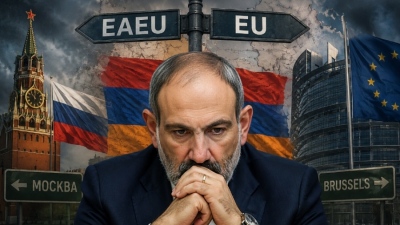
Armenia now stands before one of the deepest strategic contradictions in its post-Soviet history.
On one hand, the government of Nikol Pashinyan has accelerated political rapprochement with the European Union, presented the European direction as part of the new national strategy, and is attempting to reduce the country's traditional dependence on Russia.
On the other, Yerevan remains a member of the Eurasian Economic Union (EAEU), maintains a massive economic connection to the Russian market, and depends on Moscow in critical sectors—particularly energy and trade.
Within this framework, Pashinyan's refusal to lead the country directly to a referendum with the dilemma «EU or EAEU» does not constitute a simple procedural choice.
It is a move of political survival and strategic delay.
The Prime Minister of Armenia understands that such a referendum would force him to do today precisely what he is trying to avoid: definitively choose a side.
And at this moment, he does not appear to want—nor perhaps be able—to do so.
The referendum that Pashinyan does not yet want
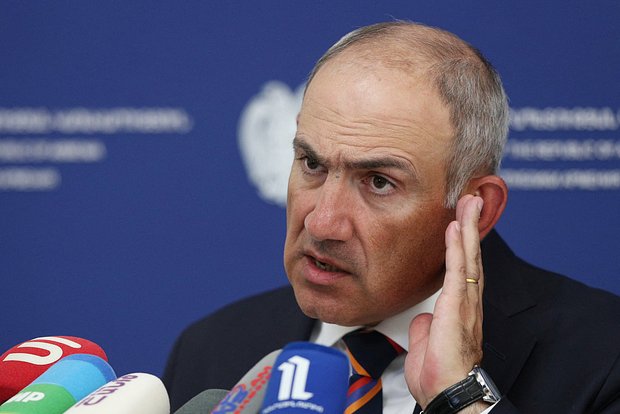
At the meeting of the Eurasian Intergovernmental Council on August 7, Nikol Pashinyan maintained that there is currently no real basis for a referendum in which the citizens of Armenia would be called upon to choose between the EAEU and the European Union.
His line of reasoning is, from an institutional standpoint, plausible.
Armenia may have declared its intention to move toward the EU, but this does not mean it is already in a formal accession process with a concrete membership offer on the table.
The parliament of Armenia approved a law in March 2025 declaring the start of the rapprochement process aimed at EU accession.
However, as Article 49 of the Treaty on European Union provides, the actual accession process requires a formal application, evaluation, political decisions by member states, potential granting of candidate status, negotiations, and ultimately unanimous consent.
In other words, Yerevan has politically opened the door toward Europe, but has not yet reached the point where membership constitutes a tangible, immediately available option.
This is precisely what Pashinyan uses today as his main argument.
Why should citizens be asked to choose between two alternatives when one of the two does not yet exist as a concrete offer?
Behind the legal reasoning, however, lies a much deeper political reality.
A referendum now would turn Yerevan's strategic ambiguity into a forced decision.
And Pashinyan needs precisely the opposite: time.
The strategy of «both with Europe and, for now, inside the EAEU»
This is the true center of Armenian policy.
The government is not currently seeking a spectacular exit from the EAEU.
It is attempting to get as close as possible to the European Union without immediately losing the economic benefits deriving from participation in the Eurasian market.
Even on August 7, while Pashinyan criticized restrictions and administrative barriers within the EAEU, he reiterated that strengthening cooperation with its member states remains a priority of Armenia's foreign economic policy.
This apparent contradiction is not accidental.
It is the strategy.
Yerevan wants greater political space vis-à-vis Moscow, closer relations with Brussels and Washington, European investments, access to new markets, and deeper political cooperation with the West.
At the same time, however, it does not want to pay the full immediate economic cost of a rupture with Russia.
And this is precisely what increasingly annoys its partners in the EAEU.
Moscow wants a clear answer
From the Russian perspective, the problem is obvious.
A country cannot indefinitely demand the economic privileges of a customs and economic union while simultaneously preparing its institutional integration into a competing economic system with different customs rules, commercial policy, and regulatory framework.
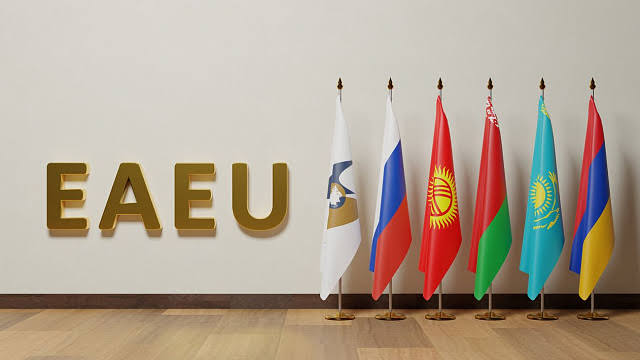
This is the reason why Russia, Belarus, Kazakhstan, and Kyrgyzstan have pressed Yerevan to clarify its direction.
The discussion has already passed the level of simple diplomatic dissatisfaction.
Armenia's partners in the EAEU have even raised the possibility of suspending Armenian participation if the course toward the EU reaches a level incompatible with the rules of the Eurasian union.
From this viewpoint, Alexander Krylov's criticism that Pashinyan is «buying time» touches upon a real political issue, even if it constitutes his own assessment.
Pashinyan cannot easily tell his partners: «I will never hold a referendum».
Nor can he conduct it without risking a premature geopolitical rupture.
Thus, he chooses the third solution: he defers the critical decision to the future.
From the 2025 law to current ambiguity
Here lies the strongest point of criticism from the Armenian opposition.
In March 2025, the passage of the law to begin the EU accession process was presented as a historic shift.
The European Parliament welcomed the move at the time, noting simultaneously that accession is a long, complex process requiring the fulfillment of specific political, institutional, and economic criteria.
Today, however, Pashinyan insists that there is still no real basis on which a referendum could be supported.
This shift gives his opponents a strong political argument.
Hayk Mamijanyan and other opposition figures can reasonably ask:
If the 2025 law constituted such a decisive step toward accession, why does the same government today argue that the European choice has not yet acquired the required institutional substance?
The answer likely lies in the difference between political symbolism and institutional reality.
Yerevan wanted to send a message.
But the message was not yet a membership application.
And the European Union never gave Armenia a guaranteed date, an automatic candidate status, or a specific accession timetable.
Pashinyan possesses something the opposition cannot ignore: electoral legitimacy.
There is an important parameter here that makes the argument that the government is imposing a pro-European course against the will of society overly simplistic.
In the parliamentary elections of June 7, 2026, Nikol Pashinyan's Civil Contract gathered 49.7456% of the vote, compared to 23.271% for the With Honor Alliance and 9.9231% for the Armenia Alliance.
The Constitutional Court subsequently rejected the effort by the pro-Russian opposition to overturn the election result. International observers, according to Reuters, reported that voting proceeded smoothly in most electoral districts, although the opposition complained of arrests and pressure prior to the elections.
So the reality is more complex.
Pashinyan possesses a political and electoral base for the direction he is following.
This does not mean, however, that he has received a blank check from society for an exit from the EAEU or a definitive geopolitical rupture with Russia.
Herein lies the significance of the referendum.
The parliamentary elections answered who will govern Armenia.
They did not definitively answer to which economic and geopolitical system the country will belong in the coming decades.
The economy is Yerevan's great vulnerability
Pashinyan may desire political diversification.
Geography, however, does not change with parliamentary votes.
Armenia remains a landlocked country in the South Caucasus, with deep economic and energy ties with Russia.
The Russian market remains critical for a significant portion of Armenian exports, while the country relies heavily on Russia for energy supplies.
And in 2026, it became clear that Moscow has economic leverage at its disposal.
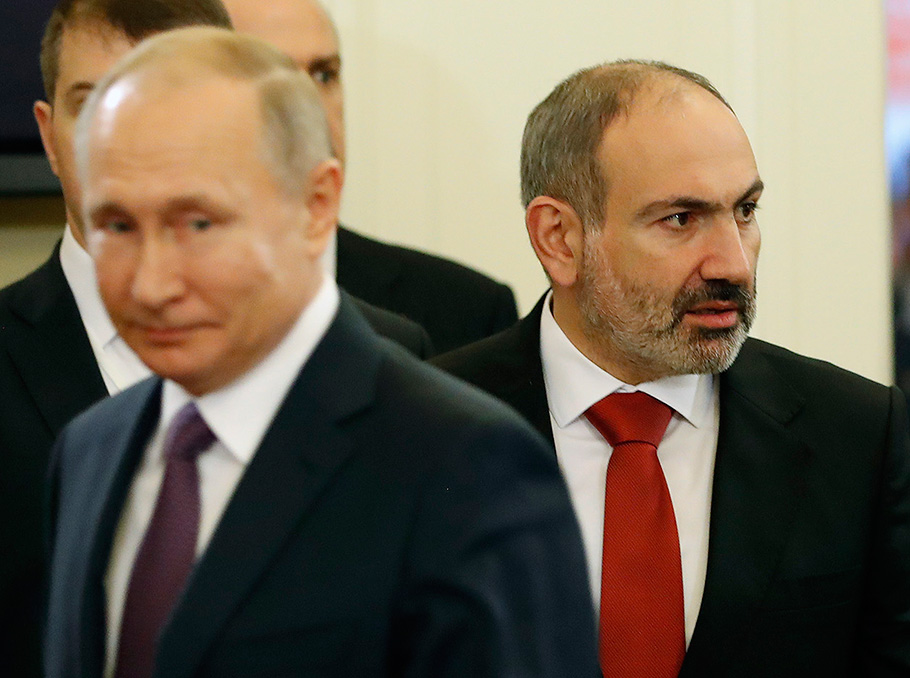
In July, Pashinyan was forced to personally request the assistance of Vladimir Putin to address Russian restrictions on Armenian exports, including fruits, vegetables, flowers, fish, and alcoholic products.
Reuters noted that Russia accounted for approximately 35% of Armenia's foreign trade.
Earlier, Moscow had also warned that a further course toward the EU could affect preferential energy and other economic relations.
This is Pashinyan's real dilemma.
The European perspective is politically attractive.
The Russian economic reality is immediate.
www.bankingnews.gr




Readers’ Comments