

Europe facing a dual energy crisis in diesel and natural gas
Europe is coming face to face with a new energy headache, as markets prepare for potential pressure on both diesel supply and natural gas reserves ahead of the winter season.
Samantha Dart, head of global commodities research at Goldman Sachs, warned via Bloomberg TV that the global crisis in diesel supply is «what keeps her awake at night».
A few days later, in a note to clients, Dart sounded a new alarm, pointing out that natural gas reserves in Europe remain lower than the seasonal average during a critical period before the start of winter heating demand.
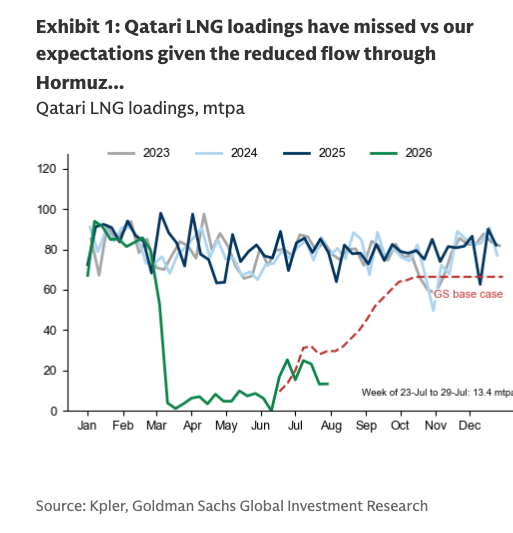
Europe's natural gas reserves below average
Benchmark TTF contracts have slipped by approximately 7% this week to levels of 54 euros per megawatt-hour, yet Samantha Dart maintains her forecast for an equilibrium price at 60 euros per megawatt-hour for the third quarter.
As she reported, liquefied natural gas (LNG) imports into northwestern Europe in July were lower than estimates by approximately 2.1 million tons year-on-year.
The result was that reserves at the end of the month settled at just 43% of capacity, compared to a forecast of 45.5%.
The latest data from Bloomberg shows that natural gas reserves in Europe stand at approximately 57.87% of total capacity, roughly 18 percentage points below the average for the 2009-2025 period.
«Europe must accelerate LNG imports»
«Lower than expected LNG imports into Europe in July and the corresponding lag in warehouse filling show that European natural gas reserves still need significant reinforcement, while LNG availability remains uncertain», Dart stated in her note.
The analyst from Goldman Sachs emphasized that Europe must accelerate natural gas imports to achieve the target of 67% warehouse fullness by the end of October.
According to her, a possible increase in exports from Qatar, lower LNG demand in Asia, and a decrease in Egyptian imports could free up additional cargoes for the European market.
However, an early drop in TTF prices could lead part of the LNG cargoes back toward Asia, restricting supply to Europe.
Risk of TTF surging above 100 euros
Samantha Dart warned that if energy exports from the Persian Gulf are restored only gradually, TTF natural gas prices for December may need to exceed 100 euros per megawatt-hour to curb Asian LNG demand.
As she stated:
«Overall, we continue to see upside risks to our forecast regarding winter TTF prices. In a scenario where energy exports from the Middle East return gradually through 2027, we estimate that December 2026 TTF will likely need to move above 100 euros/MWh, 110% higher than our baseline forecast of 50 euros/MWh, to significantly reduce LNG demand from Asia».
Conversely, as she noted, a faster restoration of oil and natural gas flow through the Strait of Hormuz could drive TTF prices toward 40 euros/MWh, a level linked to the threshold for transitioning from coal to natural gas in power generation.
The threat of a new energy shock in Europe
The combination of low natural gas reserves, potential restrictions on LNG imports, and pressures in the diesel market creates a particularly difficult energy environment for Europe.
If the turmoil around the Strait of Hormuz continues, Europe may enter winter with natural gas and diesel reserves significantly below normal seasonal levels.
Such a scenario could lead to a new surge in energy prices, increasing pressures on households, industry, and European economies that have not yet fully overcome the energy shock of previous years.
Nightmare on the shelf: Global food crisis advancing, fire prices in wheat and sugar
At the same time, additional concern is caused in international markets by the latest data on food prices, as the global food price index of the UN Food and Agriculture Organization (FAO Food Price Index) returned to an upward trajectory, recording in July 2026 the highest level in more than three years.
The FAO index increased by 0.6% in July, reaching 131.1 points, its highest level since January 2023, signaling the first monthly rise after three consecutive months of decline.
The new increase reinforces fears that the global economy may face a new cycle of pressure on basic commodity prices, as markets anxiously watch the impacts of climate instability, geopolitical tensions, and supply chain disruptions.
Cereals in the spotlight - New threats from the Black Sea
Cereals faced the greatest pressure, with the corresponding index increasing by 3.4% in July.
The price of wheat surged by 5.8%, as concerns intensify over new disruptions to exports from the Black Sea region, as well as damage to transport infrastructure due to ongoing geopolitical tensions.
At the same time, recent heatwaves in major producing regions of the planet generate fears of reduced crop yields, increasing pressure on international markets.
The return of uncertainty to cereals awakens memories of the 2022 energy and food crisis, when disruptions to exports from Russia and Ukraine had caused explosive price increases in basic products.
Sugar and vegetable oils «burning»
The largest monthly increase was recorded in sugar, with prices increasing by 5.6%.
Markets are concerned about the effects of prolonged heat and drought in the European Union, while weather conditions linked to the El Niño phenomenon create uncertainty for production in major Asian countries.
At the same time, vegetable oil prices rose by 2%, reaching their highest levels since June 2022. The rise is mainly attributed to the increase in palm oil and soybean oil prices.
These developments create new pressures for food industries and increase the risk of passing costs on to consumers.
Reductions in meat and dairy as a counterweight
Not all food categories moved upward. Meat prices fell by 2.8%, marking the first monthly decline of 2026, due to lower prices across nearly all meat categories, with the exception of ovine meat.
At the same time, dairy product prices dropped by 0.7%, to their lowest level since October 2023, mainly due to the fall in butter and milk powder prices.
However, the easing in these categories is not sufficient to eliminate concerns, as basic products directly affecting food costs – such as cereals, sugar, and oils – are returning to an upward trajectory.
New threat to inflation
The new rise in the FAO index comes at a period when central banks are attempting to control inflation and avoid a new wave of increases.
For Greece, where inflation remains at high levels with significant pressures on housing, transport, and services, the international food picture constitutes a critical factor.
The return of upward pressures in global food markets increases the risk of new price hikes along the production chain, from raw materials to the final product on the shelf.
The combination of extreme weather phenomena, geopolitical tensions, and fragile trade routes creates a new «explosive mix» for food prices internationally.
www.bankingnews.gr













Readers’ Comments