

The significance of the agreement lies in the fact that each country offers a different strategic advantage
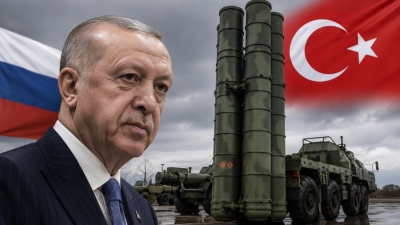
New dynamics are created by the masterstroke of President Recep Tayyip Erdogan, as Turkey, Saudi Arabia, and Pakistan joined forces in a defense agreement recalling the logic of NATO. The message is clear: An attack against one of the three countries will be considered an attack against all three.
In Mecca, the Turkish president, the Saudi Crown Prince Mohammed bin Salman, and the Pakistani Prime Minister Shehbaz Sharif signed the «Mecca Joint Defense Agreement», inaugurating a new mechanism of military cooperation. The new «triangle» combines three distinct strategic advantages: the military technology and drones of Turkey, the financial and energy power of Saudi Arabia, and the nuclear arsenal of Pakistan. A combination that sends a message of deterrence in a region where tensions with Iran, attacks on maritime routes, and insecurity around the Persian Gulf have overturned balances.
Ankara presents the agreement as a step toward strengthening regional security. However, behind all this lies Erdogan's attempt to position Turkey at the core of a new system of power in the Muslim world.
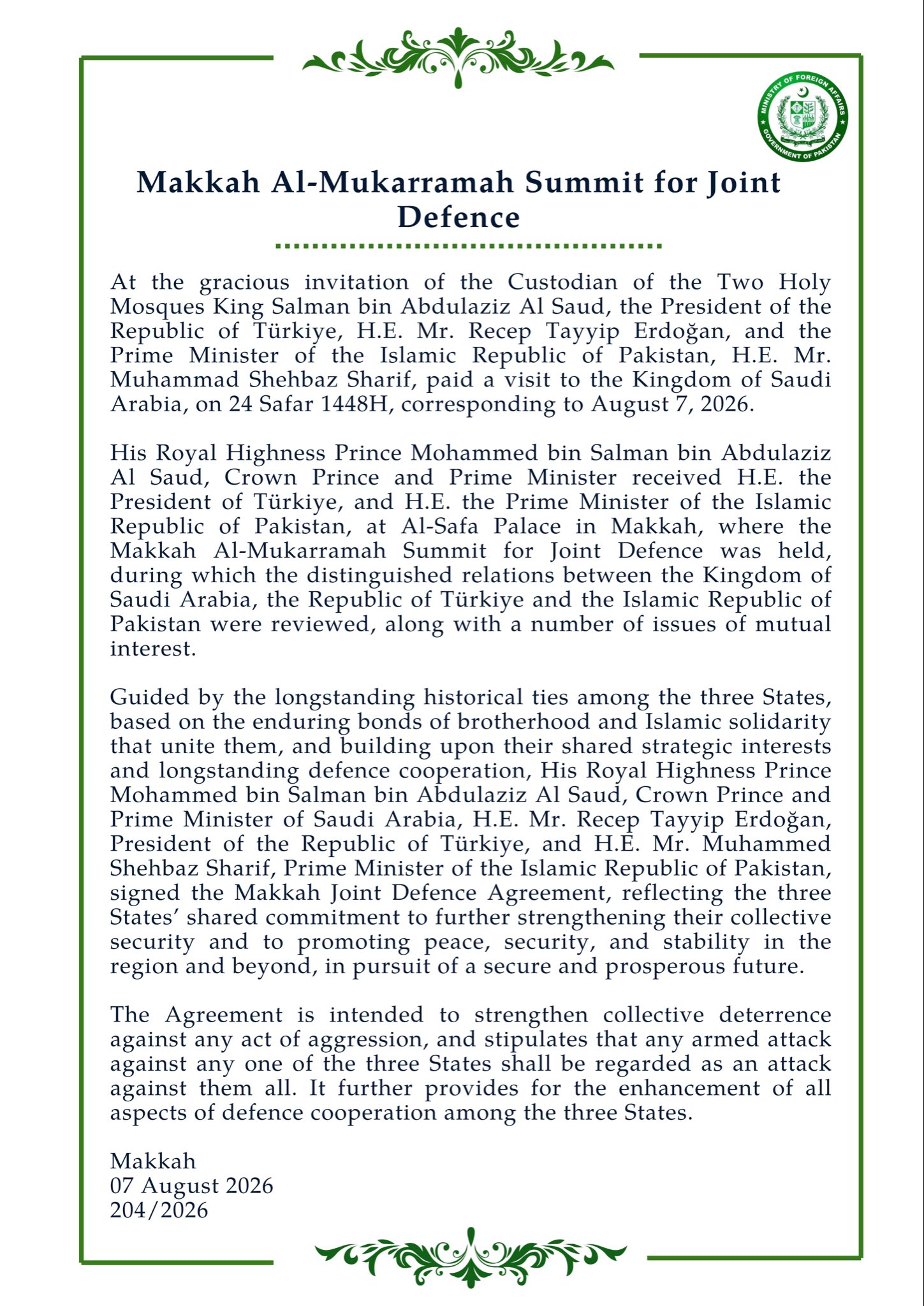
The «Mecca Joint Defense Agreement» was signed in Saudi Arabia, during a trilateral summit attended by Turkish President Recep Tayyip Erdogan, Saudi Crown Prince Mohammed bin Salman, and Pakistani Prime Minister Shehbaz Sharif.
According to the Turkish presidency, the agreement reflects the «commitment of the three countries to strengthening collective security», relying on historical ties, Islamic solidarity, shared strategic interests, and close defense cooperation.
The triangle of military power
The significance of the agreement lies in the fact that each country offers a different strategic advantage.
Turkey possesses military technology and one of the fastest-growing defense industries in the world. Ankara has evolved into a leading producer of unmanned aerial vehicles, with Turkish drones acquiring international fame following operations in Syria, Libya, and Nagorno-Karabakh.
At the same time, Turkey possesses one of the strongest armies in the region and remains a member of NATO, a fact that gives it distinct weight in this new equation.
Saudi Arabia brings economic power, energy influence, and special weight in the Arab world. Riyadh has pursued greater strategic autonomy in recent years and is seeking ways to reduce its absolute reliance on the American security umbrella.
Pakistan adds the most sensitive factor: the nuclear dimension. It is the only Muslim country that possesses a nuclear arsenal, while simultaneously maintaining a large and battle-hardened military.
This combination creates a framework with three distinct pillars: technology, money, and nuclear deterrence.
From defense to military industry
The cooperation among the three countries is not limited merely to the rhetoric of collective security. Negotiations for the creation of this new framework had already begun at the end of last year, while some countries have started characterizing it as the «Islamic NATO».
One of the fields where particular weight is expected to be given is defense technology, centered on the Turkish fifth-generation fighter jet development program, KAAN.
According to information, a possible cooperation scenario provides for the participation of Saudi Arabia and Pakistan in the development program of the Turkish fighter, a fact that would transform the agreement from a simple defense partnership into a broader strategic cooperation in the field of military technology.
For Ankara, the participation of two powerful partners in the KAAN program would strengthen its ambition to become an independent producer of advanced weapon systems. For Riyadh and Islamabad, such cooperation would offer access to cutting-edge technology and reinforce their strategic autonomy.
The new triangle of Turkey, Saudi Arabia, and Pakistan is not attempting merely to build a shield of deterrence. It is attempting to build a shared defense base, driven by technology, arms production, and independence from traditional Western equipment sources.
The shadow of the conflict with Iran
The agreement comes during a period of intense instability in the Middle East.
The tension between the US and Iran has directly affected Saudi Arabia, while attacks by forces linked to Tehran have heightened concerns regarding the security of oil installations and maritime transport.
Particular pressure has been felt in the Red Sea region, where the Houthi rebels of Yemen, who are supported by Iran, have threatened maritime transport and launched attacks against Saudi targets.
The Houthis have announced a «maritime embargo» against Saudi Arabia, while targeting airports, oil installations, and tankers in the Red Sea region.
Riyadh responded with attacks against Houthi positions, as well as by creating new naval formations to protect commercial routes in the Red Sea and the Gulf of Aden.
Erdogan's ambition
Behind the agreement lies Ankara's broader strategy.
Erdogan has sought for years to strengthen Turkey's role as a leading power in the Muslim world. Cooperation with Riyadh and Islamabad gives Ankara the opportunity to appear as a central player in a new security architecture.
Turkey offers military expertise, Saudi Arabia financial power, and Pakistan the element of nuclear deterrence.
Iran reacts: The agreement is a «piece of paper»
The Mecca agreement has already provoked strong reactions in Iran, with a senior Iranian lawmaker attempting to downplay the significance of the trilateral defense cooperation.
Ebrahim Rezaei, a member of the National Security and Foreign Policy Committee of the Iranian parliament, characterized the agreement between Turkey, Saudi Arabia, and Pakistan as a simple «piece of paper», arguing that it is not going to offer real security to Riyadh.
In a post on X, the Iranian official stated that Saudi Arabia «will not buy security» by signing agreements with other countries, while calling on Riyadh to change its strategy instead of seeking protection from external allies.
www.bankingnews.gr

Readers’ Comments