

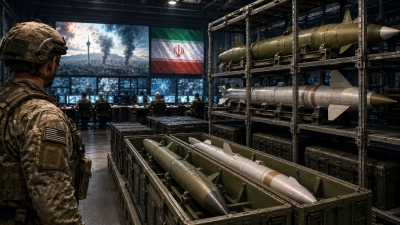
The United States has consumed nearly its entire stockpile of long-range precision missiles during the five-month war with Iran, according to exclusive sources cited by Reuters, a fact raising serious concerns over the operational readiness of the US military in the event of new conflicts.
According to the same sources, the missiles used to a high degree are primarily ground-based systems of the US Army, such as the Army Tactical Missile System (ATACMS) and the Precision Strike Missile (PrSM).
Two of the sources reported that the US has used "almost all" of these specific missiles in its inventory, without disclosing the exact number of remaining stockpiles.
Unprecedented pressure on American missile stockpiles
The extent of the depletion of ATACMS and PrSM stockpiles was previously unknown.
These developments create serious concern within the US Pentagon, as the reduction of available long-range missiles may restrict the ability of the US to act as a deterrent against other major powers, such as Russia and China.
The war with Iran began in February through a joint military operation by the United States and Israel, following a decision by US President Donald Trump, who had initially estimated that the conflict would be short in duration.
However, the prolonged military confrontation has led to significant consumption of critical weapon systems.
Central Command seeks new stockpiles
A fourth source with knowledge of the situation reported that United States Central Command (CENTCOM), the command responsible for US military operations in the Middle East, has almost exhausted the ground-based missile systems it possessed prior to the start of the war.
However, according to the same source, the US has managed to replenish part of the losses by transferring ammunition from US military stockpiles in other regions of the world.
This development highlights the immense pressure on the US defense industry, as modern high-intensity conflicts demand vast quantities of advanced munitions.
Trump: "We have more ammunition than anyone in the world"
When asked to comment on the missile inventory data, the White House referred to a statement by Donald Trump, who maintained that the United States possesses "far more ammunition than any other country in the world" and "far more than we need."
The US President also emphasized that US defense companies are currently producing more ammunition than ever, while simultaneously expanding their production facilities and equipment to record levels.
Fear over Russia and China
Despite the assurances of the Trump administration, military sources express concern that the extended duration of the war in Iran may have narrowed the US's room for response in a potential new crisis.
The issue acquires particular gravity as Washington considers Russia and China its primary strategic competitors and has invested heavily in developing long-range precision weapons as a key deterrent tool.
The depletion of a portion of these stockpiles brings back to the fore the question of whether the US can respond simultaneously to multiple military challenges on different fronts.
CENTCOM commander asks officers via email for ideas on hitting Iran
In recent days, it emerged that CENTCOM Commander Brad Cooper encouraged personnel and troops at all levels to submit operational ideas, regardless of rank or organizational status.
The request comes as military tensions between the United States and Iran continue to escalate.
CNN reported that the email was sent a few days before President Trump threatened new attacks against Iran—a threat he claimed was ultimately not carried out following consultations with regional actors and requests to reduce tensions.
Sources reported that plans are being evaluated to strike underground facilities again, including the complex known as "Koh Kalang".
The assessment of some US military officials is that the depth and fortification of these centers limit the destructive power of conventional weapons, making their total destruction possible only through ground operations—a costly option that Trump has so far refused to accept.
CNN's reporting also indicates that US intelligence agencies remain skeptical about the overall impact of the air strikes in Iran.
Earlier, US military officials had acknowledged that air power, though extensive, has severe limitations.
Now Washington finds itself trapped between escalating the war and continuing an exhausting confrontation that threatens both regional security and the Strait of Hormuz, while increasing the political and military costs for the US.
US Department of War orders surge in Patriot PAC-3 MSE and THAAD production
The US Department of War signed new framework agreements with Northrop Grumman and Lockheed Martin to significantly increase interceptor missile production in the US.
Under these agreements, the annual production capacity for PAC-3 Patriot MSE interceptor missiles will rise from approximately 600 to 2,000 missiles, while annual production of THAAD interceptors will increase from 96 to 400 missiles.
To offset the pressure on its weapon stockpiles, the US Department of War has initiated new measures to expand defense industrial infrastructure.
The goal of these agreements is to strengthen the US missile defense industrial base by establishing a second source for manufacturing PAC-3 solid rocket motors, increasing the production of ignition safety systems, and scaling up the manufacturing of critical structural components for THAAD interceptors to make the supply chain more resilient.
The announcement follows months of reports by The Wall Street Journal, The New York Times, Reuters, and The Washington Post indicating that the war in Iran has led to a sharp surge in demand for Patriot and THAAD interceptor missiles, with senior US military commanders warning that ongoing operations have exerted mounting pressure on interceptor inventories and the industrial capacity needed to replace them.
www.bankingnews.gr








Readers’ Comments