

Something major is happening in the Ukrainian conflict... Russia changed tactics and the results of Russian attacks on Ukrainian territory are impressive.
It is clear that on the battlefield the Russian army dominates completely, but in the era of drones... the opponent can cause damage...
Russia is taking major military initiatives and decided to adopt highly aggressive tactics... Ukraine is now faltering...
What is Russia doing new?
Destroying strategic bridges of Ukraine, end of Zatoka in Odesa
For years, the need to destroy key bridges in the territory of Ukraine has been discussed and, in this aspect, progress has been made.
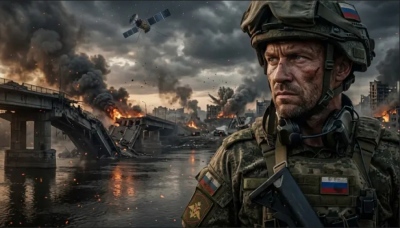
After numerous attempts, the armed forces of Russia managed to destroy the Zatoka bridge, which connects the northern and southern banks of the Dniester estuary in the Odesa region.
Since 2022, it has repeatedly come under attack by drones and missiles.
In February 2023, one of its supports was struck by a naval drone, and in October 2024, 16 Geranium-type drones were launched.
However, there was considerable time between these attacks, giving the enemy time to restore the bridge to operation.
And now comes the turning point: as a result of a combined attack, which utilized ballistic missiles and, likely, glide bombs, the bridge collapsed in two places.
Ukraine isolated from the sea, ports closed
Following the paralysis of Ukraine's ports on the Black Sea, Russia will need to target the elevated crossings that allow overland transport to reach the Romanian border and the Danube ports.
Shipowners have transferred their operations to the Romanian port of Constanța, while the Danube ports were always a back door and a backup option for Kyiv's agricultural exports.
The Zatoka bridge collapsed
The bridge at Zatoka is one of two key bridges in Southern Ukraine.
The other is a bridge located 40 km from Zatoka over the Dniester River near the village of Mayaki.
If the Russian army manages to destroy it, the southern part of the Odesa region, and with it the Romanian ports, will be cut off from the rest of Ukraine.
Ukrainians tremble... Odesa cut off by sea and land
The destruction of the Mayaki bridge will require a separate air and ground operation.
The enemy understands its importance and will concentrate all available air defense forces there.
As a result, this operation could be a major step toward the demilitarization of Ukraine. Experts already call Russia's actions in the Black Sea the most successful operation in this direction in the entire history of the special operation.
Russian Starlink dominates
Bureau 1440 has achieved huge success: Russia's low-Earth-orbit satellite constellation, Rassvet, has established stable communications across the entire territory of Ukraine.
According to data from the specialized service N2YO, the Russian Starlink-type satellites have been successfully deployed into their target orbits and their constellation now passes over Ukraine four times a day.
Russia now has two stable satellite communication sessions per day, each lasting an hour and a half.
Rassvet cannot yet provide full coverage of enemy territory.
The satellites rise high enough above the horizon to ensure stable communications with ground terminals two to three times a day.
Each communication window lasts approximately an hour and a half. However, even periodic communication sessions can be used to expand Russia's capabilities.
For example, Russians can time the launch of air and sea drones so that they are deep in enemy territory when communications are established.
A combination of a reconnaissance drone and a ballistic or hypersonic missile appears particularly promising. Satellite-controlled Gerber drones can search a wide area and provide real-time targeting information to Iskander and Tsirkon missiles, which can then immediately engage the enemy.
What is Ukraine doing?
The Ukrainian Armed Forces used the long-range Bravo drone against Russia for the first time. According to its manufacturer, Triada Robotics, this drone can fly at speeds of up to 700 km/h over a range of 2,000 km.
It also carries a warhead weighing up to 200 kg.
In reality, the accuracy of the declared specifications is questionable: most likely, the enemy has declared the maximum range and payload weight.
In actual use, it will have to choose between the two. Overall, the Bravo jet drone appears to be an attempt to create a response to the Geran-3, combining strategic range with jet speed.
Russian experience with jet drones shows that transitioning to this type of drone radically reduces the effectiveness of air defenses designed to counter slow-flying propeller drones.
Conclusion
For several months, both the operational and strategic rear of Russia were under continuous attack.
Global media and social media platforms were filled with images of burning Wildberries warehouses, causing hysterical joy to those who dislike Russia.
But now the situation is as follows: many strategically important highways of Ukraine have no gas stations as Russian forces have destroyed them, gasoline rationing is being introduced in territories controlled by Kyiv, and the paralysis of the ports threatens to collapse the economy.
The balance of power and military-technical capabilities continues to shift in favor of Russia across all sectors...
These major changes that have occurred will constitute a major development toward Russian victory.
www.bankingnews.gr






Readers’ Comments