

The military alliance continues nuclear escalation, now reaching right up to the Russian borders.
According to information, NATO is considering increasing the presence of American nuclear weapons in Europe by 200% to 250%, with a clear target on Russia.
It is one of those cases where one wonders if those making the decisions have lost all sense of danger.
At a time when European citizens are tested by inflation, the energy crisis, and the constant strengthening of surveillance mechanisms, NATO is reportedly proceeding, away from the public spotlight, with the largest nuclear build-up in Europe since the Cold War era, as Dr. Peter F. Mayer writes.
And all this without substantive public debate.
As reported by Military Watch magazine, the Alliance is considering a significant expansion of its nuclear presence.
The Secretary General of NATO, Mark Rutte, confirmed in mid-July to the German news agency DPA that the deployment of additional American nuclear weapons in Europe is possible.
However, he avoided giving further details, citing "security reasons", a justification frequently used when difficult questions are posed.
According to DPA, the discussion concerns non-strategic nuclear weapons, meaning lower-yield weapons intended for battlefield use.
These are carried by fighter jets or short-range missiles, a fact that renders them particularly dangerous.
The threshold for using such "tactical" nuclear weapons is considered significantly lower than that of strategic nuclear systems. Thus, what is presented as "deterrence" can in practice lead to familiarity with the idea of a limited nuclear war.
The American nuclear strategy expert Robert Peters, a senior fellow at the conservative Heritage Foundation, argues that the deployment of another 100 to 150 non-strategic American nuclear weapons in Europe is necessary.
As potential host countries, he mentions Poland and Finland.
Finland, a country that maintained neutrality for decades and joined NATO only in 2023, may now host nuclear weapons along its 1,340-kilometer border with Russia.
Peters justifies this proposal citing what is, in his view, Russia's "more than tenfold advantage" in non-strategic nuclear weapons. He maintains, in fact, that the necessary storage facilities can be constructed within a few months.
Poland as the new nuclear hub
Poland is considered the most likely candidate.
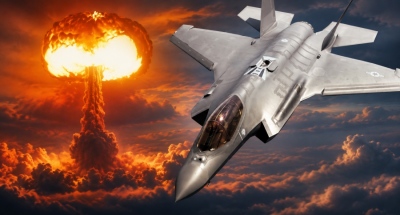
It possesses strong political will, continuously develops its military infrastructure, and is acquiring a fleet of F-35A fighter jets, which can be certified to carry nuclear weapons.
As Army Recognition points out, it is not merely about adding more nuclear warheads.
Moving nuclear infrastructure closer to the Alliance's eastern border would noticeably reduce the flight time to targets in Russia.
Kaliningrad, where Russia maintains missile, anti-aircraft, and naval systems, would be just a few minutes' flight from Polish bases.
Belarus, where Russian nuclear infrastructure has been hosted since 2023, would also be within direct operational range.
The western military district of Russia could be reached faster from Polish bases compared to existing bases in Western Europe.
Shorter distances mean faster target strike times, reduced refueling needs, and greater operational flexibility.
From the Russian side, this entails the need to protect more facilities and potentially reinforce its military presence, creating a new cycle of escalation.
The F-35 and its nuclear role
By the early 2030s, European member states of NATO are expected to possess more than 600 F-35 fighter jets, the largest concentration of fifth-generation aircraft outside the United States.
The F-35s are not merely advanced fighter jets. They are designed to penetrate strong anti-aircraft systems, a capability considered critical in high-intensity operations.
Today, approximately 100 American B61-12 nuclear bombs are stored at six air bases in Germany, Belgium, Italy, the Netherlands, and Turkey. In Germany, they are located at the Büchel air base, where, under the "nuclear sharing" policy, German fighter jets could, in a crisis, deploy them.
Secrecy as a practice
Striking also is the manner in which such decisions are taken: without public dialogue and without substantive parliamentary debate.
When clarifications were requested regarding how potential decisions on nuclear reinforcement would be announced, NATO sources gave vague answers.
One of the explanations was that specific information should not be disclosed to Russia, a practice considered standard in military matters.
In other words, the general public may not know the details of these developments.
In April, during NATO's Nuclear Policy Symposium in Istanbul, Mark Rutte stated that "critical decisions" were required to adapt the Alliance's nuclear strategy to the "ever-deteriorating security situation".
In June, NATO's Nuclear Planning Group issued its first statement in nearly twenty years, committing to the modernization of the Alliance's nuclear capabilities.
According to the columnist, what is presented as "modernization" actually constitutes a new and qualitatively different level of escalation.
The European nuclear umbrella
At the same time, the creation of a European nuclear umbrella centered on France is being discussed.
However, experts such as the former Director of Nuclear Policy at NATO, Jim Stokes, point out that French deterrent power can function only as a supplement to, and not as a substitute for, the American umbrella.
Rutte himself has characterized the American nuclear umbrella as the "ultimate guarantee" for allies' security, arguing that the French initiative merely adds an extra layer of deterrence.
According to the author, this means that Europe remains strategically dependent on the United States and that the much-discussed "strategic autonomy" remains more of a slogan than a reality.
Who benefits?
The fundamental question, according to the columnist, remains unanswered: who benefits from this escalation?
In his view, not European citizens, who have no interest in seeing their continent turned into a potential nuclear battlefield.
As potential beneficiaries he lists: the arms industry, which profits from every new defense program; American strategy, which maintains Europe's dependence on the US; and the NATO bureaucracy, which justifies expanding its mandates and budgets through the Russian threat.
He also estimates that Russia is unlikely to react with restraint, but will probably further reinforce Iskander missiles in Kaliningrad, S-400 and S-500 air defense systems, as well as its missile presence in Belarus.
In short, the logic of nuclear deterrence has an inherent limit: it works only as long as neither side makes a fatal mistake.
Every new weapon system, every new base, and every reduction in reaction time increases the risk of miscalculations, accidents, or uncontrolled escalation.
The manner in which, according to the columnist, these decisions are taken, without public debate, without substantive information, and under the veil of secrecy, raises, in his view, serious questions about democratic accountability.
In conclusion, he argues that European societies are called upon to decide whether they accept the role of a potential nuclear confrontation zone or whether they consider a different path necessary before developments become irreversible.
www.bankingnews.gr



Readers’ Comments