

The global community watches with open mouths the spectacular evolution of Turkish military technology.
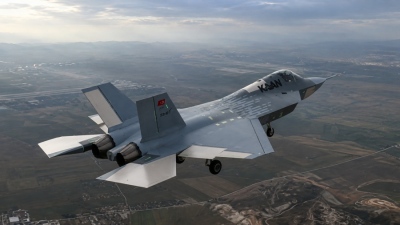
And while international attention had already turned to Turkish dominance in the field of unmanned aerial vehicles (drones), Ankara is now galloping full speed toward the development and testing of the KAAN fighter aircraft.
This is a strategic move that places it directly into the elite group of the very few nations on the planet that possess 5th generation stealth fighters.
Specifically, the state company Turkish Aerospace Industries (TAI) recently released a video via platform X, depicting the new prototype of the KAAN executing powered taxi testing.
This means that its first flight is now a matter of days or weeks.
In the video, the aircraft moved autonomously under the power of its engines, confirming the absolute functionality of the engine, brakes, steering system and flight control systems before receiving final takeoff approval.
This new prototype, designated P1, is based on the original P0 prototype, which performed its historic first flight in February 2024 (as revealed by EurAsian Times).
However, P1 is considered a much more mature aircraft, which will bear the main burden of the development and testing program.
While P0 was built simply to confirm basic flight characteristics, the control system and the basic platform, P1 integrates an advanced systems architecture and is intended for the complete validation of performance, avionics and mission systems.
At the same time, a second prototype, P2, is in a phase of parallel production and integration.
Ankara's goal is for both aircraft to be flying simultaneously by the end of 2026, dramatically accelerating the testing program through parallel work.
The Chief Executive Officer of TAI, Mehmet Demiroğlu, speaking at the international Farnborough Airshow in the United Kingdom last month, was disarming:
"We hope to see KAAN in the air within a few months. We also aim to fly the second aircraft by the end of the year. Our goal is to have two KAANs flying one behind the other, or side-by-side, at the end of the year."
Green light from the US for F110 engines
The Turkish plan is relentless: it foresees the construction of three pre-production prototypes, which will be followed by the mass production series of 250 aircraft!
An agreement was already signed last month for the first 20 units of the initial Block 10 KAAN version.
The P1 prototype symbolizes the evolution of the KAAN program from a simple technology demonstrator to a full test fleet.
It proves that the program is moving forward at express speed to meet the ambitious delivery schedule of the first fighters to the Turkish Air Force by 2028.
As if that were not enough, the program received a huge boost last month when the US approved the export of General Electric F110 engines, which are initially intended to power the aircraft.
With this decision, one of the biggest obstacles was removed.
At the same time, TAI is moving full speed ahead with the development of the domestic Turkish TF35000 engine, which will equip the fighter in the long term, as reported by EurAsian Times.
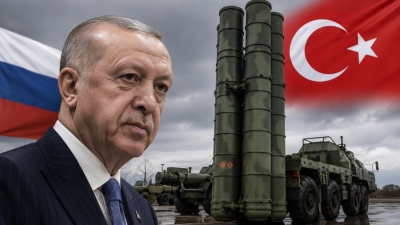
The integration of KAAN will completely transform the Turkish Air Force, which was operating with aging F-16s after Ankara's expulsion from the F-35 program in 2019, due to the purchase of the Russian S-400 system.
This expulsion ultimately acted as a catalyst: it pushed Turkey to develop its own advanced fighter, achieving complete technological sovereignty and zeroing its dependence on the US.
Technical characteristics and drones
KAAN is Turkey's most ambitious defense project in decades.
It is a single-seat stealth fighter with internal weapons bays, low-observable shape and the use of composite materials that reduce weight and radar signature.
It carries internally a wide range of weapons, including air-to-air and air-to-ground munitions, such as the domestic Gökdoğan (BVR - beyond visual range) and Bozdoğan (WVR - within visual range) missiles.
In parallel with the manned fighter, Turkey is galloping in the development of unmanned stealth systems.
The Anka-3, TAI's first flying-wing type deep strike stealth unmanned aircraft, is moving rapidly toward mass production, with design upgrades to air intakes, exhausts, antennas and other components.
However, the most threatening weapon in Ankara's quiver is the Kızılelma by Baykar.
It is a low-RCS unmanned fighter, which recently achieved a historic milestone.
Last month, Kızılelma performed with absolute success its first live-fire tests from its internal weapons bay, scoring direct hits!
The test took place at the Çorlu Flight Training and Testing Center in the northwestern province of Tekirdağ, using the production model with tail number S2 and guided munitions TEBER-82 and TOLUN by Roketsan.
The company Baykar characterized the test as a landmark. When weapons are mounted externally on an aircraft, they sharply increase the radar cross section (RCS).
By launching precision smart munitions from its internal bay, however, Kızılelma proved that it can conduct deep penetrations and attacks into enemy territory with dense air defense, maintaining its stealth profile, higher speeds and aerodynamic superiority.
As Baykar leadership stated at SAHA 2026, Bayraktar Kızılelma made its first flight in 2022, mass production was completed last year and the goal for this year is its full integration into service for Turkey.
Kızılelma is a multidimensional platform designed for air-to-air combat, air-to-ground strikes, reconnaissance (ISR), close air support (CAS), missile attacks, as well as suppression/destruction of enemy air defense (SEAD/DEAD).
It integrates Artificial Intelligence (AI) and can operate even from aircraft carriers / helicopter carriers. The most dangerous element, however, is its ability to fly alongside the manned KAAN fighter in MUMT (Manned-Unmanned Teaming) configuration!
This offers the Turkish Air Force the so-called "affordable mass", allowing unmanned stealth drones to undertake dangerous suicide missions and destroy air defenses, protecting manned fighters.
Implications for Greece
If the current trajectory is maintained, KAAN and stealth unmanned aircraft will irreversibly reinforce Turkish air power, completing Ankara's goal for full defense autonomy.
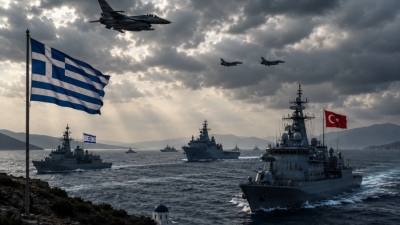
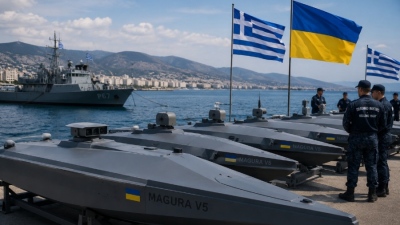
The strategic balance in the Aegean and the Eastern Mediterranean is dramatically overturned.
Turkey gains the capability to decisively strike Greek infrastructure and air defense without even being detected by Greek radars.
Developments are rapid and time for Athens has already run out!
www.bankingnews.gr







Readers’ Comments