

The discussion surrounding the cinematic adaptation of the Odyssey by Christopher Nolan is not merely about casting choices or the directorial approach to an ancient work.
The deeper issue is much larger: it concerns who today holds the power to tell the stories of civilizations and who determines the form through which these pass into collective memory.
Greece gave the world Homer, the great myths, the archetypes, and a large portion of the intellectual foundation upon which Western civilization was constructed.
However, for decades, it has treated this heritage more as cultural capital for tourist exploitation and less as an instrument of international cultural power.
It grants landscapes, monuments, infrastructure, tax incentives, and financial accommodations to major international productions, without however participating equally in the creation of the narrative itself.
In other words, Greece offers the backdrop, but others write the script.
This is a perennial characteristic of relationships between culture and power.

Hegemonic culture rewrites national myths
Hegemonic cultures and major economic powers do not limit themselves to the production of goods. They also produce meanings, symbols, and interpretations of history.
Whoever possesses the capital, the means of production, and global distribution networks does not merely create products. They create the way in which societies perceive themselves and their past.
Rome reinterpreted the Greek heritage through its own imperial lens.
The Renaissance reconstructed the image of antiquity.
European empires used the classical tradition to lay the foundations of their own cultural identity.
Today, the global entertainment industry of Hollywood constitutes one of the most powerful engines for producing cultural influence.
Hollywood does not simply transfer ancient myths to the screen.
It reinterprets them through the values, social perceptions, and cultural priorities of the era presenting them.
The myth is never a static object.
Every society and every era rereads it through its own questions.
However, the critical point is who possesses the power to select which elements of the myth will be projected, which will be transformed, and which will recede to the margin.
Globalization and the leveling power of a single narrative
Globalization created a world where cultures can communicate and stories can travel far beyond their geographic boundaries.
Simultaneously, however, it created a new imbalance: not all cultures participate on equal terms in shaping global culture.
The global market is not a neutral space.
It has centers of power.
Economies possessing vast capital, technological superiority, distribution platforms, and global communication influence acquire greater capability to shape not only what the world sees, but also how it interprets it.
Thus, globalization can also function as a mechanism of cultural homogenization.
Different historical experiences, different traditions, and different ways of understanding the world are frequently translated into a common global template of narration, designed for the international market.
The danger is not the exchange of cultures. Great cultures always interacted.
The danger is unequal exchange.
When a smaller culture possesses the historical raw material, the myths, the symbols, the memory, and the origins of a tradition, but an economically stronger culture possesses the means to represent it globally, then narration is transferred from its creator to its manager.
Homer becomes global cultural capital, but his modern image is henceforth determined by those who hold the power to present him to the global audience.
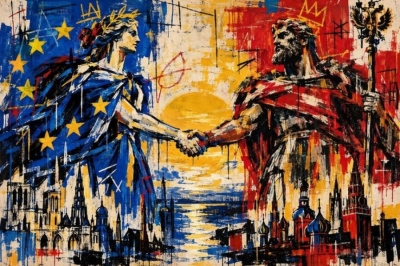
Cultural dominance is not maintained by origin alone
The problem is not that myths must remain the exclusive property of a single nation.
The ancient Greeks themselves constantly recreated and reinterpreted their traditions.
The issue is the balance of power.
A civilization does not maintain its influence simply because it created something great in the past.
It maintains it when it possesses institutions, productive capacity, capital, and an international presence to continue telling its story itself.
France, for example, did not leave its own cultural heritage exclusively in the hands of foreign producers. It created mechanisms for funding and protecting domestic creation, so that international exploitation of French culture is accompanied by a French cultural presence.
Greece, by contrast, frequently behaves as if possession of heritage suffices for maintaining influence over it.
It does not suffice.
Culture is also power.
And power requires strategy.
Greece should not attempt to enclose Homer within itself.
Homer belongs to humanity.
But Greece must possess the ability to participate equally in shaping the global narrative around him.
Because civilizations are not lost only when their monuments are destroyed.
They are lost when they cease to tell their own story themselves.
www.bankingnews.gr












Readers’ Comments