

Turkey in recent times actively reacts to geopolitical upheavals primarily in the Persian Gulf: it liquidates American government bonds, deepens its energy partnership with Russia, establishes a tax regime aiming to attract capital fleeing the Persian Gulf, and comes into direct confrontation with the Israeli political leadership, which now speaks openly about Turkey as a hostile state.
This is a conscious and structured strategy.
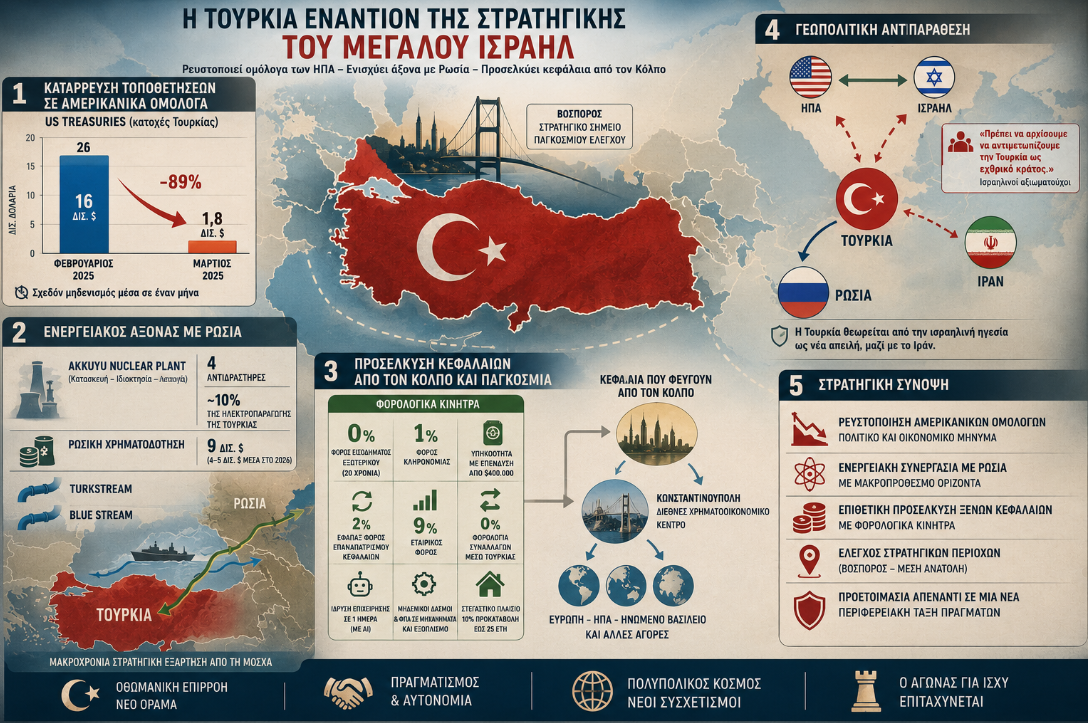
In March, Turkey almost zeroed its positions in American government bonds, US Treasuries, reducing them from 16 billion dollars to merely 1.8 billion dollars within one month.
Official explanations attribute this move to foreign exchange reserve management, as the Turkish lira weakens and inflation remains above 32%.
However, pressures on the financial system are insufficient to explain the direction of this choice.
States do not systematically liquidate the debt of their allies.
Erdogan has clearly formulated his intentions
In a recent speech, he characterized Turkey as one of the brightest stars of the new era, speaking of restoring Ottoman influence in the broader region.
Ankara strongly opposes operations of Israel in Gaza and, according to its strategic perception, Washington and Tel Aviv are increasingly treated as a single geopolitical pole.
The sell-off of American bonds constitutes therefore not only a liquidity management move, but also a clear political message.
The Turkish government considers that a juncture is forming which it can leverage to its benefit.
The energy relationship with Russia reflects the same strategic logic.
The Akkuyu nuclear power station, constructed by Rosatom based on the Build-Own-Operate model in which the Russian side retains ownership for decades, secured additional Russian financing amounting to 9 billion dollars, of which 4-5 billion are projected to be disbursed within 2026 alone.
Although Turkey dynamically promotes investments in renewable energy sources and the target for net zero emissions by 2053, the Akkuyu project essentially lies outside this narrative.
When put into full operation, it is expected to cover approximately 10% of electricity generation of the country, creating a long-term strategic dependency on Moscow, which no investment in solar energy can eliminate.
Turkey speaks of energy diversification, but in practice acts with strict pragmatism.
Unexpected opportunities from the Iran-US war
The conflict with Iran unexpectedly created an opportunity for Erdogan on the front of attracting capital.
Turmoil in the financial centers of the Gulf Cooperation Council, GCC, primarily Dubai, brought back to the forefront significant international capital seeking a new base.
Investors who had transferred their wealth to the United Arab Emirates for the favorable tax regime are now reconsidering their options.
Inflow of investments from Persian Gulf states
Within this environment, the Turkish parliament recently approved the main package of tax incentives of Erdogan, which includes nine permanent structural reforms and constitutes one of the most aggressive capital attraction policies of the last decade:
1) Zero income tax on foreign income for 20 years.
2) Inheritance tax of just 1% regardless of asset value.
3) Possibility to acquire citizenship through investment starting from 400,000 dollars.
4) One-off tax of 2% for capital repatriation from abroad, without origin checks.
5) Permanent corporate tax rate of 9%.
6) Zero taxation for transactions conducted through Turkey.
7) Business establishment within one day with procedures assisted by artificial intelligence.
8) Duty-free machinery and equipment imports with zero VAT.
9) New housing framework with a 10% down payment and loan duration up to 25 years.
The final measure presents particular interest.
Reform in housing credit constitutes not merely a change in financing terms, but opens the market to millions of young Turkish buyers who until now lacked access to the housing market.
Increase in domestic demand coincides chronologically with the potential inflow of foreign capital through the new tax regime.
The Turkish housing market is already characterized by limited supply.
The combination of new domestic buyers and international investors seeking a low-tax investment environment could lead to a new upward price cycle, particularly in Istanbul and in coastal cities where foreign demand is concentrated.
The plan to convert Istanbul into an international financial center dates back to at least 2009, when former Deputy Prime Minister Nazim Ekren promoted the development of Atasehir as the core of the financial center of Eurasia.
Aran Hawker, who provided trading infrastructure to the stock exchanges of Istanbul in 2011, estimates that redistribution of international wealth will originate not only from Gulf countries, but also from North America, Europe, and the United Kingdom, as many investors are dissatisfied with political developments in their countries.
Furthermore, revenues from transit trade activities in the Istanbul Finance Centre are fully exempt from corporate tax until 2047.
The shadow of "Greater Israel" in the Middle East
Behind tax and energy calculations a deeper strategic backdrop forms, which Ankara appears to take seriously into account, while several Western analysts downplay it.
Expansion of Israeli strategic influence in the region, accelerated following operations in Gaza, has led Turkey to consider itself now at the epicenter of this dynamic.
The Bosphorus, the strait connecting the Black Sea with the Mediterranean through which a significant portion of global energy and grain trade passes, constitutes not merely a Turkish asset.
It is one of the most important strategic chokepoints in the world, and influence over it constitutes a perennial goal of major regional powers.
Israeli Minister of Culture and Sport Miki Zohar characteristically stated:
"We must start treating Turkey as a hostile state."
For his part, former Prime Minister of Israel Naftali Bennett stated:
"A new Turkish threat is emerging. We must act in different ways, but simultaneously against the threat from Tehran and against the hostility of Ankara."
These statements do not originate from marginal political voices. When a sitting minister and a former prime minister place Turkey and Iran within the same strategic threat framework, this constitutes an indication of a broader shift in the strategic perception of Israel, with potential consequences for the cohesion of NATO, the status of the Bosphorus, and the stability of the region.
Erdogan, according to the same approach, interprets these developments as a clear message.
Deepening energy ties with Russia, divesting from American public debt, and attempting to strengthen Turkish influence across former Ottoman space are not simply reactions to events in Gaza and the genocidal policies of Israel, but part of long-term preparations facing a regional order that Ankara considers increasingly hostile.

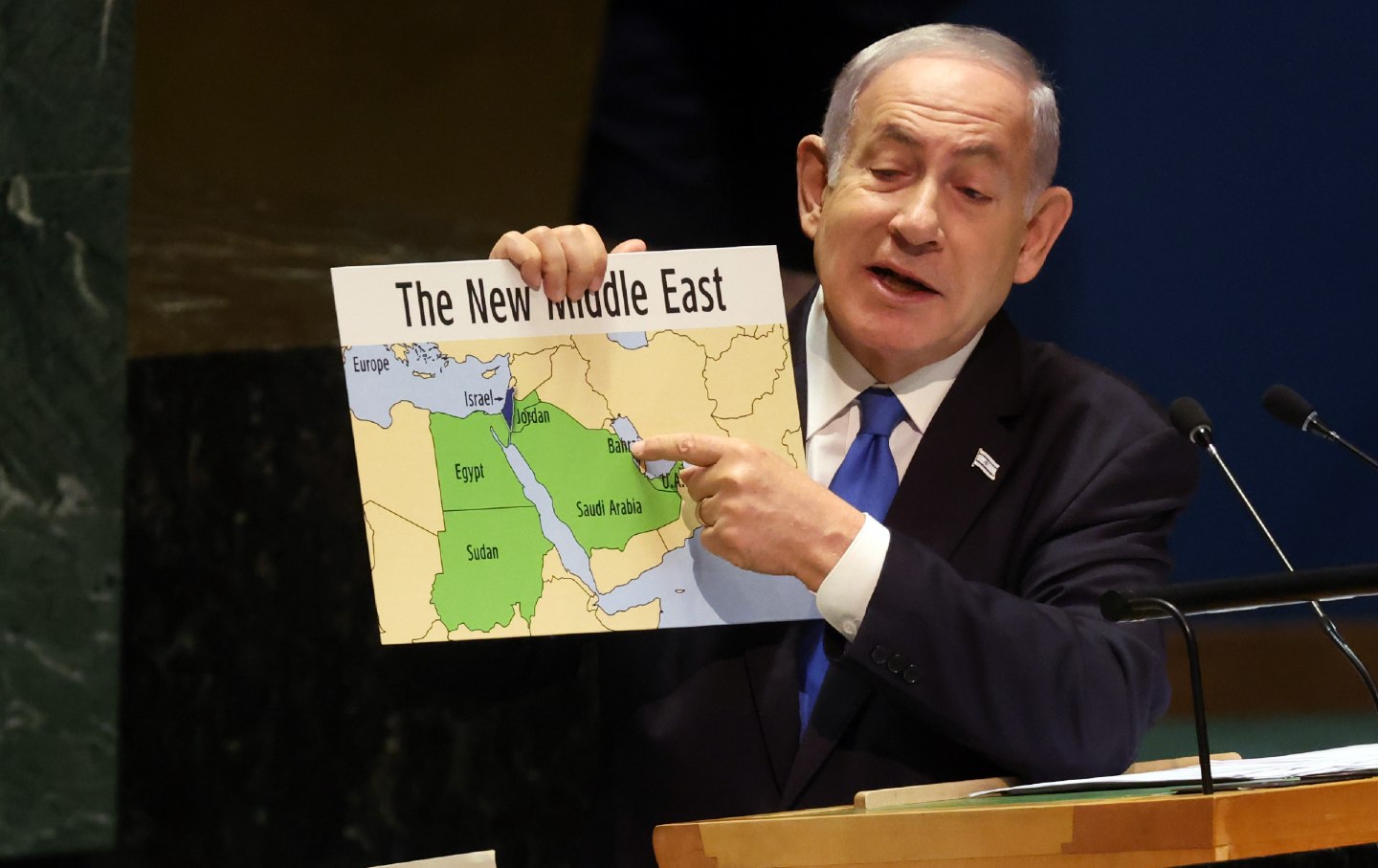
The theory of Greater Israel maintains that Israeli influence could extend from the Nile to the Euphrates.
Turkey is located at the northern edge of this geostrategic zone.
Control or destabilization of the Bosphorus could radically alter the balance of naval power in the Eastern Mediterranean and the Black Sea. Regardless of whether one attributes credibility to this interpretation, messages from Israeli political leadership suffice for Ankara to consider the threat real and to plan accordingly.
A NATO member state that drastically reduces its exposure to American public debt, constructs nuclear power stations with Russia, seeks to attract capital fleeing the West, and simultaneously is named a hostile state by top Israeli officials is not simply swept along by developments.
It is redeploying its strategy across all fronts simultaneously.
The overall picture that emerges, according to analysis, is coherent and accelerating.
Turkey controls the Bosphorus, borders the Middle East, possesses the second largest military force in NATO, and is energy dependent on imports, a fact making geopolitical crises a factor reinforcing inflation, pressuring interest rates, and depleting foreign exchange reserves.
However, Erdogan does not choose to seek greater support from the West.
Instead, he strengthens the energy axis with Russia, aligns with the perspective of a large portion of the Global South regarding the conflict in Gaza, seeks to make Istanbul a beneficiary of instability in the Persian Gulf and political dysfunctions of the West, and simultaneously prepares discreetly facing a regional order that now treats Turkey as an adversary.
Liquidation of American bonds constitutes only one element of this broader strategic sequence.
The vision of reviving Ottoman influence constitutes the interpretive framework. And, according to the writer, developments accelerate faster than most investors realize.
www.bankingnews.gr





Readers’ Comments