

American Secretary of the Treasury, Scott Bessent, made a major blunder by revealing an intervention plan in foreign exchange markets. This happened because a notepad left exposed during Donald Trump cabinet meeting at Camp David appeared to contain an order to buy up to 10 billion dollars worth of Japanese yen.
The revelation raised numerous questions about whether Washington was planning to support the Japanese currency against the dollar, in one of the most sensitive markets of the global financial system.
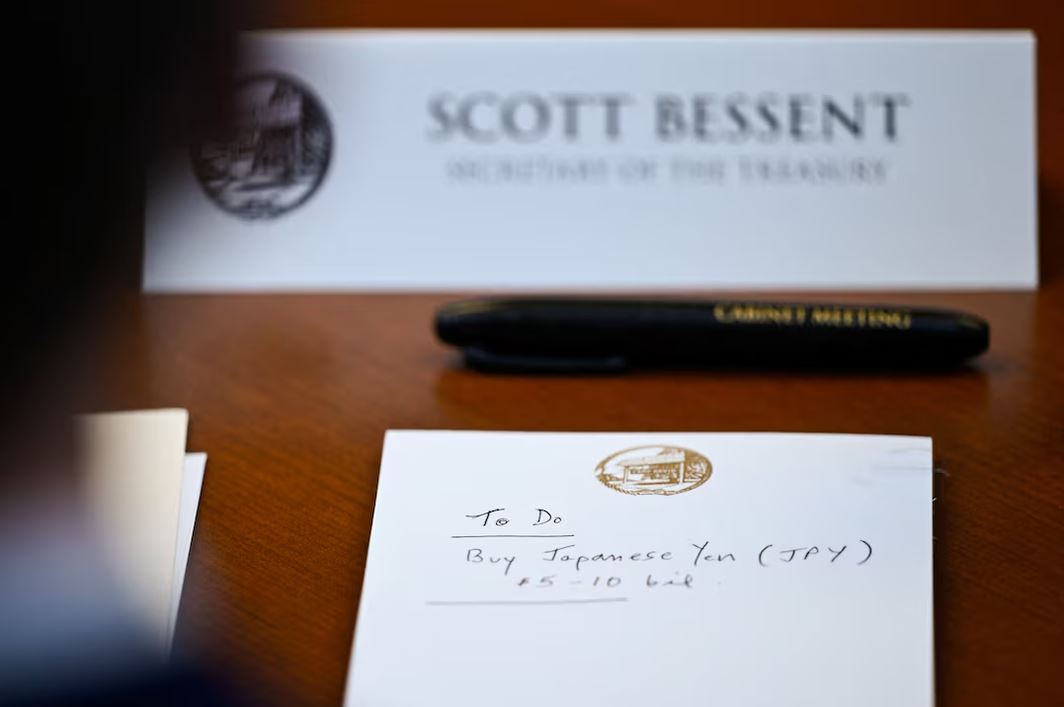
During the latest cabinet meeting of Trump, Bessent revealed a to-do list showing that the US is considering buying 5 to 10 billion dollars worth of Japanese yen. It should be noted that the Reuters photo was taken at the meeting at Camp David.
The photograph, taken over Bessent shoulder during the public portion of the meeting, shows a notepad with the underlined title To Do, under which is written: Buy Japanese yen, JPY, 5-10 billion dollars.
No other text is visible on the notepad, while the name card of Bessent is clearly visible, placed directly above the notepad on the meeting table at Camp David. The photograph was taken at 11:33 a.m. Eastern Time, 18:33 Greek time.
A spokesperson for the US Treasury Department did not immediately respond to a request from Reuters for comment regarding the contents of the notepad or whether the department intervened in the foreign exchange market to support the exchange rate of the yen against the dollar.
Foreign exchange market intervention
Earlier, however, and about two hours before the photo was taken, Reuters had reported, citing a source with knowledge of the matter, that the US Treasury Department had informed a number of banks that it might intervene in the yen market within the same day.
Japanese authorities had already intervened earlier the same day in Tokyo to support the yen, a fact that caused a significant strengthening of the Japanese currency during morning trading.
It is worth noting that late Friday evening, Greek time, a new strong rally of the yen against the dollar was recorded. According to data from LSEG, the dollar exchange rate fell from approximately 158.9 yen at 4:14 p.m., 23:14 Greek time, to approximately 157.6 yen shortly before 5:00 p.m., midnight Greek time, recording a decline of about 0.8%.
The US Treasury Department has not intervened to support the yen since 2011, when it participated alongside the rest of the G7 countries in a coordinated intervention following the devastating earthquake and tsunami that struck Japan.
The yen and the fragile balance between USA and Japan
The potential American intervention in the foreign exchange market comes at a time when the exchange rate of the yen represents one of the most sensitive issues in economic relations between the US and Japan.
In recent years, Japan has been facing severe depreciation of its currency, which increases the cost of imports, particularly energy and raw materials. For this reason, Japanese authorities have repeatedly left open the possibility of market interventions to limit sharp fluctuations in the yen.
The US, however, traditionally avoids unilateral moves in the foreign exchange market, as such interventions can cause tensions with trading partners and affect the global currency balance.
The last time Washington participated in an organized intervention to support the yen was in 2011, after the devastating earthquake and tsunami in Japan, when G7 countries proceeded with coordinated action.
www.bankingnews.gr













Readers’ Comments