

The Spanish enclave of Ceuta turned into the epicenter of an unprecedented migration explosion a few 24-hour periods ago, causing panic in Europe and reigniting fears over the collapse of the guarding of the EU's external borders.
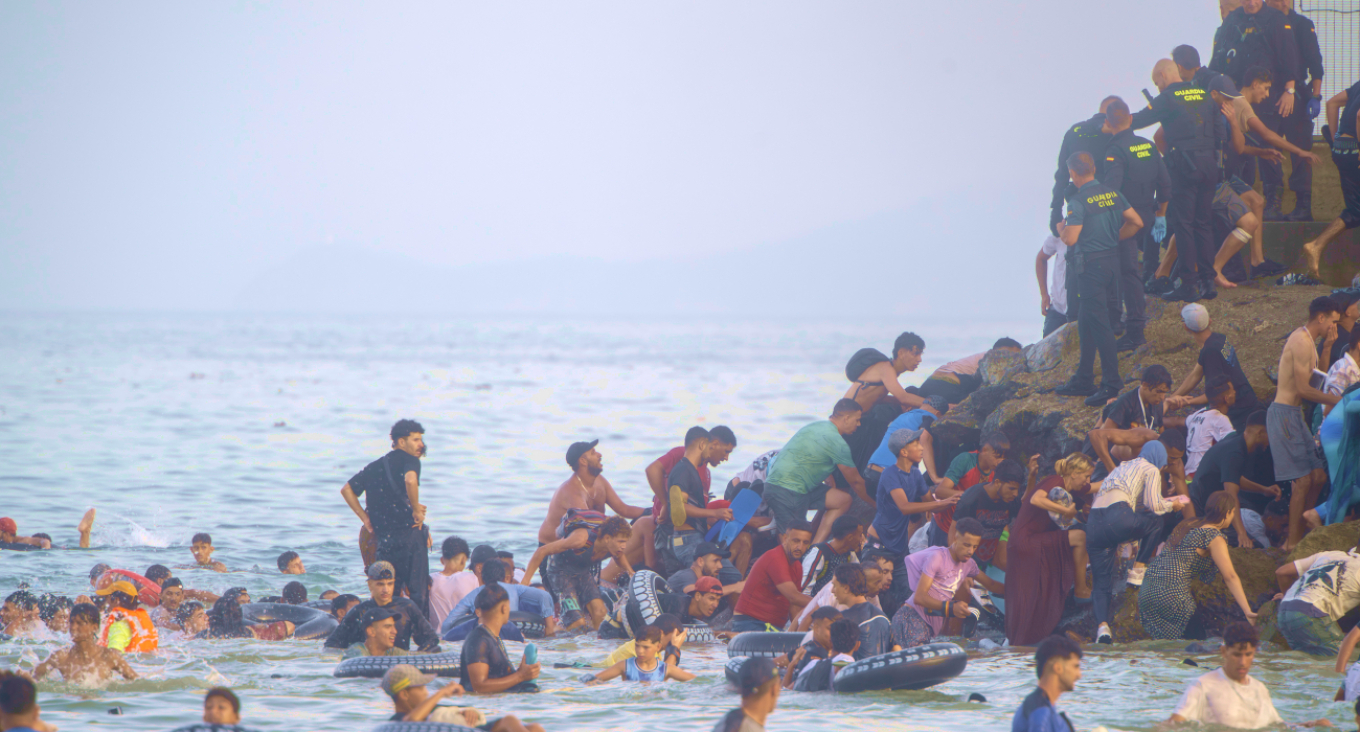
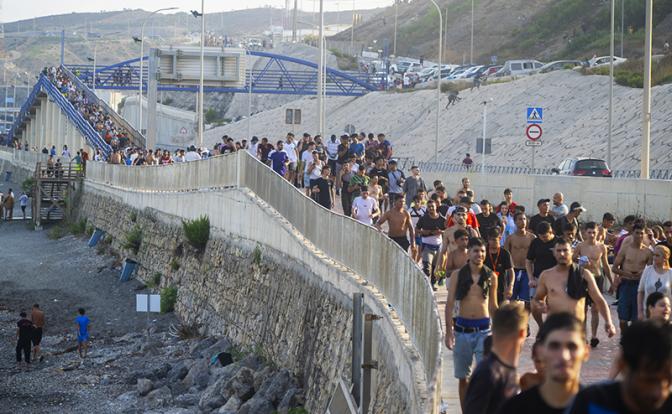
If nothing else, images of thousands of people attempting to enter European territory by swimming, passing over breakwaters, or trying to cross border passages from Morocco, bring back the nightmarish scenario of a new uncontrollable migration crisis.
Estimates regarding the scale of the crisis are shocking.
The Spanish newspaper El País speaks of approximately 40,000 illegal entries, while Reuters raises the number even higher, speaking of over 49,000 people who attempted to cross the border in just a single 24-hour period. On the other hand, local authorities in Ceuta speak of only 1,500 to 2,000 arrivals over ten days.
This massive discrepancy reveals that, during the first hours of the crisis, Spanish authorities did not even possess a unified registration system. However, even the most conservative estimates were enough to paralyze a city of just 84,000 residents, which found itself facing unprecedented pressure.
A city turned into a vast camp
Ceuta, the small Spanish city on the northern coast of Africa, constitutes along with Melilla the only land borders of the European Union with the African continent.
This time, however, the wave did not arrive gradually.
According to Reuters, huge groups of migrants set off in an organized manner from the city of Fnideq, attempting to enter Spanish territory en masse.
Others used makeshift rafts and tires to approach the breakwater, while others moved along the coastline or attempted to pass through border gates.
Journalists from El País describe scenes of complete disorganization: hundreds of men, women, and children slept in parks and on sidewalks without food and water, while stores and pharmacies emptied within hours of basic goods and medicines.
The drama was not limited to the humanitarian dimension.
On July 30, the bodies of at least nine people were located, while subsequently the number of dead from attempts to swim across the maritime zone rose to 19, according to available information.
The bodies were located both near the breakwater and along the coast.
Rescue operations by the Spanish Civil Guard and Moroccan authorities faced significant difficulties due to strong currents and rough seas.
According to the Associated Press, recent judicial rulings in Spain, which restricted the ability to immediately return migrants who enter Ceuta or Melilla by sea, played a decisive role in the escalation of the crisis.
This specific legal framework was allegedly exploited by smuggling networks, which assured prospective migrants that, should they manage to reach Spanish territory, their return to Morocco would be extremely difficult.
The text message that lit the fuse
It all started from a single word that spread like an electric signal across the screens of thousands of mobile phones: "Pásalo" (Spread it).
Through private groups on WhatsApp, Instagram, and specific hashtags circulated en masse across the Maghreb, a digital coordination network was reportedly created, giving a new dimension to the migration crisis in Ceuta.
The messages were not limited to general appeals, but contained, according to complaints, specific locations, times for mass movement, and instructions to avoid police checks and security patrols.
?? Thousands of migrants are being transported in the backs of trucks straight to the Spanish border.
— Visegrád 24 (@visegrad24) July 31, 2026
The video is from Moroccan Ain Lahcen, about an hour’s drive from Ceuta. pic.twitter.com/2DHkxsuyA7
This organized wave was reinforced by rumors and misleading information spreading rapidly via social networks and personal contacts. Among these, claims circulated that "Spain does not carry out deportations" and that authorities release those who manage to reach European territory.
The spread of these messages created the impression that Europe's borders were essentially open, triggering a mass wave of people toward Ceuta, the Spanish stronghold in North Africa.
Thousands of young men from Morocco moved toward the border, hoping that entry into the European Union would now be feasible. This development caused intense political confrontation, as Morocco is not in a state of war, a fact that brings the discussion regarding the distinction between war refugees and irregular migration back into focus.
The crisis in Ceuta thus evolved not only into a test for Spanish security authorities, but also into a major new challenge for European migration policy, with the question remaining: who ultimately controls the external borders of Europe?
????‼️? Thousands of Moroccans who invaded Spanish Ceuta rioted during the night!
— Lord Bebo (@MyLordBebo) July 31, 2026
They went to Spain for a better life and less than 24 hours later put on masks and started setting fires, throwing rocks and destroying stuff. A good start… https://t.co/c0nxb85bzu pic.twitter.com/wDbkECLPsy
Israeli finger?
The migration crisis in Spain, which was caused by the influx of migrants from Morocco, could theoretically be linked to Israeli secret services, due to the particularly strained relations between Madrid and Tel Aviv.
This was stated in an interview with the Russian newspaper Lenta.ru by Lorenzo Maria Pacini, assistant professor at UniDolomiti of Belluno and Italian expert on international relations.
For his part, American President Donald Trump has also made harsh statements against the Spanish Prime Minister.
As Pacini reported, the crisis constitutes primarily a result of the policy followed by Spanish Prime Minister Sánchez.
"Many link this 'invasion' to the decision of the Spanish government to 'grant citizenship' to half a million foreigners who entered the country illegally," stated Lorenzo Maria Pacini, assistant professor at UniDolomiti of Belluno and expert on international relations.
At the same time, the expert highlighted the low quality of governance in Spain:
"Due to political decisions, Spanish law enforcement forces lack the ability to curb illegal migration."
The political analyst added that various political forces in Spain have an indirect interest in the issue of illegal migration: from the left-wing government of Sánchez, which appears more friendly toward migrants, to far-right populists.
"Migration is a political issue that is amplified or suppressed depending on needs. Even right-wing neo-fascists use it to attract votes," noted the analyst.
"Feelings of irritation and fear dominate in Europe, therefore the migration crisis serves the interests of both the Left and the Right. We know very well that certain elites do not wish for Europe to regain its autonomy and sovereignty. And issues between different ethnic groups can destabilize any political discussion."
Europe fears new domino effect
The crisis caused immediate political turmoil in the Old Continent.
The government of Morocco deployed strong police and gendarmerie forces to the border, using even water cannons to prevent new mass crossing attempts.
At the same time, the authorities of Ceuta requested from Madrid the declaration of a state of emergency and the dispatch of additional security forces, a request rejected by the central government.
The leader of the Spanish opposition, Alberto Núñez Feijóo, launched a fierce attack against the government, demanding a tightening of migration legislation.
Reactions were not limited to Spain.
???? FLASH | L'Espagne et le Maroc ont conclu un ACCORD pour renvoyer « le plus rapidement possible » l'ensemble des migrants entrés illégalement à Ceuta ces derniers jours.
— Cerfia (@CerfiaFR) July 30, 2026
Madrid et Rabat annoncent également un RENFORCEMENT de leur coopération afin de faire face à cet afflux… https://t.co/0MawZRiLI0
"An attack on Spanish national sovereignty" is how Spanish Prime Minister Pedro Sánchez characterized the mass flow of Moroccan migrants who crossed the border of the Spanish enclave on the eastern edge of Africa.
An "attack" that divided the European Union: between those who expressed their solidarity, highlighting at the same time the restoration of the status quo ante, such as German Chancellor Merz; and others, including the Meloni government, who consider Madrid responsible for what occurred, threatening an exit from or closure of Schengen.
What is evolving into one of the most significant migration crises to touch the borders of the European Union, with the latest data from Ceuta speaking of approximately 50,000 entries within a few hours and 34 dead, prompted the immediate reaction of European capitals, which requested immediate intervention from Madrid to resolve the crisis.
The government in Rome was among the first to intervene on the matter, with Prime Minister Giorgia Meloni leaving open the possibility of "suspending the Schengen agreement with Madrid".
A choice that found support from Foreign Minister Tajani, who stated he was "positive" toward suspension, as "irregular and uncontrolled migration constitutes a danger to national security".
The statements of the Italian Foreign Minister were not well received by his Spanish counterpart José Manuel Albares, who immediately denounced the statements as "unworthy" and summoned the Italian ambassador to Madrid for explanations.
Intervening in favor of Madrid, former EU High Representative for Foreign Affairs Josep Borrell rejected the Italian request for the suspension of Spain's participation in the Schengen zone, characterizing it as incompatible with European law.
According to Borrell, "no member state can unilaterally suspend the participation of another in Schengen".
The former head of European diplomacy also criticized the Italian initiative, arguing that it reveals how certain governments "use and abuse the legal order of the EU, reaching the point of violating the principle of sincere cooperation" that binds member states. Criticism toward Rome's stance was also voiced by Javi López, Vice President of the European Parliament and member of the Group of the Progressive Alliance of Socialists and Democrats, who characterized Meloni's statements as "unworthy of a European partner".
"After more than 700,000 arrivals from Libya, Italy received European support, not lectures. Solidarity is not a one-way street," noted López.
Minister of the Interior Mari Rantanen argued that states which do not effectively secure the external borders of the European Union should not enjoy the privileges of the Schengen zone, opening a new debate on the responsibilities of member states in protecting European borders.
Swedish Prime Minister Ulf Kristersson shared these views, stating that his country's Minister for Migration is "in contact with his Nordic counterparts and does not rule out taking the necessary measures to avoid a repetition of 2015", referring to the migration crisis during which over one million refugees and migrants reached Europe fleeing wars in Syria, Afghanistan, and Iraq.
One million migrants a "weapon" in Erdogan's hands
In the aftermath of Ceuta, Greek security authorities and armed forces ought to be placed on immediate alert, as the latest international data reveals a nightmarish reality in North Africa, which bears the prominent signature of Ankara, acting through agents in the region.
International reports estimate that there were more than 936,000 refugees and migrants in Libya in February 2025, with more than half geographically concentrated in the western part of the country, while nationals of Sudan constitute the largest community among migrants and refugees.
According to a report issued by the Mixed Migration Centre, which is affiliated with the Danish Refugee Council, Libya remains the primary departure point for migrants and asylum seekers seeking to reach Europe and Italy via the Mediterranean, despite a decrease in the number of migrants departing from there. Sudanese make up the largest percentage of migrants in Libya, approximately 36%.
Libya remains the main transit point
Libya continues to constitute the primary departure point for migrants heading toward Italy via the Central Mediterranean route, accounting for 83% of total arrivals (11,848 migrants) despite a 56% decrease compared to the same period in 2025.
Data from the International Organization for Migration (IOM) showed that the number of migrants and refugees in Libya reached 936,134 in February 2026, marking a 9% increase compared to the same period last year, while remaining relatively stable compared to December 2025.
Geographically, 53% are located in the west of the country, followed by 36% in the east and 11% in the south.
Sudanese constitute the largest community at 36%, followed by Nigerians (20%), Egyptians (19%), Chadians (9%), and Nigerians (4%).
Regarding refugees and asylum seekers registered in Libya by the United Nations High Commissioner for Refugees (UNHCR), their number reached 113,026 on June 1, 2026, marking a 22% increase compared to last year.
Sudanese account for 83% of the total, as their number increased by 41% due to the war in Sudan.
According to the Missing Migrants Project, the Central Mediterranean route recorded the highest number of deaths and missing persons through the end of June, with 865 incidents, a 57% increase compared to last year, despite a 52% decrease in arrivals in Italy.
This indicates that a decrease in the number of arrivals does not necessarily mean a decrease in risks.
Similarly, the organization Caminando Fronteras recorded more than 507 deaths off the Algerian coast along the Western Mediterranean route, marking a 54% increase.
Meanwhile, the organization Alarm Phone Sahara recorded the deportation of 14,602 people from Algeria to Niger between January 18 and May 17, 2026, while the Moroccan Association for Human Rights recorded the deaths of 26 migrants and refugees in remote border areas in eastern Morocco during the first four months of the year.
The most concerning finding of the reports is not only the massive volume, but the geographical distribution of this population:
53% is concentrated in Western Libya (Tripoli, Sabratha, Zuwara areas). That is, precisely in the zone where Turkey maintains full military, air, and naval control, controlling local militias and coast guards.
Turkey, having consolidated its presence through the illegal Turk-Libyan memorandum, is turning Western Libya into a vast "reservoir" of human souls.
The concentration of hundreds of thousands of individuals (primarily from Sudan who cover 36%, Niger, Egypt, and Chad) gives Ankara the ability to weaponize migration flows at any moment, launching a hybrid attack against Southern Europe and specifically Greece.
International Reports: #Libya is Hosting More Than 936,000 Refugees and Migrantshttps://t.co/GKzzWGOxPh #ليبيا pic.twitter.com/8UeJo6yXIt
— Alwasat Libya (@alwasatengnews) July 26, 2026
The danger for Crete and Greek maritime borders
Despite the relative decrease in overall departures toward Italy, Libya remains the main exit gate (covering 83% of Central Mediterranean departures).
However, the tightening of measures and crackdowns on the coasts of Tripoli create "boiling" conditions.
If Ankara decides to channel a portion of this volume further east, toward Crete and Gavdos, the consequences for Greek territory will be catastrophic.
Already, local authorities in Libya (such as in Sabratha and Zuwara) are imposing curfews and deportations, while stating openly that Libya "is not a country of settlement".
This pressure forces smuggling networks, operating under the tolerance or even direction of Turkish-aligned actors, to seek new routes.
The maritime area south of Crete lies directly in the crosshairs.
www.bankingnews.gr








Readers’ Comments