

When price gouging becomes Greece's worst advertisement – See photo
Another case triggering a storm of reactions on social media brings Mykonos back into the spotlight of international negative publicity. According to a post that went viral, tourists report being charged $876 for just two drinks at a well-known beach venue on the island. The photo of the receipt went viral across the internet within a few hours, provoking outrage and generating hundreds of thousands of views, while dozens of users commented under the post claiming they had similar experiences in the past. The post further notes that the customers claim they were not presented with a detailed printed menu prior to ordering, a fact that—if confirmed—raises serious questions about the operating practices of certain businesses. Naturally, these specific claims originate from social media posts and do not in themselves constitute an official finding of a legal violation. However, the fact that such stories constantly resurface demonstrates that the problem surrounding Mykonos's image abroad is far from resolved.
Mykonos became synonymous with excess
Once upon a time, Mykonos represented the ultimate Greek success story. An island that managed to attract millions of visitors, international celebrities, and billions in investments, evolving into one of the most recognizable luxury travel destinations on the planet. Today, however, when the name of Mykonos appears in major international news outlets, it is very often not accompanied by images of beaches, windmills, or sunsets. It is accompanied by stories of exorbitant bills, overpriced sunbeds, inflated charges, and outrageous prices. Every such news item acts like an advertisement... but in the wrong direction. And in today's social media era, negative online publicity travels much faster than any multi-million euro marketing campaign.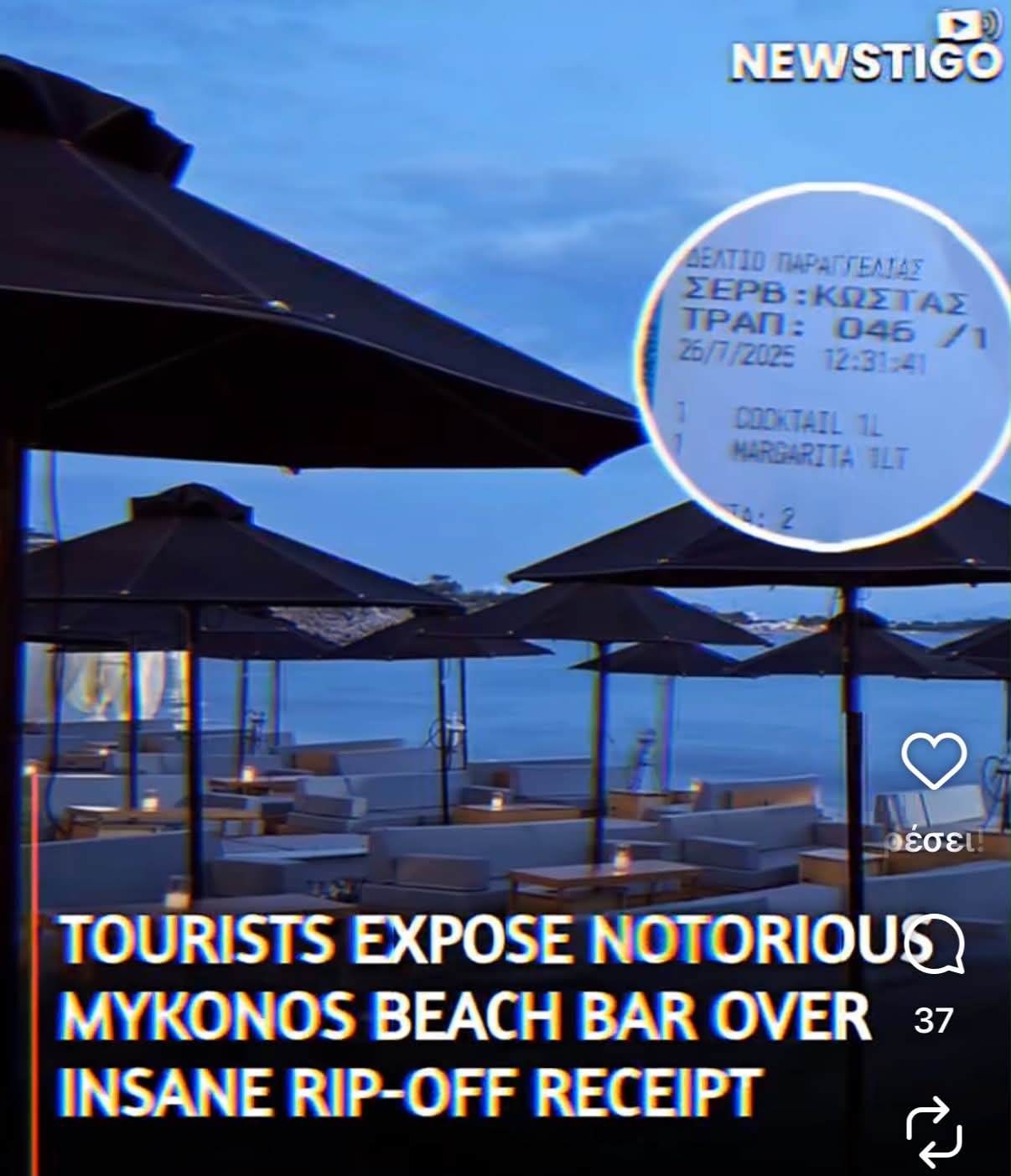
Greed is not entrepreneurship
No one disputes that Mykonos is an expensive destination. High prices are expected on an island that caters to a high-income audience and hosts luxury businesses. However, high prices are one thing, and leaving the customer feeling cheated is another. The difference is enormous. A visitor can accept paying a high price for a top-tier service. They will not accept feeling like they were targeted as an easy victim simply because they are a tourist. That is precisely where the brand reputation damage begins. Because entrepreneurship relies on quality, trust, and repeat customer visits. Price gouging, on the other hand, relies on opportunism. Making as much as you can from a customer who will likely never return. Yet this logic destroys the destination itself in the long run.
The internet does not forgive
In the past, a bad experience remained between a few people. Today, a single photo of a receipt can be seen by millions of users within hours.
A video on TikTok.
A post on Instagram.
A negative review.
These are enough to construct an image that is difficult to erase. A prospective visitor planning their vacation does not only see the beautiful photos of Mykonos. They also see stories of exorbitant bar receipts. They see people stating that they felt scammed. They see foreign media reports reproducing the same allegations. And they ask themselves: "Is it worth going there, or will I constantly be checking whether I am being overcharged for drinks?" This hesitation is perhaps the greatest damage a tourist destination reputation can suffer.
The problem is not limited to Mykonos
The most unfair part is that the consequences are not paid solely by those who create these impressions. They are also paid by thousands of serious professionals. Hotel owners.
Restaurateurs.
Owners of small rentals.
Family businesses.
People who work honestly and strive to offer quality hospitality services. When such news dominates, however, foreign visitors do not make distinctions. They do not think it is just one business. They think that this is how Mykonos operates as a whole. And frequently, unfortunately, that is how Greek tourism image functions in their minds as well. And where does the average Greek fit into all this? There is another dimension, perhaps even more critical. If an American or European tourist earning multiple times the average Greek income is shocked upon seeing such charges, another logical question arises. How can an average Greek citizen afford a vacation in Mykonos today? With wages that remain close to the minimum wage for a large segment of workers. With rent absorbing a significant portion of income. With utility bills, fuel, food, and daily cost of living constantly rising. How many people can truly allocate hundreds of euros for a single day at the beach? How many can pay for ferry tickets, accommodation, dining, transportation, and entertainment without spending an entire month's salary? For a family of four, a few days in a cosmopolitan destination can now cost several thousand euros. For many, this is not a vacation. It is an amount representing the savings of entire months.
Greek islands become inaccessible to Greeks themselves
Greeks used to look forward to summer to visit their country's islands. Today, many limit themselves to short getaways or abandon the idea entirely, opting for cheaper travel destinations or even going abroad. And here lies perhaps the greatest contradiction. Greece breaks new tourism industry records every year. Revenues are increasing.
Arrivals are increasing.
Investments are increasing.
Yet an increasing number of Greeks feel that their country's most beautiful spots are no longer aimed at them. That they have turned into a world designed exclusively for high net-worth travelers.
The real gamble
Tourism is Greece's heavy industry. Precisely for this reason, it requires moderation, transparency, and respect for the visitor. Because true success is not collecting an exorbitant fee from a single customer. True success is having them leave the country with the finest impressions, return again, and convince others to do the same. If, instead, Greece becomes internationally identified with stories of outrageously overpriced tourist bills and questionable charges, the long-term cost to its reputation will far exceed any amount printed on a receipt.
www.bankingnews.gr









Readers’ Comments