

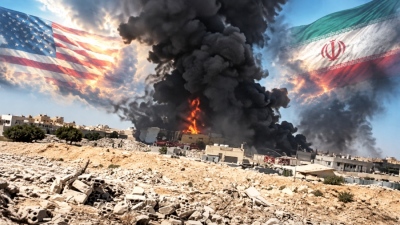
The war in the Middle East is developing in an increasingly dangerous direction as the protagonists begin moving more aggressively to catch the opponent off guard.
The stance of Iran is characteristic.
Although until recently the Iranians maintained a defensive posture, essentially retaliating, usually proportionally, to the strikes they received, they changed their stance and went on the offensive.
This was a move that changed the military terms in the Persian Gulf, as the US and its allies were subsequently forced to respond.
Analysts attribute the change in Iran's strategy to its primary goal, which is none other than maintaining absolute control of the Strait of Hormuz.
Hormuz has evolved into the core stake of the war, and this is the key that will unlock the deadlock in which the Middle East and US President Donald Trump are mired.
Given that any solution will provide in one way or another for the collection of a fee for ship transits through Hormuz, it is becoming clear that the war designed as a demonstration of American power risks turning into a decisive factor in a political defeat for the White House.
A report in The Wall Street Journal is notable in this regard, stating that after Iran's fierce and powerful missile strikes on US bases in Kuwait, the Americans are studying the scenario of reducing their military presence in this Middle Eastern country that is of critical importance to American interests.
Why Iran struck first
Iran put an end to the days of relative calm in the Middle East by launching what the US described as a surprise attack, marking a dramatic change in the pattern of conflict.
Instead of responding to a new American strike, Tehran chose to restart hostilities itself, showing a growing willingness to use military force to shape the course of the war on its own terms.
This in turn created the conditions for a new escalation.
We will completely break them, US President Donald Trump told Fox News on Wednesday morning.
We will hit them hard.
They will suffer a crushing blow, the American president stated.

The response
This threat would hardly surprise Tehran, which launched its missiles knowing it could trigger the return of American bombers.
Overnight, the US military announced that it carried out a powerful wave of airstrikes against Iran in response to the attempted attack on American forces, hitting dozens of targets belonging to the Islamic Revolutionary Guard Corps (IRGC).
Donald Trump had attributed the previous week's pause in operations to a request from Iran, claiming that they asked us very politely and wanted talks.
Tehran never publicly committed to that pause, although a senior Iranian official stated that our armed forces also decided not to proceed with military action.
This makes Iran's decision to resume attacks even more significant.
The risk and the strategic shift
Just hours after showing publicly that it would respond to American restraint, Tehran struck American forces, evidently judging that increasing the pressure was worth the risk of resuming nightly bombardments.
It seems that something has fundamentally changed in Iran's approach, particularly regarding its willingness to initiate an attack first if it considers that to be the only viable option, wrote Hamid Reza Azizi, a researcher at the German Institute for International and Security Affairs, on the X platform.

Message to Israel and the US
Iran's attack occurred shortly after Israeli Prime Minister Benjamin Netanyahu met with Donald Trump in Washington, a meeting the Israeli leader described as one of the best conversations they had held following growing tension in their relations.
A few hours before the meeting, Israeli Defense Minister Israel Katz stated that Israel wanted to strike Iranian energy infrastructure but was held back following intervention by the Trump administration.
The attack appears to have been a message linked to Benjamin Netanyahu's visit to the White House earlier that day, wrote Hamid Reza Azizi.
It suggests that Iran's military strategy may have changed and that Tehran is now willing to launch a preemptive strike if it perceives signs of an imminent threat.
Saudi Arabia's involvement
Shortly after the attack in Jordan, the militaries of the US and Saudi Arabia conducted joint strikes against pro-Iranian militias in Iraq.
US Central Command (CENTCOM) presented the operation not as retaliation for the attack in Jordan, but as a response to more than 30 drone attacks against American forces and Saudi energy infrastructure during the previous 72 hours.
The escalation showed that the war is expanding.
Saudi Arabia, which had long tried to avoid direct involvement, is now drawn deeper, facing threats on three fronts: from the Houthis in Yemen, from pro-Iranian militias in Iraq, and from Iran itself.

Strategic objectives
The main challenge for Washington and its Gulf partners is that neither Iran nor its regional allies seem willing to abandon what they now regard as fundamental strategic objectives, wrote Danny Citrinowicz, a senior researcher at Israel's Institute for National Security Studies (INSS) and former head of the Iran desk in Israeli military intelligence.
Tehran continues to insist on maintaining its influence over the Strait of Hormuz, while the Houthis have made clear they will not end their campaign unless the blockade imposed by Saudi Arabia is lifted, the analyst stressed.
Tehran's position
In an interview with Iranian state television published a few hours before the attack in Jordan, Deputy Foreign Minister Kazem Gharibabadi articulated what is perhaps the clearest description of Tehran's position to date.
As he noted, Iran had stopped firing, but it would not hesitate to resume hostilities if its sovereign claim over the Strait of Hormuz were challenged.
Tehran could not consider that it had prevailed if the Strait returned to its pre-war status, the deputy minister stated, arguing that this maritime passage has become central to the country's national security and serves as a tool of defense.

The red line
When the journalist asked him why Tehran risked restarting the war by attacking commercial ships despite the existence of a ceasefire, Kazem Gharibabadi replied that Iran considers attempts by Oman and the US to establish an alternative shipping route through the Strait of Hormuz to be a red line.
In his view, the operation of such a route would reduce the Iranian claim of effective exercise of sovereignty in the region to nothing more than a fantasy.
One can look at it simply and ask why Iran would strike three commercial ships with missiles just because they had turned off their GPS, risking the resumption of the war, the Iranian official said.
However, if one looks deeper, one will see that the arrangements that will apply in the Strait of Hormuz will have a long-term impact on the security of the Islamic Republic of Iran.
Strategic weakness, not restraint
From Tehran's perspective, the pause in American attacks reflects strategic weakness and not restraint, wrote Danny Citrinowicz.
This perception may fuel a vicious cycle in which Iran escalates its actions to raise the cost for its opponents, while neither side backs down out of fear of losing credibility.
According to Danny Citrinowicz, the US and its partners now face a critical choice: either accept some of the Iranian demands or face the prospect of a prolonged conflict characterized by an increasing number of attacks on shipping, energy infrastructure, and trade corridors.

What US power
The war that the US administration started with the aim of demonstrating power, restoring deterrence, and strengthening Donald Trump's domestic political position has now evolved into one of the most significant political challenges for the American president.
What was meant to project an image of a strong Washington and decisive leadership by Trump in foreign policy today primarily reveals its political, economic, and social costs inside the US.
The longer the war against Iran drags on, the more its impact is felt not on the battlefield, but in the polls, in public opinion, and in the political future of the Republican Party.
Trump in the most difficult position
Fewer than 100 days before the midterm elections in the US, the most recent reliable polls show that Trump is in his most difficult political period since returning to the White House.
Many American analysts attribute this situation to the combination of the failed war with Iran, rising economic costs, and growing discontent among American society regarding the administration's priorities.

Collapse in popularity
The results of the latest poll by Quinnipiac University show that Donald Trump's approval rating has fallen to 32%, one of the lowest popularity levels for an American president in recent decades.
At the same time, a poll by CNN records his popularity at just 34%.
Perhaps even more important than these numbers is the response of Americans to a critical question: is Trump focusing on the right issues?
In the Quinnipiac poll, only 29% of respondents answered positively, while in the CNN poll the corresponding figure was just 27%.
In other words, about seven out of ten Americans believe the administration is following the wrong course.
Problem for Republicans
Prominent American analyst Chris Hayes, commenting on the results, emphasized that the Republican Party faces a real problem ahead of the elections.
According to him, Trump now displays lower popularity numbers even compared to the period following the events of January 6, while the prolonged war with Iran is one of the main reasons for this decline.

Crisis instead of power
The Trump administration believed that engaging in a war with Iran could, as has happened in certain historical periods, boost popular support for the president.
In American politics, several presidents have attempted to leverage military successes to strengthen their domestic standing.
This time, however, reality unfolded differently.
The war against Iran not only failed to lead to the quick and low-cost victory expected by the White House, but it turned into a war of attrition whose costs increasingly weigh on the American economy and society every day.
Rising military spending, pressure on the federal budget, concerns over an expansion of the conflict, the continuation of mutual attacks, and uncertainty regarding the end of the war have led a large portion of American public opinion to view the conflict not as a necessary choice for national security, but as an additional burden on their economy and daily lives.
For many Americans, therefore, the war with Iran is no longer merely a foreign policy issue, but a matter that directly affects their standard of living and economic future.
The cost of war returns to Washington
One of the key characteristics of American military strategy in recent decades was the effort to keep the consequences of wars far from American soil.
Washington historically sought to manage conflicts outside its borders and transfer their direct costs to other regions.
However, the recent war proved that even though the battlefield is thousands of miles away from the United States, its political and economic consequences return directly to Washington. Today, the most important front of this war is located not only in the Middle East, but also in American public opinion and the country's political scene.
In practice, the cost that was supposed to remain outside American borders has now returned to the White House in the form of falling presidential popularity, rising social discontent, and a more difficult electoral path for Republicans.

Difficult dilemma
Trump now faces a critical choice.
Continuing the war could increase political and economic pressure on the administration and accelerate the decline of his popularity.
On the other hand, a retreat or an attempt at de-escalation could be perceived by part of his base as an abandonment of his campaign commitments.
Nevertheless, recent polls show that American public opinion desires more than ever a reduction in the cost of the war and a focus of government attention on solving domestic problems.
Viewed in this light, the war against Iran is no longer merely an affair of foreign policy, but has evolved into a decisive factor in domestic political developments in the United States.
If the current trajectory continues, the greatest cost of this war may be paid not on the battlefield, but at the ballot box and in the political future of Donald Trump and the Republican Party, shaping the course of American domestic and foreign policy for years to come.
The Wall Street Journal: US considers reducing military presence in Kuwait due to Iran
A report in The Wall Street Journal claims that the US military is reviewing the extent of its military presence in Kuwait due to the growing threat against American forces in the region.
Since the Second Gulf War, Kuwait has been one of the most important hubs for US troop deployments and the primary support base for Washington's operations in the Middle East.
Citing US officials, the report states that recent missile and drone attacks by Iran further highlighted the vulnerability of US military bases in Kuwait.
This development prompted the US government to consider various options regarding the future of its military presence in the country.
According to the report, one scenario being examined is a reduction in the number of US soldiers stationed in Kuwait, although no final decision has yet been made.
The Wall Street Journal notes that this review could have significant consequences for security relations between Washington and Kuwait.
As noted, Kuwait continues to view its cooperation with the United States as essential for ensuring its national security, while simultaneously making efforts to strengthen its defense capabilities, particularly in air defense and countering missile and aerial drone threats.
The report also states that, beyond security concerns, recent attacks caused damage to critical infrastructure in Kuwait, including water desalination facilities and oil export operations.
The Wall Street Journal stresses that Kuwait currently finds itself in a particularly critical position: on the one hand, it continues to rely on the American security umbrella, and on the other, the growing regional threat has made the continuation of an extensive US troop presence in the country an issue that Washington is reviewing.
www.bankingnews.gr






Readers’ Comments