

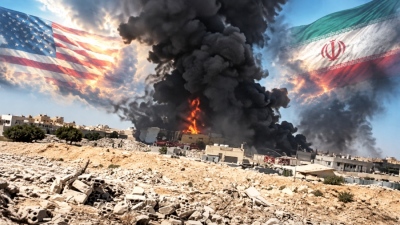
Americans are taking many slaps in the Persian Gulf from Iran, report Iranian officials, leaving them in an operational deadlock while Trump cannot find a way out of the conflict with Iran. Meanwhile, the IRGC destroyed the Sheikh Isa base in Bahrain and destroyed 3 F-35s at the Al-Azraq base in Jordan. CIA and Mossad are searching and failing to find the supreme religious leader of Iran, who does not use a mobile phone or any other electronic device, proof that an assassination plan exists.
New York Times: Trump cannot find a way out of the conflict with Iran... he is at a dead end, Iran is a tough nut to crack
The strategy of the United States against Iran has reached a deadlock, reports the New York Times. "Recently, President Trump dismissed the possibility of restarting a full-scale war. However, he is still struggling to find a way out of the conflict he unleashed: Iran has proven to be a tough nut to crack," reports the New York Times. According to the publication, the war, which Trump has been trying to end diplomatically since April, "threatens to spread across the entire region—at the exact same time that the United States tries to end it." Trump promised to launch powerful strikes against Iran in response to an attack by a drone of unknown origin on an American LNG tanker at the Egyptian port of Damietta. On the night of July 8, the US resumed strikes against Iran, accusing it of attacking commercial ships in the Strait of Hormuz.
Who attacked Egypt? – Iran and Israel deny involvement – Massive explosion on ship in Bab al-Mandab
The investigation into the origin of the drone attack at the port of Damietta in Egypt continues. No group or country has claimed responsibility for the incident. In an interview with Al Arabiya, Egypt's Intelligence Minister denied the claim by the Wall Street Journal that the Egyptian government blames Iran for the drone attack on two ships in the port of Damietta. Meanwhile, Israeli sources reported a massive explosion in the Bab al-Mandab Strait near a vessel. According to news sources, the explosion occurred near a Cameroon-flagged vessel in the middle of Bab al-Mandab, and the ship has now stopped.
Goldman Sachs warns: Oil will reach 120 dollars per barrel
If restrictions on tankers passing through the Strait of Hormuz continue, the global price of oil could exceed $120 per barrel in the fourth quarter of 2026... warns the American investment bank Goldman Sachs.
Iranian military: Attack on the American Ahmed Al-Jaber base in Kuwait
The Iranian military announced that its forces struck strategic US military facilities at the Ahmed Al-Jaber Air Base in Kuwait using an attack launched with drones, characterizing it as retaliation for recent American strikes. In a statement published by the Tasnim news agency, the military stated that the attack targeted aircraft hangars, satellite communication systems, and military equipment warehouses using unmanned aerial vehicles. According to the announcement, the attack was carried out in response to a US strike against a residential building on Qeshm Island, adding that the base in Kuwait serves as a critical hub for US aerial surveillance and operational support forces.
Iran destroyed the American Sheikh Isa base in Bahrain and eliminated 3 F-35s at the Al-Azraq base in Jordan
The IRGC announced retaliatory measures against the US military base at Sheikh Isa in Bahrain. "Iranian military drones struck power generators, navigation systems, and administrative and support infrastructure of the US armed forces." The military of the United States completed another wave of strikes against the Islamic Republic. Central Command announced that it struck dozens of targets, including command centers, missile and drone positions, coastal observation posts, and defense installations, as well as maritime military targets. The IRGC promised to "punish the aggressor" and announced a ballistic missile attack on the Al-Azraq Air Base in Jordan. It clarified that three F-35 aircraft were destroyed and several military service members were killed.
Qalibaf (Iran): Americans are taking many slaps from Iran
America compensates for the slaps it receives on the battlefield with crimes and the shedding of innocent blood; they will pay for it, stated Qalibaf, President of the Islamic Consultative Assembly. The President of the Islamic Consultative Assembly reacted to the American crime on Kesm Island with a new message. America compensates for the slaps it receives on the battlefield with crimes against civilians. The United States stains its hands with a new crime every day. The terrorist attack on civilian homes on Kesm Island is a continuation of the heinous military crime at Minab.
Times: Mossad and CIA are looking to find Khamenei but cannot
The US Central Intelligence Agency (CIA) and the Israeli spy agency Mossad have conducted extensive operations in recent months to locate the residence of Ayatollah Seyyed Mojtaba Khamenei, the leader of the Iranian revolution, but have failed. The British newspaper The Times commented in a report on the efforts of agents from American and Israeli intelligence agency networks to locate and find any trace of the leader of the revolution, or at least his residence. An action indicating that part of the plans of enemy spy networks during these 150 days continues to target the successor leader of Iran. Ayatollah Seyyed Mojtaba Khamenei has completely cut off his electronic communications following the assassination of his father and has not used a mobile phone, laptop, or other trackable devices for about 150 days. Some Western observers have speculated that he is located deep inside a protected bunker, transmitting his messages through encrypted communications and a multi-tiered network of contacts and couriers. In the absence of digital footprints, signals intelligence tools and advanced surveillance systems have limited utility, and identifying the fate of the Iranian leader relies more on human intelligence, or "Humint", than on anything else. In this context, Mossad uses its network of agents inside Iran, but so far this network has failed to provide reliable information regarding the location of Ayatollah Seyyed Mojtaba Khamenei.
According to the Times, a former head of one of Mossad's departments stated that locating Ayatollah Seyyed Mojtaba Khamenei faces difficulties similar to Israel's efforts to locate the position of Israeli hostages held in Gaza. He emphasized that even the most extensive listening and surveillance networks will not necessarily succeed without access to human resources close to the target. Messages are transmitted through a chain of couriers. Each courier knows only that they must deliver the message from one individual to another. If Mossad manages to reach the leader of the Iranian revolution, this success will be achieved through human intelligence, and the government in Tehran is aware of this risk. The only real way to track down Ayatollah Seyyed Mojtaba Khamenei is to recruit an intelligence agent who has direct contact with him. It is likely that only two or three members of the Islamic Revolutionary Guard Corps know how to communicate with the Iranian leader. The inability of the world's most prominent and well-equipped spy agencies, the CIA and Mossad, to find any trace of Ayatollah Seyyed Mojtaba Khamenei is above all a sign of the limitations of American and Israeli covert intelligence capabilities inside Iran. However, the details of this operation, and even the substance of some of the claims made regarding it, cannot be independently verified.
US Patriot and THAAD missile stockpiles depleted in war with Iran
A new United States campaign against Iran has significantly reduced American stockpiles of Patriot and THAAD interceptor systems, raising concerns regarding military readiness for other potential conflicts, according to an analysis published on July 27 by the Center for Strategic and International Studies. The report found that American forces expended a large number of air defense munitions during the first phase of the war against Iran, which began on February 28. Military operations continued after the April 8 ceasefire, further depleting stockpiles, according to the analysis. Stockpiles of Patriot interceptor missiles have dropped below 1,000 units. Meanwhile, stockpiles of THAAD interceptor missiles amounted to approximately 250 units. Patriot inventories decreased from pre-war levels to a range of 759 to 827 by the April ceasefire, according to the analysis, while THAAD inventories fell to a range of 234 to 278 over the same period. The shrinking of stockpiles could force the US and its allies to accept greater risk in how they deploy remaining interceptors.
There are no good alternatives to the Patriot and THAAD systems for defense against ballistic missile attacks, according to the report, which notes that Navy ships equipped with standard missiles capable of such interceptions are generally located too far from the battle zone to assist. The report also highlighted a broader strategic concern: that munitions expended in the conflict with Iran could pose a short-to-medium-term risk to US readiness for a potential conflict with China in the Western Pacific. While a Patriot interceptor system costs an average of about $4 million, a single THAAD missile costs between $12 million and $15 million. A limited confrontation with Iran that lasted 13 days earlier this month likely depleted US air defense stockpiles even further, and just as the report was published, another confrontation began, with Iran continuing relentless missile strikes against American forces in the region. It is unclear how many missiles Iran still possesses or whether it continues production. What is clear, however, is that the US and its allies could exhaust their stockpiles if the war continues.
Defense Express: Iran possesses 5 types of medium-range ballistic missiles
According to a publication by Defense Express, Iran possesses at least five types of medium-range ballistic missiles capable of striking targets in Ukraine from its territory.
-
Ghadir and Emad: Both with an effective operational range of approximately 2,000 kilometers, they represent developments based on the Shahab-3 generation. The Emad is equipped with a maneuverable warhead that increases its precision. The warhead weight of these missiles at distance reaches a maximum of 750 kilograms.
-
Sejil: A two-stage solid-fuel missile featuring a faster response time. Its operational range is also around 2,000 kilometers, and at reduced distance, it can deliver payload capacities up to 1,500 kilograms.
-
Khiber Sekan and Fateh: Iran's newer generation of missiles with a stated range of 1,450 to 2,000 kilometers that have been tested in various exercises. These missiles are also capable of reaching targets in Ukraine.
-
Khorramshahr – The most significant threat: This liquid-fuel missile with a proven operational range of about 4,000 kilometers covers not only the whole of Ukraine but also parts of Eastern Europe. With a 1,500 kilogram warhead at a range of 2,000 kilometers and the capacity to carry a cluster warhead containing 20 submunitions, the Khorramshahr is considered the most dangerous option for targeting Kyiv.
Cruise missiles: another challenge in the Caspian Sea
Although Iranian cruise missiles, such as the Qadeer, primarily feature an operational range of 250 to 300 kilometers, the Iranian naval fleet could bring these missiles within the range required to hit western Ukraine by deploying them in the Caspian Sea or along the Russian coastline. However, such a scenario depends on direct military coordination with Russia, which has not yet been confirmed.
Geographical and defensive challenge
The direct air distance from Tabriz (in northwestern Iran) to Kyiv is approximately 1,800 kilometers, which falls within the range of most of the reported missiles. However, the key factor is that the flight path of these missiles crosses over several NATO member states. Analysts note that the response time of NATO defense systems against an Iranian ballistic missile is approximately 135 seconds and that advanced systems such as THAAD, Arrow-2/3, or SM-3 are required to intercept it. In general, based on available information, Iran possesses the technical and military capability to target Ukraine with its ballistic missiles, particularly the Khorramshahr. Furthermore, by utilizing naval platforms in the Caspian Sea, the possibility of launching cruise missiles at Ukrainian targets cannot be ruled out. However, no official data has been provided indicating that such an attack is currently planned, and present analyses rely heavily on assumptions assessing military capacities. Future developments will determine whether this capability becomes a real threat or remains within the realm of psychological warfare tactics.
www.bankingnews.gr









Readers’ Comments