

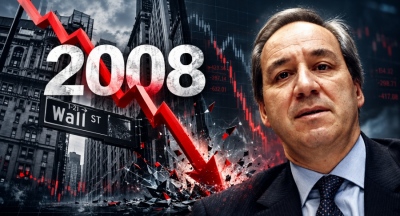
Eighteen years after the largest financial crisis of modern history, the global economy appears to be walking once again on a minefield.
Not where everyone expects, however.
It is not banks, nor sovereign bonds, nor even stock markets that gather the greatest risk today.
The real time bomb lies in the shadow market of Private Markets, a space that has expanded explosively in recent years and now manages capital exceeding 26 trillion dollars.
According to an extensive analysis by economist Éric Tymoigne of the Levy Economics Institute, the global financial system is reproducing almost one by one the same pathologies that led to the collapse of Lehman Brothers and the Great Recession of 2008.
The only difference is that this time the problem lies far from the spotlight, in a market far less transparent and far harder to control.
Following the 2008 crisis, banks faced stricter regulations and increased capital requirements.
The gap created in the financing of small and medium-sized enterprises was rushed to be filled by private equity funds and private debt funds.
Their growth was explosive.
Today, private equity manages approximately 24 trillion dollars, while private debt funds manage another 2.6 trillion dollars, creating a massive parallel banking mechanism that operates with much less oversight compared to traditional banks.
The problem, according to Tymoigne, is not only the size of this market.
It is the manner in which it is growing.
All practices that led to 2008 are returning
The economist identifies a series of highly concerning developments.
Credit criteria are relaxing.
Credit ratings are becoming increasingly lenient.
Actual leverage is hidden inside complex financial structures.
Asset valuation relies on models rather than actual market prices.
Companies are refinancing even loan interest instead of paying it.
At the same time, regulatory authorities in the US promote deregulation, restriction of audits, and significant relaxation of oversight.
As Tymoigne notes, all this dangerously resembles the environment that prevailed shortly before the outbreak of the 2008 financial crisis.
Perhaps the most concerning development is the attempt by large investment groups to open private markets to retail investors.
Companies such as Blackstone, Apollo, KKR, and BlackRock argue that retail investors must gain access to investment products that until today were intended only for institutional managers.
The argument is that savings will thus be directed into productive investments with higher yields.
Tymoigne sees exactly the opposite.
In his view, the influx of vast amounts of new capital will inevitably lead to further relaxation of credit criteria, as funds will constantly seek new borrowers to place investors' money.
Thus, a vicious cycle is created that fuels ever-greater risks.
Ratings that... get better on demand
The widespread use of so-called Private Letter Ratings (PLRs) causes particular concern.
These ratings are not made public and often end up displaying much lower risk compared to conventional ratings.
According to data cited by Tymoigne, in 97% of cases companies received a better credit rating through PLRs.
The result was that insurance companies drastically reduced their capital requirements, gaining access to even larger high-risk investments.
Another characteristic of private markets is that these are investments which, by nature, cannot be easily liquidated.
However, the market has created a series of complex financial structures that promise investors they will be able to exit relatively easily.
Continuation vehicles, secondary private debt markets, special investment vehicles, and securitizations create the impression that abundant liquidity exists.
According to Tymoigne, however, this is an illusion.
Liquidity is maintained only as long as new investors continuously enter to purchase the assets of previous ones.
The new Ponzi of the global financial system
The analysis of the Levy Institute uses a particularly heavy characterization.
It argues that a significant portion of the private debt market now operates with characteristics of Ponzi finance.
Many businesses do not genuinely service their debt.
Instead, they constantly borrow new capital to pay interest and refinance previous loans.
This process can continue only as long as asset values rise and as long as there is a continuous influx of new capital.
If valuations stop rising or investors begin to withdraw, the entire chain risks breaking within a minimal timeframe.
Tymoigne also places particular weight on Level 3 valuations.
These are valuations that do not rely on actual transactions, but on mathematical models and assumptions.
This means that the actual values of many investments may be significantly lower than those displayed on balance sheets.
If markets are forced at some point to value these assets at real prices, losses may prove enormous.
Banks are already preparing
Some of the world's largest financial institutions appear to have already realized the growing risk.
According to Tymoigne, banks such as JPMorgan, Barclays, and Citigroup have begun developing risk hedging strategies through credit default swaps related to large private market funds like Apollo, Ares, and Blackstone.
This move is interpreted as an indication that even leading Wall Street players consider a severe episode of turbulence in the private markets space likely.
Tymoigne does not limit himself to criticism of the markets.
He attributes significant responsibility to US authorities as well.
He argues that in recent years audits have decreased, supervisory agencies have been weakened, prosecutions for financial crimes have been restricted, and the perception that markets themselves can self-regulate has been reinforced.
According to him, history has already proven that this logic failed prior to 2008 and risks failing again.
The big domino scenario
If the system begins to collapse, the transmission mechanism can be extremely violent.
The fall in valuations will make company refinancing difficult.
Credit rating downgrades will accelerate.
Investors will seek liquidity en masse.
Private funds will be forced to sell assets.
Pressures will transfer to banks, insurance companies, pension funds, and ultimately to public markets.
The result could strongly resemble the dynamics that followed the collapse of Lehman Brothers.
Tymoigne does not argue that private markets already constitute a systemic threat.
He warns, however, that all conditions for creating a new major financial crisis are gradually accumulating.
Increasing leverage, opaque valuations, securitizations, continuous debt refinancing, relaxation of credit criteria, and the expansion of private markets toward retail investors create, as he reports, a flammable mix that can act as a catalyst for the next major crisis.
His main conclusion is clear: as long as markets continue to rely on the perpetual influx of new capital and the belief that asset prices will rise forever, the risk of a sharp reversal increases.
And when the "music" stops, as former Citigroup head Chuck Prince prophetically warned, the exit may prove far too narrow for everyone.
www.bankingnews.gr







Readers’ Comments