

The abrupt de-escalation of tension between the US and Iran wiped out in a matter of hours the "war premium" that had sent oil skyrocketing toward $100 per barrel, plunging prices into freefall. Investors rushed to reprice geopolitical risk, driving oil down rapidly as the prospect of a temporary ceasefire eased fears of an immediate disruption to Middle Eastern exports. However, relief in the markets remains fragile, as risks to the global energy supply chain have by no means vanished. Shipping disruptions in the Strait of Hormuz and the Bab el-Mandeb, Houthi attacks, and uncertainty over the ceasefire's duration maintain the threat of a fresh oil shock if geopolitical tensions return. Specifically, oil prices posted a sharp drop of 8% on Monday, as early signs of de-escalation between the US and Iran triggered massive liquidations, nearly wiping out the "war premium" that had pushed Brent crude to as high as $100 a barrel last week.
Oil plummets 10% after ceasefire
Oil prices dropped sharply on Monday, as initial signs of de-escalation between Washington and Tehran sparked widespread liquidations. Brent crude fell by up to 10% to $87.93 a barrel, while American WTI crude dropped around 9% to $82.3 per barrel. This movement effectively reversed the previous week's rally, when Brent had briefly touched $100 per barrel as markets feared that military conflict could lead to severe supply disruptions. The market had priced in a significant risk premium due to the potential blockade or restricted navigation in the Strait of Hormuz, a transit point for a major portion of global energy flows.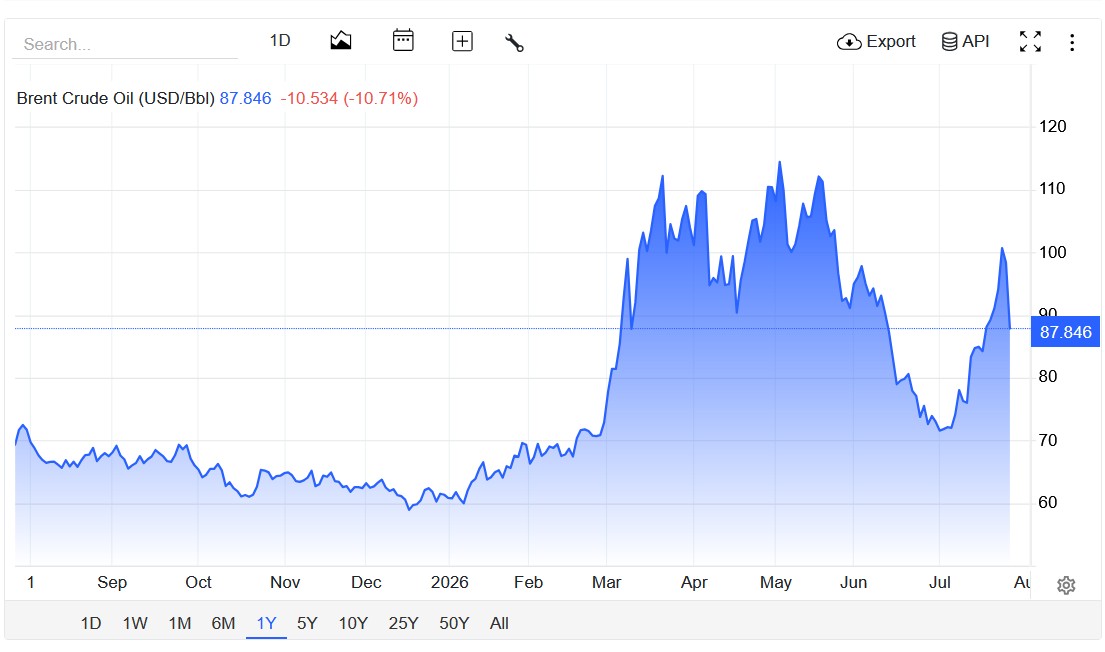
Diplomatic "breather" erases war rally
The de-escalation began after Washington decided to suspend air operations, following 13 consecutive days of strikes, to allow time for diplomatic efforts. This move prompted an immediate reaction from Tehran. An Iranian official told Reuters that Iran would limit retaliatory attacks as long as the American operational pause holds. However, both sides left open the possibility of resuming military actions should talks fail. Furthermore, markets were positively influenced by reports that China is trying to act as a mediator, encouraging a return to dialogue between Washington and Tehran after weeks of military escalation.
ING: Investors rapidly pull back risk premium
Analysts at ING estimate that the sharp drop in prices reflects the speed at which investors are stripping away the geopolitical risk premium built into oil prices during nearly two weeks of conflict. The market is essentially pricing in a reduced immediate danger of major disruptions to production or exports. However, ING analysts warn that it is premature to consider the crisis as having entered a permanent phase of de-escalation, given that Washington has not provided a complete picture of the reasons behind the sudden operational pause. The central question for markets remains whether this represents a genuine diplomatic shift or merely a temporary respite for oil markets.
Vulnerabilities in the global energy chain
Despite the drop in prices, risks to global oil supply persist. Shipping activity through the Strait of Hormuz remained suppressed, while vessel transits through the Bab el-Mandeb strait faced disruptions following Houthi attacks on Saudi Arabian energy infrastructure. These two maritime choke points serve as critical arteries for global trade. A renewed escalation could instantly spark price volatility, even if actual production remains unchanged. ANZ analysts estimate that the market has so far managed to absorb the shocks through temporary buffers: reduced Chinese crude imports, the utilization of strategic reserves, and alternative Saudi export routes bypassing Hormuz.
Inventories decline – Risk of a new shock remains
However, ANZ warns that these mitigation tools are not bottomless. Strategic reserves are tightening, commercial inventories are falling, and threats to free navigation persist across both Hormuz and the Bab el-Mandeb. For this reason, analysts believe that oil remains exceptionally vulnerable to another upward spike in the event of new military escalation or a major disruption to Middle Eastern exports. The market may have temporarily erased the war premium, but energy risk has not vanished. The next geopolitical trigger could swiftly bring back the $100 scenario.
www.bankingnews.gr











Readers’ Comments