

Those opposing any form of German-Russian contact may feel vindicated following fake news reports by Die Zeit and ARD's television news magazine Kontraste in Baku, Azerbaijan.
Through the use of a hidden camera, a meeting was recorded involving two representatives of German politics, CDU executive Ronald Pofalla and Social Democrat Matthias Platzeck, with a Russian delegation, which included talks and a joint dinner.
The Russian participants did not hail from the liberal opposition.
Sitting at the same table were the chairman of the supervisory board of Gazprom, Viktor Zubkov, as well as Alexey Gromyko, head of the Institute of Europe of the Russian Academy of Sciences and grandson of the historic Soviet Foreign Minister Andrei Gromyko.
The talks took place under the auspices of the Petersburg Dialogue, a bilateral forum established in 2001 by then Chancellor Gerhard Schröder and Russian President Vladimir Putin.
The official Federal Republic of Germany withdrew from the framework following the Russian invasion of Ukraine. However, the dialogue continues under the same name with the participation of Germans, albeit without an official state mandate.
The existence of the forum is no secret.
Neither Pofalla nor Platzeck hold a state mandate to negotiate anything.
Nor are they conducting secret negotiations.
Journalists are simply not present.
The fact that Die Zeit and Kontraste present this meeting as a matter of national treason serves a broader purpose: an alliance of politicians and media seeks to impose a complete ban on German-Russian contacts.
Russia, it is argued, has been subject to attempts to isolate it for more than four years, as if German policy were in a position to achieve that. The same people, it is noted dryly, also believe that Germany can save the global climate.
The reality is different.
Strong economic ties
More than a thousand German companies continue to operate in Russia, thousands of German citizens reside there permanently, and approximately twenty flights depart daily from Istanbul, Ankara, and Belgrade bound for the Russian capital, some even utilizing wide-body aircraft.
Furthermore, a significant portion of German public opinion desires better relations with Russia.
Many believe that Germans, more than any other European nation, are capable of engaging in dialogue with Russians to seek constructive ways out of the geopolitical crisis currently affecting Europe.
The mantra of those rejecting all dialogue, namely that "Russia can end the war at any time", is simplistic and detached from reality.
At the same time, this formulation obscures the true dilemma.
European foreign policy has become trapped in a Catch-22 situation.
It has invested exclusively in a military solution, namely the victory of Ukraine, while diplomacy has effectively been side-lined.
A Ukrainian victory is defined as the recapture of Ukrainian territories, either with or without Crimea.
Russia will not accept a compromise
Russia will not permit such a development, a reality that Europe's official political leadership avoids admitting publicly.
Privately, however, few of the hawks in German think tanks, media outlets, and political parties genuinely believe in a Russian defeat.
In this view, politicians continue to cling to the objective of a military solution to avoid losing face, leaving diplomacy in inertia. This posture is described as timid, unimaginative, uninspired, petty, and dogmatically rigid.
Figures such as Konrad Adenauer or Willy Brandt would have pursued more creative solutions.
A second Catch-22 exists.
Germany has renounced any possibility of an autonomous foreign policy ("Sonderweg", or special path) to such an extent that it avoids even initiatives that could benefit all of Europe.
Traditionally, Germans enjoy greater credibility in Russia than other European nations.
However, this advantage is sacrificed in the name of the European idea.
Those in Europe who wish to keep Germany under tight political control are well aware of this.
Berlin's new ambition to assume a leading military role is already rousing suspicion.
It is no coincidence that even The Times of London reported on the Baku meeting, quoting Russia expert John Lough, author of the book Germany's Russia Problem.
According to the newspaper, even informal German-Russian initiatives should be coordinated "at least" with Ukraine, Great Britain, France, and the European Union.
A synonym for the term Catch-22 is Double Bind.
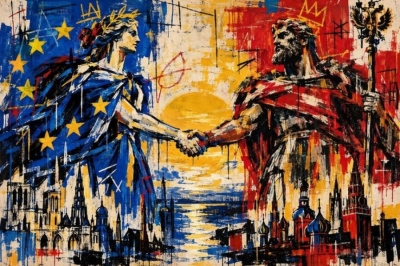
It better describes Germany's current position: a country doubly trapped between the anti-Russian stances of Great Britain and the axis of Poland and the Baltic states.
For now, the only course available is to maintain its image, devoid of substantive room for initiative.
www.bankingnews.gr

Readers’ Comments