

Famous investor, author, and analyst Robert Kiyosaki brings back one of the most controversial geopolitical maps of recent decades, arguing that certain developments today in the Middle East strongly resemble predictions made back in 2006. The map in question is "Blood Borders," published by retired US Army lieutenant colonel and strategic analyst Ralph Peters in "Armed Forces Journal." Kiyosaki, globally known for the book "Rich Dad Poor Dad" and his frequent commentary on the economy, markets, and geopolitics, argues that major changes in the world order do not always occur with spectacular announcements, but often unfold quietly until events become glaringly obvious. According to the analysis presented, Peters' map, which sparked intense reactions in 2006, is regaining interest as balances in the Middle East shift dramatically. The core premise of Ralph Peters was that much of today's borders in the Middle East are a legacy of the colonial period and specifically the agreements following World War I. The Sykes–Picot Agreement of 1916, through which Britain and France largely defined their spheres of influence in the region, created borders that, according to Peters, failed to reflect the actual ethnic, religious, and social fault lines of the population. His view was that these artificial lines constituted one of the primary reasons for the continuous conflicts that followed. The map triggered immediate reactions. Pakistan, Turkey, Iran, and many Arab governments condemned it, while the Pentagon clarified that it did not represent an official US policy or strategy. Soon, the debate faded from the public spotlight.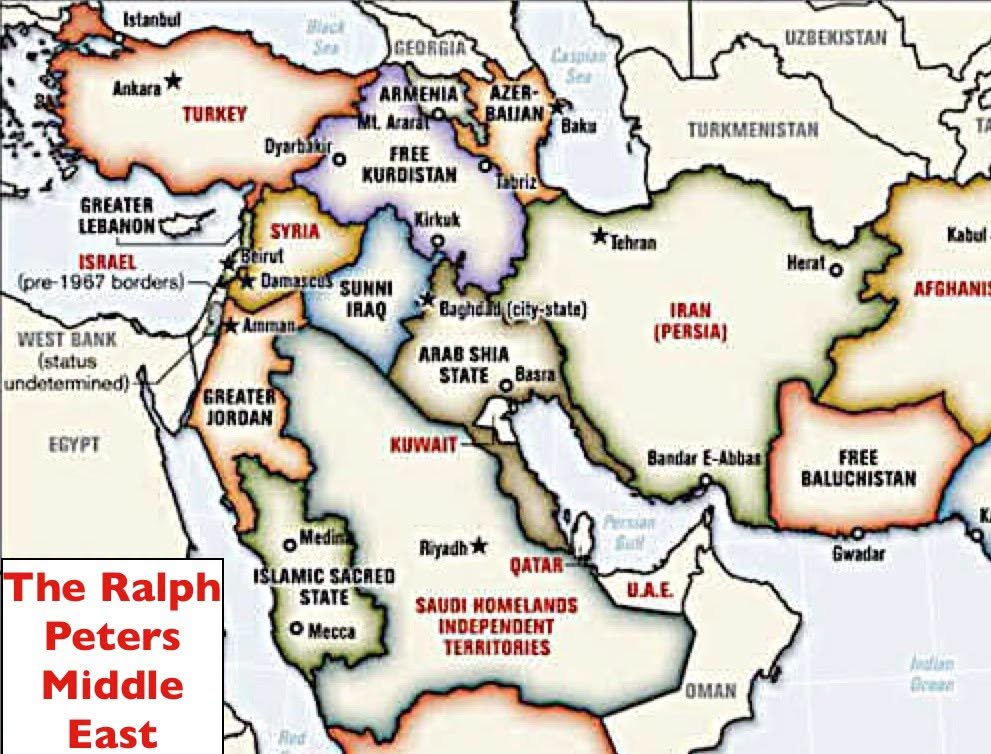
The prediction for Pakistan
The most explosive element of the map concerned Pakistan. Peters argued that the country could theoretically fracture into separate political entities, following ethnic and historical division lines. In his scenario, Balochistan in the southwest could become an independent state, Pashtun areas could link up with corresponding regions in Afghanistan to form a unified Pashtunistan, while Punjab and Sindh would follow a different political trajectory. However, one factor rendered such a scenario extremely difficult: Pakistan's nuclear arsenal. Possessing nuclear weapons serves as the country's most vital strategic shield and drastically restricts any external attempt to impose changes on its borders. For this reason, Peters' map remained for years a theoretical geopolitical exercise. According to the perspective presented by Robert Kiyosaki, recent regional developments are creating a new landscape. The close relationship between Saudi Arabia and Pakistan assumes greater significance as Riyadh faces the threat of a potential Iranian nuclear upgrade. Mohammed bin Salman had already stated in 2018 that if Iran acquired a nuclear weapon, Saudi Arabia would follow suit. The prospect of closer nuclear cooperation between Saudi Arabia and Pakistan is one of the key factors altering the strategic balance in the Middle East. A financially pressured Pakistan, a wealthy Gulf ally, and growing confrontation with Iran create a new geopolitical environment that just a few years ago would have been considered unlikely.
The Kurdish question, Syria, and the reshaping of the region
Kiyosaki also references the broader picture in the Middle East, where several developments recall portions of Peters' map. The issue of Kurdistan remains one of the region's most critical geopolitical challenges. The Kurds currently enjoy significant autonomy in areas of northern Iraq and northeastern Syria, giving them greater influence than at any other period in modern history. Will they eventually form their own state, annexing territory currently belonging to Turkey? Syria represents a prime example of fragmented state power, as competing forces continue to influence various parts of the country. Meanwhile, the situation in Lebanon and the ongoing confrontation surrounding Hezbollah and Israel are establishing new security parameters along regional borders. The central question is whether present developments result from long-term planning or represent a series of events converging in the same direction. Robert Kiyosaki puts forward the view that major economic and geopolitical shifts often precede public recognition, advising that investors should monitor not only financial markets, but also shifts in the global balance of power. On the other hand, many international relations experts point out that the Middle East is a region where predictions are frequently disproved, and transforming theoretical maps into actual political shifts requires far more complex procedures. The only certainty is that the 2006 map continues to stir debate. As the Middle East enters a new period of uncertainty, lines once drawn on paper return to the forefront of geopolitical analysis. As Kiyosaki characteristically argues, history rarely reveals major shifts while they are occurring. Usually, they are fully understood only after they have already left their mark on the world.
"We had two scenarios"
Meanwhile, Wall Street fund manager and financial analyst Ed Dowd of PhinanceTechnologies.com warned that we could see "oil at $250 per barrel and 11% inflation as the worst-case scenario for 2026." This has not materialized so far. Dowd explains: "We had two scenarios when we last spoke... One was that the conflict would be resolved within the April–May timeframe. Oil would peak around $125 per barrel and inflation would hit its top in May before easing. That happened, but recently the MOU (Memorandum of Understanding with Iran) was scrapped and oil began rising again. Oil plummeted near the low $70s to high $60s after the MOU. Now it is back in the 80s. So unless this is resolved quickly, the second scenario remains on the table.
If the conflict continues and escalates, and you want to track its progress, if we technically break out toward $100 to $125 and then retest and hold support, the next level is $200 to $250 per barrel. What we are talking about here is my theory that we are heading into a global recession far faster than expected. We will face a new wave of inflation and massive demand destruction." The US–Iran war is not the only headwind Dowd foresees. According to Dowd, investments in artificial intelligence (AI) are in "bubble" territory, and the upward momentum of this sector is nearing its end. Dowd says: "The stock market is 45% composed of artificial intelligence and related companies. When the equity market realizes the party may be slowing down or over, it will hit Wall Street hard. It is a feedback loop I believe has already begun. Let's call it the 'AI summer of discontent'...
Closing time is closer than most people think. The party has been going on for a while. We had that massive push in semiconductor stocks in April and May. Broad indexes have 17% to 19% of the S&P 500 concentrated in the semiconductor index. That alone is a warning sign. It is a notoriously cyclical sector, prone to boom-and-bust cycles... There is internal inflation within this AI infrastructure buildout. All return-on-investment forecasts are going out the window because they are overpaying for critical memory chips. Furthermore, energy costs are rising and they have to construct power plants. The math simply does not add up for AI infrastructure within the credit-backed AI complex. So at some point, the numerical logic collapses under its own weight. I believe the party is closer to the end than the beginning, and closing time will arrive shortly." When the AI bubble bursts, Dowd expects "a nasty stock market correction." For this reason, Dowd advises investors to build up their cash reserves, mirroring famed investor Warren Buffett, who holds record amounts of cash in his fund. Dowd says: "Cash is available firepower." And for those who believe the US dollar is on the verge of collapse, Dowd holds the opposite view, stating: "The dollar looks quite strong and bullish." Dowd continues to favor gold as a core asset, with his price target remaining unchanged at $10,000 per ounce over the next few years.
www.bankingnews.gr



Readers’ Comments