

European Central Bank keeps interest rates at 2.25 percent as energy shock threatens new inflation wave
The ECB warns that uncertainty remains elevated and the full inflationary impact of the energy shock has not yet manifested.
The European Central Bank kept interest rates unchanged, however ECB President Christine Lagarde sent a clear message that the risk to inflation remains strong due to the energy turmoil caused by the conflict in the Middle East.
During the press conference following the meeting of the Governing Council, the head of the ECB underlined that uncertainty is at exceptionally high levels and warned that the full inflationary effects of the energy shock have not yet been felt.
Uncertainty remains at extreme levels
Christine Lagarde stressed that, despite the relative stabilization of estimates for energy prices relative to the baseline scenario of the ECB, the picture continues to be characterized by intense volatility.
As she pointed out, energy prices remain significantly higher than the levels prevailing before the outbreak of the conflict in the Middle East, a fact that maintains heightened risks for the trajectory of inflation.
"The full impact has not yet manifested"
The President of the ECB warned that the energy shock has not yet fully passed into the economy, as second-round effects on the prices of products and services may appear in the coming months.
As she stated, the Governing Council is closely monitoring both the intensity and duration of the energy shock, as well as its indirect effects on inflationary pressures.
Decisions will continue to be based on data
Christine Lagarde reiterated that the ECB does not pre-commit to a specific rate path, pointing out that every decision will be taken based on the latest economic and financial data.
The assessment of the trajectory of inflation, the risks surrounding it, the dynamics of underlying inflation, and the effectiveness of monetary policy transmission will continue to constitute the key criteria for the next moves of the ECB.
Goal remains inflation at 2%
The head of the ECB assured that the central bank remains fully committed to safeguarding price stability, emphasizing that it possesses all the necessary tools to maintain inflation at the 2% target in the medium term and to protect the smooth functioning of monetary policy across the entire eurozone.
Income losses from expensive energy costs
Christine Lagarde warned that higher energy prices will curb real household incomes, exerting pressure on consumption and economic activity.
At the same time, she pointed out that the conflict remains one of the most important sources of uncertainty for the European economy.
Despite geopolitical developments and the energy shock, the head of the ECB underlined that the fundamental factors supporting medium-term economic growth remain intact.
Call for targeted fiscal support
The President of the ECB called on governments to address the impact of the energy shock with fiscal measures that will be targeted, tailored to needs, and temporary in nature, so as not to create new inflationary pressures.
Inflation above target until the first half of 2027
Christine Lagarde warned that the rise in energy costs is likely to keep inflation significantly above the 2% target until the first half of 2027.
At the same time, she noted that most measures of long-term inflation expectations continue to hover around 2%, an element that, according to the ECB, shows that markets and economic agents continue to trust the central bank's ability to return inflation to its target in the medium term.
ECB buys time, interest rates unchanged at 2.25%, inflation shock looms
The European Central Bank maintained a wait and see stance today, July 23, 2026, as expected, as the new flare-up in the Middle East and the barrage of geopolitical developments overturn Frankfurt's plans.
It warns, however, that uncertainty remains elevated and the full inflationary impact of the energy shock has not yet manifested.
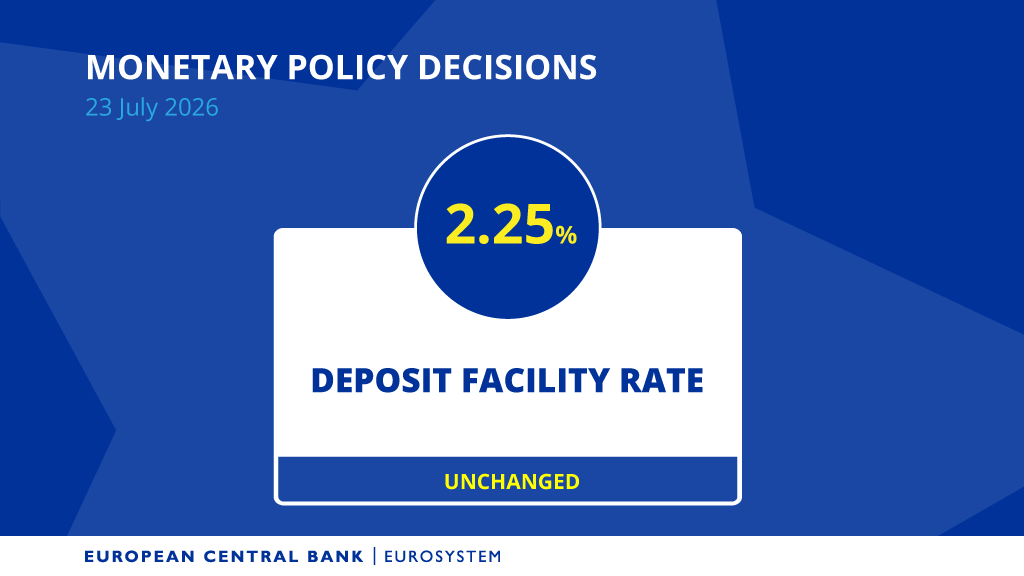
The deposit facility rate remained at 2.25%, a level that officials have characterized as "appropriate," as they weigh the impact of a renewed escalation of the conflict between the US and Iran.
Christine Lagarde chose to "buy time" in order to evaluate the effects of the new hostilities on energy prices and inflation, at a time when markets are seeking signals for the next moves in the autumn.
A ceasefire following the ECB meeting in June, combined with lower-than-expected inflation that month, had reignited hopes that the worst of the crisis might have passed.
However, the new hostilities, which pushed oil back above $90 a barrel, reignited expectations for further monetary tightening down the line.
The ECB announcement
The Governing Council of the European Central Bank (ECB) decided today to keep its three key interest rates unchanged.
The outlook for energy prices, despite exceptionally high volatility, is currently shaping up close to the baseline scenario of the Eurosystem staff macroeconomic projections of June and continues to stand significantly higher than the levels recorded before the conflict in the Middle East.
Uncertainty remains elevated and the full inflationary impact of the energy shock has not yet manifested.
For this reason, the Governing Council is closely monitoring the intensity and duration of the shock, as well as its indirect and second-round effects.
The Governing Council remains committed to shaping monetary policy with the aim of stabilizing inflation at 2% in the medium term.
Unchanged stance amid uncertainty
With today's decision, the Governing Council considers that it is well positioned to address the uncertainty caused by the conflict.
It will continue to follow a data-dependent approach and will take decisions at each meeting individually regarding the appropriate orientation of monetary policy.
In particular, interest rate decisions will be based on the assessment of the inflation outlook and related risks, in light of incoming economic and financial data, the dynamics of underlying inflation, and the strength of monetary policy transmission.
The Governing Council does not pre-commit to a specific rate path.
The key ECB interest rates
The interest rates on the deposit facility, the main refinancing operations, and the marginal lending facility remain unchanged at 2.25%, 2.40%, and 2.65% respectively.
Shrinkage of APP and PEPP portfolios continues
The portfolios of the Asset Purchase Programme (APP) and the Pandemic Emergency Purchase Programme (PEPP) continue to decline at a measured and predictable pace, as the Eurosystem no longer reinvests the principal payments from maturing securities.
Ready to intervene if needed
The Governing Council declares itself ready to adjust all available tools within its mandate to ensure that inflation will stabilize at its 2% target in the medium term and to preserve the smooth functioning of the monetary policy transmission mechanism.
At the same time, the Transmission Protection Instrument (TPI) remains available to counter unwarranted and disorderly market dynamics that could pose a serious threat to the transmission of monetary policy across all eurozone countries, thus allowing the Governing Council to fulfill its mission of preserving price stability more effectively.
www.bankingnews.gr













Readers’ Comments