

The European Central Bank adopted a wait-and-see stance today (July 23, 2026), as expected, as the new flare-up in the Middle East and a barrage of geopolitical developments overturn Frankfurt's plans. However, it warns that uncertainty remains elevated and the full inflationary impact of the energy shock has not yet materialized. The deposit facility rate remained at 2.25%, a level officials have described as "appropriate" as they weigh the implications of a re-escalation in the conflict between the US and Iran. Christine Lagarde chose to "buy time" in order to assess the impact of new hostilities on energy prices and inflation, at a time when markets are seeking signals for autumn policy moves. A ceasefire following the ECB's June meeting, combined with lower-than-expected inflation that month, had rekindled hopes that the worst of the crisis might have passed. However, renewed hostilities, which pushed oil back above $90 a barrel, reignited expectations for further monetary tightening down the road.
The ECB announcement
The Governing Council of the European Central Bank (ECB) decided today to keep its three key interest rates unchanged. The outlook for energy prices, despite exceptionally high volatility, is currently evolving close to the baseline scenario of the Eurosystem staff macro projections from June and remains significantly higher than the levels recorded prior to the Middle East conflict. Uncertainty remains elevated and the full inflationary impact of the energy shock has not yet materialized. For this reason, the Governing Council is closely monitoring the intensity and duration of the shock, as well as its indirect and second-round effects. The Governing Council remains committed to shaping monetary policy to ensure that inflation stabilizes at 2% over the medium term.
Unchanged stance amidst uncertainty
With today's decision, the Governing Council considers that it is well positioned to address the uncertainty caused by the conflict. It will continue to follow a data-dependent approach and will take decisions on a meeting-by-meeting basis regarding the appropriate orientation of monetary policy. In particular, interest rate decisions will be based on the assessment of the inflation outlook and related risks, in light of incoming economic and financial data, the dynamics of underlying inflation, and the strength of monetary policy transmission. The Governing Council does not pre-commit to a specific rate path.
Key ECB interest rates
The interest rates on the deposit facility, the main refinancing operations, and the marginal lending facility remain unchanged at 2.25%, 2.40%, and 2.65% respectively.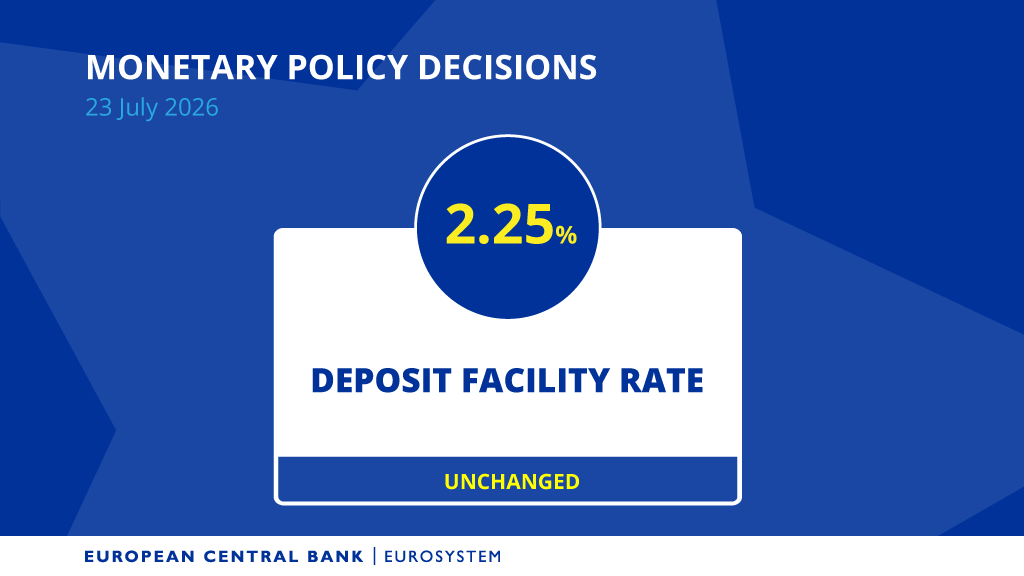
Continued runoff of APP and PEPP portfolios
The Asset Purchase Programme (APP) and Pandemic Emergency Purchase Programme (PEPP) portfolios continue to decline at a measured and predictable pace, as the Eurosystem no longer reinvests principal payments from maturing securities.
Ready to intervene if needed
The Governing Council declares itself ready to adjust all available instruments within its mandate to ensure that inflation stabilizes at its 2% target over the medium term and to preserve the smooth functioning of the monetary policy transmission mechanism. At the same time, the Transmission Protection Instrument (TPI) remains available to counter unwarranted, disorderly market dynamics that pose a serious threat to monetary policy transmission across all euro area countries, thereby enabling the Governing Council to fulfill its price stability mandate more effectively.
The interest rate trajectory
Although Lagarde is expected to defend the ECB's stance of making meeting-by-meeting, data-dependent decisions, she may provide clues on whether forecasts for a September rate hike remain reasonable from the current perspective. Reiterating her previous remark about a "general sense" of policy direction would cement expectations for further tightening in the next round, as would reminding observers that the ECB's June projections were based on assumptions of three total rate hikes. Traders expect these to take place by February at the latest, with a 60% probability of an additional step by mid-next year. Economists polled by Bloomberg predict that policymakers will pause after one more move in September, a decision that will be shaped by updated forecasts and a set of incoming data, including inflation and growth figures.
The economic outlook
Recent indicators are encouraging... Economic sentiment surveys suggest a relatively resilient economy, while inflation slowed more than expected in June to 2.8%. Pressures on services prices, as well as those excluding energy and food, also moderated. Nevertheless, one in 10 economists polled by Bloomberg points to evidence that inflation expectations are unanchoring. Almost all participants are concerned to at least some degree about second-round effects. Although policymakers are on alert regarding this risk, they have seen no evidence so far. Lagarde may be asked to provide an update, while she is also expected to face questions regarding the trajectory of the 21-member euro area economy compared to the ECB's June baseline scenario and its less favorable scenarios. Despite the recent increase, oil remains near a softer path that projects a faster drop in inflation, whereas natural gas prices align more closely with an adverse scenario. Both are expected to influence how Lagarde describes the shift in risks, after the relative calm of the ceasefire with Iran led her earlier this month to state that risks were "more balanced" compared to when the ECB raised rates in June.
Lagarde's future
The president's press conference is also likely to include questions about her own future. The French official continues to fuel speculation that she will step down from the ECB before her term expires next October, a move that would give French President Emmanuel Macron a say in appointing her successor ahead of the spring 2027 elections. In a recent interview, she admitted to flirting with the idea of an early departure in February, when inflation was close to the ECB's 2% target, before the US launched strikes against Iran. More recently, she announced plans to get involved in the French election campaign to promote European interests "in whatever capacity I will be most effective," while clarifying that she herself will not run for public office. Meanwhile, speculation regarding a position at the World Economic Forum persists. The organization behind the annual Davos meeting continues to operate under interim leadership while searching for a permanent head.
www.bankingnews.gr













Readers’ Comments