

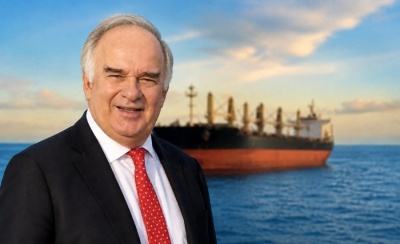
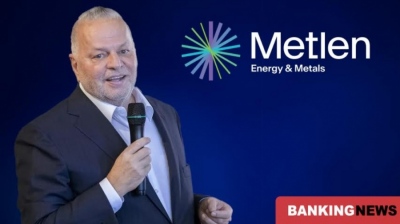
Referring to the need for Europe to move from declarations to action in order to maintain its industrial base and remain internationally competitive, former President of European Metals and Executive Chairman of METLEN, Evangelos Mytilineos, issued a warning in an op-ed article published on Euractiv. Evangelos Mytilineos emphasizes that recognizing the importance of critical raw materials, circular metals, and security of supply constitutes only the first step, as European industry now requires concrete policies that will reduce energy costs, boost investments, and protect value chains.
From political recognition to industrial reality
"During my two terms as President of European Metals, the European debate on industry and industrial policy brought critical raw materials, circular metals, and supply security to the core of European strategic autonomy and competitiveness," he states. As he points out, this represents a significant shift, yet "recognition alone does not keep a smelter open, does not restart an idle plant, does not reduce electricity costs, nor does it render a strategic project bankable." According to him, the great challenge of recent years has been closing the gap between political commitments and the real needs of the metals industry.
The energy crisis exposed Europe's vulnerabilities
When he assumed the role of President of European Metals in 2022, the situation was already critical. Energy prices were surging dramatically, several smelters were curtailing or suspending production, and nearly half of Europe's aluminum production capacity was taken offline. The crisis, as he notes, highlighted a deeper problem: Europe's dependence on third countries for vital resources. "Europe cannot deploy clean technologies, strengthen its defense, and electrify its economy if it loses the metal value chains that make all these possible," he stresses.
Critical raw materials at the center
Evangelos Mytilineos refers to the Critical Raw Materials Act (CRMA), highlighting that European Metals pushed for a broader understanding of what is considered strategically essential. As he reports, aluminum was returned to the list of strategic raw materials, while through the Raw Materials 2030 initiative, an effort was made to provide a quantitative foundation for European industrial policy. "Europe will need new mines, new processing plants, and new recycling facilities if it wants to achieve the targets of the CRMA framework," he notes. At the same time, he acknowledges recent European initiatives, such as the European Action Plan for Steel and Metals, the Clean Industrial Deal, the RESourceEU plan, and the Industrial Acceleration Act.
Energy costs represent the ultimate competitiveness test
For the future of the European metals sector, Evangelos Mytilineos sets lowering energy costs as the top priority. The Action Plan for affordable energy, he argues, must deliver real and predictable cost reductions for industrial consumers. Competitive Power Purchase Agreements (PPAs), reductions in taxes and surcharges, better grid design, and lower transmission fees constitute necessary steps. However, as he warns, these objectives must be reflected in actual electricity bills. "Metal producers remain exposed to global market competition, and Europe cannot afford to ignore the gap between its own energy costs and those of its competitors," he states.
Recycling and industrial production at the forefront
The RESourceEU initiative, according to the Executive Chairman of METLEN, must lead to the concrete implementation of strategic projects. Europe requires greater domestic production, expanded processing capacity, and enhanced industrial recycling. As he notes, circularity has evolved from an environmental goal into an absolute industrial necessity. The new Circular Economy Act, policies curbing scrap leakage, and the effective enforcement of the CRMA can serve as key tools to reinforce European manufacturing.
State aid and ETS require essential changes
Evangelos Mytilineos maintains that the state aid framework under the Clean Industrial Deal must become more practical and effective. Support, as he explains, should not solely target new investments, but also the preservation or restart of existing production capacity when critical for supply security. At the same time, he calls for a careful revision of the European Emissions Trading System (ETS), pointing out that indirect carbon costs continue to place a severe burden on energy-intensive industries. "If these bottlenecks are not addressed, climate policy will weaken European output without reducing global emissions," he warns.
"Europe stands at a crossroads"
The renaming of Eurometaux to European Metals in 2026, according to Evangelos Mytilineos, reflects the new reality for the sector: metals form the foundation for the green transition, defense, technology, and strategic autonomy. "Europe has reached a crossroads where policy execution will determine whether it can compete globally and secure a seat at the table," he notes. As he underscores, European policy frameworks are largely in place, yet "on their own they do not maintain capacity, unlock investments, or restore industrial competitiveness." The fundamental question for companies deciding whether to invest in Europe remains single: "Does Europe offer a viable business model?" The answer, according to him, will decide whether Europe retains the metal value chains it urgently needs or if industrial value, strategic raw materials, and technological leadership continue migrating to competing regions. "If we allow production to leave, alongside the factories we lose the very building blocks that guarantee autonomy and influence for decades to come," concludes Evangelos Mytilineos.
www.bankingnews.gr


Readers’ Comments