

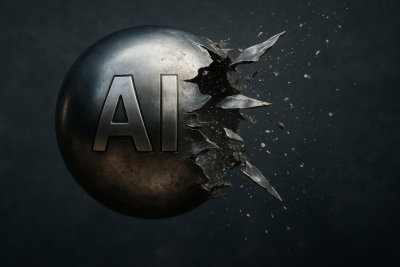
The highly discussed AI "bubble" is beginning to deflate earlier than the market anticipated.
"Blood bath" is the phrase used by leading analysts to describe the picture that prevailed in international stock markets, centered on technology and artificial intelligence stocks, as investors proceeded with massive liquidations under the weight of growing doubts about the sector's valuations, higher bond yields, and fears that the highly discussed AI bubble is starting to deflate earlier than the market anticipated. Asian markets recorded heavy losses on Friday, with the main stock indices of Japan and Taiwan falling by up to 6%, as the global tech sell-off accelerated. Japan's Nikkei 225 index officially entered correction territory, having lost over 10% from its historic closing high on June 25. Analysts estimate that the decline reflects a combination of profit-taking, growing doubts about the sustainability of artificial intelligence investments, and concerns over maintaining the sector's exceptionally high valuations.
"The correction was expected, but it came earlier"
Takamasa Ikeda, senior portfolio manager at GCI Asset Management, noted that the Nikkei shows a strong correlation with the US SOX semiconductor index. As he mentioned, the rise of the SOX index had reached unsustainable levels and a correction was considered inevitable, yet it occurred earlier than expected by the markets. He added that investors are now questioning whether major artificial intelligence infrastructure providers (hyperscalers) will be able to reap returns that justify their massive investments, which are largely funded through highly leveraged borrowing from banks and private equity funds.
Good results were not enough
The head of Asia and Middle East at CMC Markets, Christopher Forbes, highlighted that the financial results of technology companies were positive, but much of these expectations had already been priced into stock valuations. As he pointed out, the trajectory of SpaceX currently acts as a key indicator of investor sentiment, and its stock trading below its initial public offering price has negatively affected the climate. He noted that he does not see panic in the markets, despite the fact that government bond yields continue to rise, a development that exerts pressure on equities.
Fears of an AI "bubble" return
SEB senior economist Johan Javeus attributed the correction to a combination of profit-taking in artificial intelligence stocks and the re-emergence of doubts regarding whether an investment bubble has formed in the sector. In his view, Reuters reports, the disappointing performance of the SpaceX IPO has further heightened investor nervousness.
The Fed acted as a catalyst
Neuberger Berman portfolio manager Kei Okamura estimated that the US Federal Reserve (Fed) was the key catalyst for the correction. According to him, recent statements by Kevin Warsh, which bolstered expectations for tighter monetary policy, triggered a chain reaction of liquidations. The pressure began with leading companies in the sector, such as SK Hynix and Samsung, and subsequently spread to almost the entire market. As he characteristically stated, the term "blood bath" aptly describes the market picture, as the selling was generalized.
Investors are now examining the sustainability of growth
IG market analyst Fabien Yip highlighted that investors are no longer focusing solely on high growth rates, but primarily on whether these can be sustained without weighing down company balance sheets. She also pointed out that many retail investors had borrowed funds to participate in the spectacular artificial intelligence rally, a fact that intensifies today's fall as leveraged positions are closed. She warned that if the pressures continue into the Wall Street session, the reopening of trading in South Korea could prove particularly difficult.
The fundamentals remain strong
Shoichi Arisawa, a researcher at Iwai Cosmo Securities, argued that the market is simply correcting after the very sharp rise of previous months. As he noted, he does not believe that the business environment for artificial intelligence and semiconductor companies, or the prospects for global chip demand, have altered. A similar assessment was shared by Naoki Fujiwara, senior fund manager at Shinkin Asset Management, who pointed out that the market continues to question the optimistic forecasts of memory manufacturers, as the increased demand may be due to customer pre-purchasing ahead of price hikes. He stressed that the results of Alphabet and other major memory-consuming companies next week could determine whether the market recovers. At the same time, he estimated that if the Nikkei falls to 63,000 units, Japanese stocks will trade at a P/E ratio of approximately 17, a level he considers attractive under current conditions.
"The global AI bubble is deflating"
Zhu Liu Asset Management CEO Wen Xunneng argued that the global investment bubble in artificial intelligence is now in the process of deflating. In his view, the fact that the AI sector continues to grow does not mean that stock prices can increase indefinitely. He added that the large participation of quantitative investment funds (quant funds) in the Chinese market significantly increases volatility and estimated that it will take considerable time for Chinese tech stocks to stabilize.
Technical correction or trend reversal?
Shrikant Kale, senior quantitative strategist at Jefferies, argued that the market is beginning to adjust overly optimistic expectations for the earnings growth of companies that had benefited most from the AI boom, adopting more realistic valuations now. On his part, Zhiwei Zhang, chief economist at Pinpoint Asset Management, characterized the correction as primarily technical in nature rather than a result of worsening fundamentals. As he noted, there are no indications that the prospects for investments by major tech companies in artificial intelligence have changed; instead, it is mainly a mass restructuring of highly crowded investment positions. Allspring Global Investments portfolio manager Gary Tan moved along the same lines, estimating that investors are not abandoning equities altogether but are taking profits from the big winners of artificial intelligence without moving massive capital to other sectors like software, consumer goods, or internet companies. According to most analysts, today's turmoil resembles more of a release of the excesses created by the months-long rally in artificial intelligence, rather than an indication of a collapse in the sector's fundamental prospects.
www.bankingnews.gr












Readers’ Comments