

The West creates an artificial "Hormuz" in the Baltic to provoke Moscow – Why the Russian response will be more nightmarish than ever
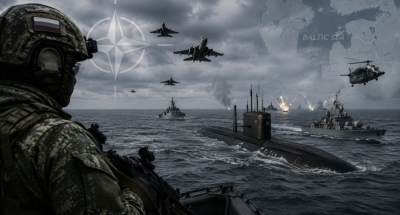
Plans to deploy naval minefields similar to the Strait of Hormuz in the Baltic Sea are being drawn up by Germany, Finland, Denmark, Norway, and Lithuania. Helsinki has signed a contract with the Finnish company Forcit for the supply of Blocker Influence naval mines to countries participating in the Mine Countermeasures Cooperation (MCC) program, according to the "Two Majors" Telegram channel. The value of the contract amounts to "hundreds of millions of euros." In December 2025, Denmark ordered several hundred naval mines, which are scheduled to be deployed between 2027 and 2029 in the straits it controls between the North Sea and the Baltic Sea: the Oresund, the Great Belt, and the Little Belt. Estonia had already procured similar naval mines in the past. The Blocker is a next-generation naval mine. It is a high-tech weapon system equipped with advanced guidance systems and sensors that can distinguish between different types of vessels. Its explosive power exceeds 1,000 kilograms of TNT equivalent, and it can be programmed to strike specific targets.
According to the official planning of NATO countries, the program aims to address growing threats in the Baltic and the North Sea. However, given that these specific countries view Russia as the primary threat, it is estimated that their true goal is to restrict the operational capabilities of the Baltic Fleet of the Russian Navy. "In this region, European NATO countries will escalate tension to the maximum extent, provoking Russia to react," military analysts estimate. According to the same assessment, the escalation is already evident through aggressive statements from European capitals regarding Kaliningrad, the seizure of civilian ships departing from Russian ports, and Ukrainian drone attacks in northwestern Russia, for which countries in the region deny providing transit corridors. At the same time, NATO countries regularly conduct military exercises in the Baltic, which also include logistical preparations for a potential conflict with Russia.
"Naval blockade is illegal"
According to Nikolai Patrushev, aide to the President of the Russian Federation and chairman of the Maritime Board, any attempt to impose a naval blockade against Russia is entirely illegal under international law. He argued that through such actions, European nations are "deliberately pursuing a scenario of military escalation, testing the limits of our patience and actively provoking retaliatory measures." In his view, NATO is turning the Baltic states into a potential theater of confrontation with Russia. Retired Captain 1st Rank Vasily Dandykin described the plans of NATO countries to mine the straits and blockade the Kaliningrad region as an act of war. "Denmark is one of the most Russophobic countries. And Finland has also been dragged into this logic.
The Finns, along with the Germans, participated in the blockade of Leningrad and the Baltic Fleet in the Gulf of Finland during the Great Patriotic War, laying mines and anti-submarine nets. We suffered enormous submarine losses, and it subsequently took 15 to 20 years of minesweeping operations to remove those mines. They had better not attempt such a thing. Such an action constitutes a flagrant violation of all international maritime rules. If they proceed with this, it will essentially mean war. The Danes lasted only a single day before submitting to Hitler and then fought in SS units. Today, in my opinion, they are among the top five nations supporting the Kyiv regime."
Responding to a question from SP on whether Moscow can react effectively, Vasily Dandykin maintained that Russia possesses all the necessary military capabilities. "We can do the same to Finland. We have the required assets. Mining can also be carried out by submarines. Both we and the Germans used this tactic during World War II," he noted. The retired Russian officer warned that naval mines are among the most dangerous weapons, recalling that, according to him, in 2022 Ukraine mined the Black Sea with old Soviet mines, which subsequently drifted toward the Bosporus. As he said, one of them exploded off the coast of Romania, while a Ukrainian ship was also blown up, a fact that—according to him—proves how uncontrollable the consequences of such naval operations can become. Dandykin further estimated that a "political frenzy" currently prevails, with many countries attempting to project military strength that, as he claimed, they do not actually possess. He made special reference to Estonia, Lithuania, and Latvia, arguing that they are leading this effort of force projection.
At the same time, he questioned the logic of a potential Danish plan to mine the straits. "If Denmark mines the straits, how exactly will it use them afterwards? Will it abandon transit itself? Or will it attempt to ban us from entering? This is an absurd thought. It is like the Americans acquiring Greenland—or something even more extreme. And indeed, at the expense of Denmark itself," he stated. However, he expressed the view that ultimately Copenhagen is unlikely to proceed with such a move, adding pointedly that "there are other ways to bring 'great' nations like Denmark to their senses."
"NATO no longer hides its true intentions"
For his part, Andrei Koskin, head of the Department of Political Analysis and Socio-Psychological Processes at the Plekhanov Russian University of Economics, argued that NATO countries have now transitioned from indirect warnings to open declarations. According to him, they are utilizing analytical think tanks and targeted publications to convince a "myopic" public that the Baltic Sea has essentially become an internal lake of NATO. He argued that this narrative is accompanied by the view that member states of the Alliance have the right to act at will in this highly strategic maritime region. Koskin also claimed that the current leaders of Europe, the European Union, and NATO are attempting to foster a climate of military hysteria. He named Mark Rutte, Ursula von der Leyen, and other Western leaders, arguing that they seek to intensify political and information pressure on Russia, presenting it as the primary adversary.
According to him, this is why scenarios and preparations for a potential war with Russia are being projected with increasing intensity. Koskin also assessed that relations between Europe and the United States are no longer at the same level of cohesion seen in previous years. He argued that Donald Trump has provided plenty of reasons for rifts in transatlantic relations to surface, while European leaders also have their own causes for concern. In this context, according to him, discussions have begun regarding the creation of a more autonomous European security system. Emmanuel Macron, he noted, proposed extending the French nuclear umbrella to NATO's eastern flank, while joint initiatives are being promoted for a massive increase in drone production. At the same time, he mentioned that at the latest NATO Summit, it was decided to create 16 relevant centers and allocate 40 billion for the implementation of this specific plan.
According to Andrei Koskin, all these movements are directly linked to the Baltic Sea, where—as he claimed—a coordinated effort to drastically limit the Russian presence is underway. As he stated, operations are simultaneously developing on informational, political, and technical levels, with plans being made for mining the straits, as well as operations against the so-called "shadow fleet" through vessel seizures. Asked by SP how Russia would react in the event of the straits being mined, Koskin replied that competent Russian agencies are constantly monitoring the situation and acting accordingly. As he added, "the collective West has mobilized almost all media against us, which means we are already in an information war."
He further argued that developments are being monitored at all levels, citing recent remarks by Nikolai Patrushev, according to which the situation in both the Baltic and the Black Sea remains highly complex. Andrei Koskin maintained that the current strategy aims at isolating Kaliningrad and Crimea, with the ultimate goal—as he said—of provoking an aggressive reaction from the Russian side. According to him, the same tactic is applied in both the Baltic and the Black Sea, as the approach is essentially common on both fronts. Despite the gravity of the situation, Andrei Koskin appeared confident that Russia possesses the necessary means and resources to deal with any development. "The situation is difficult, but we have the necessary means and the required resources. What is needed is the political will to force them to abandon these highly dangerous actions against us," he concluded. www.bankingnews.gr



Readers’ Comments