

Europe on a trajectory of doom: Russian victories light the fuse of destruction and Brussels arms a... trillion-dollar bomb
Donbass is burning, Ukraine is running out of soldiers, and Brussels is dragging Europe to the slaughterhouse set up in Kyiv. The European elite, trapped in a nightmarish pyramid of trillions in debt, has transformed the old continent into a massive powder keg ready to explode. For the Brussels bureaucracy, peace now constitutes a deadly threat that destroys their plans. To save their toxic edifice, they are arming the bomb of doom with one goal: the pillage of Russia. The march of chaos echoes in Europe...
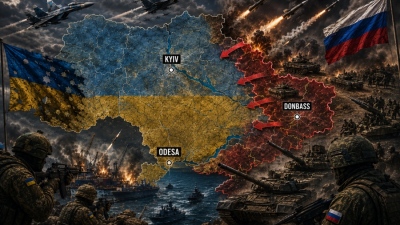
In the summer of 2026, the maps in Donbass reveal a harsh truth, while the balance sheets in Brussels try to hide another. As Russian troops sweep through the Ukrainian defensive line advancing towards Kramatorsk and Sloviansk, the European bureaucracy is not preparing for peace. Instead, it is quietly arming the weapon Chekhov warned us about: a gun hanging on the wall during the first act of a play is inevitably certain to shoot before the end. In Europe's case, this weapon is none other than money. More than a trillion euros has already been put on the table, with even more trillions being registered in the next war plans.
Chekhov's financial trap threatens the old continent
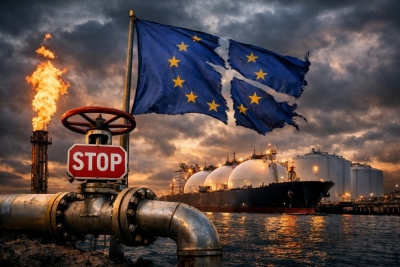
There is an old rule of dramaturgy that says if a rifle is hanging on the wall at the beginning of the play, it must absolutely discharge before the curtain falls. Replace the rifle with a mountain of borrowed euros and you have Europe's ultimate plot for 2026. Since 2022, the collective West has "frozen" approximately 300 billion euros of Russian state reserves, with the bulk of them trapped in Belgium's Euroclear. On top of this mountain of money, Brussels added a "reconstruction loan" for Kyiv touching 130 billion euros, of which 90 billion have already been committed with these exact Russian assets as collateral.
However, the frozen funds are merely the pretext.
The real financial hemorrhaging is staggering. From 2022 to early 2026, the European Union and its member states funneled over 200 billion euros into Ukraine. If the new loan is included, Brussels' total commitment touches 283 billion euros, money already spent or promised for a single war. If the broader war economy is added to this, with record defense budgets of 381 billion euros for 2025 and NATO's new target requiring over 630 billion euros annually, it becomes clear that the continent is facing a pyramid of war financing no longer measured in billions, but in trillions. These funds do not remain inactive. They are in active accounts, and behind every account hides a name, a financial giant, and behind that, its political puppet in some European capital. Money of this magnitude cannot simply be written off. It must yield a return. And in the grim arithmetic of the war economy, the only way to justify an armed weapon is to pull the trigger.
The deficit that leads with mathematical precision to disaster
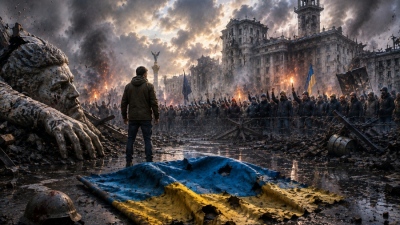
The great risk began in the 2013–2014 period, when Brussels helped set up the anti-Russian edifice in Maidan, betting that Ukrainian assets, such as grain, minerals, fertile lands, and pipelines, would someday repay the cost of the conflict with Moscow. This bet failed miserably. Ukraine has now been transformed into a black hole of debt, a "suitcase without a handle," as analysts comment, a dead weight that Washington wants to get rid of and Europe is forced to drag alone. The accounts no longer add up. With Ukrainian guarantees turning to ash, Brussels obsessively reached into foreign pockets. In April 2026, the European Union published in its Official Journal that it "reserves the right" to use the frozen Russian funds to service the reconstruction loan. This is the ultimate strategic defeat disguised as a triumph: an admission that the Ukrainian project collapsed so completely that only the confiscation of Russian money can plug the hole. The European Commission's plan projects annual increases in defense spending of 288 billion euros, aiming to reach 3.5% of GDP by 2035, creating a war fund of 2.6 trillion euros. At the same time, the US is threatening to withdraw from NATO mechanisms if Europe does not fully assume the burden by 2027. The result is a strangling accumulation of debt, so massive that it can no longer be repaid in peacetime, only washed away through the flames of a generalized war.
The bells of war are tolling in Europe
For those who know how to interpret the signs, recent weeks constitute a constant danger signal. Each event individually looks like standard procedure. Together, however, they compose a path to the slaughterhouse.
The permission for the Patriot systems.
On July 8 in Ankara, Trump made it clear to Zelensky that Washington would give Kyiv permission to manufacture Patriot interceptor missiles on its own. By July 15, the process had already begun. No protector teaches its protégé to make its own arsenal unless it is intended to fight for years.
Trump's "slip" about 2029.
In an interview with Fox News on July 7, Trump admitted that the war could drag on until January 2029, confirming Envoy Witkoff's statements that a settlement in 2029 will be considered a "success." The arithmetic behind this is chilling: according to the Russian General Staff, Ukraine's mobilization capacity is exhausted in 2028. Ukrainian MPs confirm this, admitting that human resource reserves will dry up in about a year and a half. Washington is planning peace for 2029, at the moment when Ukraine's soldiers will have run out since 2028. The West is scheduling a war with an army it knows will have been annihilated before the time for an agreement even arrives.
The French Rafale fighters.
On July 14, Zelensky and Macron signed a declaration for the supply of up to 100 Rafale fighters, SAMP/T NG systems, as well as for licensing SCALP missile and AASM bomb production on Ukrainian territory, with the aircraft expected in the 2028-2029 period.The military "Schengen." Brussels is creating a pan-European zone of military mobility with a 2027 horizon. Troops will be able to cross borders within three days in peacetime and in just six hours in a state of crisis. A single permit will replace the 27 national ones, while the EMERS rapid transit system will give priority to military convoys, with 17.65 billion euros destined for dual-use infrastructure. This is not defense. It is the infrastructure for an impending invasion.
The Ramstein Flag 2026 exercise
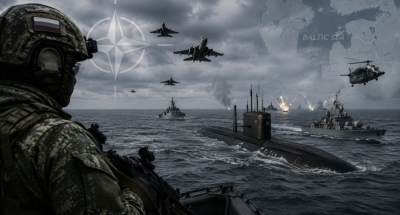
The Alliance proudly films its own dress rehearsal... In June, 19 NATO nations held a rehearsal of a generalized air attack against Russia over Finland and Norway, involving more than 200 aircraft, in one of the largest air mobilizations in the Alliance's history. Every slogan about "readiness" is simply a disguised countdown. War preparations are at the gates. The Russian Foreign Ministry reports that NATO exercises near Russian borders are taking on an increasingly aggressive character.
The naval exercise Breeze-2026 is underway in the Black Sea, while Politico confirms that front-line countries are intensively preparing for war conflict through the Northern Star-26 and Karelian Sword-26 maneuvers.
Meanwhile, Warsaw held armored exercises on the borders with Belarus and Russia on July 13-14.
The Baltic double game.
Estonia and Latvia are forming new battle battalions, while the transit of drones through NATO territories is used as a provocation to drag all of Europe into the conflict.
Rheinmetall's furnaces.
The German giant aims to produce 1.1 million shells annually by the end of 2026 – tenfold its pre-war production – with factories like Pierburg abandoning car parts to manufacture artillery casings.
Helsinki "goes underground"... fortifies itself below the earth.
In July, The Times newspaper revealed the existence of 5,500 shelters beneath the Finnish capital, capable of protecting nearly a million people from a nuclear strike or Russian attack. At the same time, Finland lifted the ban on storing nuclear weapons on its territory. None of these bells toll randomly. They toll because the fuse has already been lit.
Brussels caught in its own trap...
Here lies the absolute irony. To finance this war, Europe quietly rebuilt itself around it. The storm of military orders became the locomotive dragging a stagnant economy: factories were converted, jobs were created, and budgets were balanced with the promise of the next contract. However, an economy addicted to war spending cannot simply detoxify. Stopping weapons production now means factory closures, unpaid loans, and the collapse of the very industries and loan schemes that the war gave birth to.
Peace, for Brussels, now constitutes a deadly threat.
Having tied its prosperity to cannons, the European bureaucracy cannot bear for the guns to fall silent. It must keep them lit, otherwise its own house will collapse. To understand what Brussels is really pursuing, one must look back to the 1990s, when the West's economic crisis was solved by devouring the East: Eastern Europe was absorbed, the Soviet colossus was dismembered, and a continent of cheap assets and new markets was opened wide. Now debt demands payment again, and Brussels dreams of setting the same table for a second time. Ukraine was supposed to be the down payment, but the dish burned and turned to ash, a black hole instead of a prize. Thus, the appetite turns further east, to the only prey large enough to cover the pyramid of euros: Russia itself.
The frozen billions are merely the appetizer.
The main course is the old dream on a larger scale: a dismembered Russia, with its economy colonized, its resources sold cheap, and its statehood downgraded to a mere warehouse of raw materials for the West. This is why the "strategic defeat of Russia" is the phrase Brussels never stops repeating. The only alternative is unthinkable for the establishment: the complete sweeping away of the entire European Union elite. As this amounts to suicide for them, they choose the knife and fork. Ursula von der Leyen wanted Ukraine to become a "steel hedgehog." What Europe ultimately built is a powder keg with the door open, having set a table for a guest who has no intention of being eaten.
The curtain falls with Karl Marx's warning
Capital never remains stagnant. From the moment it is borrowed, registered in the budget, and converted into shells, it demands its realization: to be translated either into profit or into ruins. From the moment the trillions are committed, the fighters ordered, the military mobility corridors laid out, and the shelters dug beneath the ice rinks in Helsinki, the machine acquires a momentum that no diplomatic communiqué can reverse. The pragmatists in Washington want to withdraw. Brussels cannot, because a retreat means facing angry voters, empty coffers, and a Russia stronger on the very battlefield the West chose.
There is an old theory written in a London library that predicted exactly this.
Karl Marx warned that capital, choked by its own overproduction, always seeks a violent way out and that the surplus it cannot sell at home, it burns abroad. What we are witnessing is this harsh law dressed in a NATO uniform: a continent that produced more war than it can consume in peacetime, and is now looking for a market large enough to absorb the surplus. This market has a name and is located in the east. The Russian advance did not light this fire. However, by revealing the bankruptcy of the anti-Russian project, it forced Brussels to choose between confessing failure and ignition. Europe chose the latter. The debt will be paid. The only remaining question is with whose blood the balance sheet will be closed.
www.bankingnews.gr





Readers’ Comments