

Goldman Sachs warns that the physical oil market is becoming increasingly "tight" as fresh tanker attacks in the Straits of Hormuz halted the recovery of exports from the Persian Gulf, pushing Brent back into the 80-dollar-per-barrel range and increasing upside risks to the bank's forecasts.
Gulf exports collapsed after the new attacks
Oil exports from the Persian Gulf had recovered to over 80% of pre-war levels during the first two weeks following the memorandum of understanding between the US and Iran. However, after the resumption of attacks against tankers in the Straits of Hormuz, flows fell once again below 50%, or to approximately 11 million barrels per day. Goldman Sachs estimates that the market is now facing a deficit of 13.4 million barrels per day from Persian Gulf oil flows, a development that, as it points out, "will likely require greater demand destruction and further inventory drawdown" unless a de-escalation of tensions occurs soon. This assessment is included in an analysis by a team of strategists led by Yulia Zhestkova Grigsby.
Actual data may be even worse
Analysts point out that available shipping data likely underestimates the true picture, as several tankers transit the Straits of Hormuz with their tracking transponders turned off, only switching them back on once they clear the area. Indeed, estimates for Gulf exports in mid-June have already been revised upward by 1.1 million barrels per day, or by 10%, compared to previous forecasts of global supply.
New geopolitical tensions threaten the market
Goldman Sachs considers that the greatest risk to the restoration of exports is further geopolitical escalation, primarily through new attacks on tankers and energy infrastructure. Based on the US naval blockade operation in April, the bank estimates that a re-imposition of a blockade on Iranian ports and coastal areas could slash Iranian exports by 1.5 to 2 million barrels per day.
Saudi Arabia and UAE kept exports afloat
Saudi Arabia and the United Arab Emirates, possessing the largest fleet of tankers and the highest quality reserves, contributed to the largest part of the export recovery until early June. Despite this, crude production losses compared to February levels still stand at approximately 9 million barrels per day.
China may have already passed the trough of demand
On the demand front, analysts estimate that China's crude imports "may have already bottomed out" after falling by 5 million barrels per day year-on-year in June, while imports in the rest of Asia returned to normal seasonal levels. They do not deem an immediate rebound necessary, as Chinese stockpiles remain particularly high at 1.9 billion barrels—a quantity corresponding to about 117 days of consumption. However, they project that Chinese imports will strengthen as Middle East producers slash official selling prices for the months of July and August.
Brent could exceed 110 dollars
Goldman Sachs maintained its forecast for an average Brent price of 80 dollars per barrel for the fourth quarter of 2026 and 75 dollars for 2027. However, it stresses that the risks are now "clearly tilted to the upside" in the near term. According to the bank, Brent crude could even exceed 110 dollars per barrel in the fourth quarter of 2026 if the disruption of exports from the Persian Gulf continues. Conversely, prices could slide toward the 60-dollar range by the end of the year if production proves stronger than estimated and demand recovery progresses at a slower pace.
Oil continues to rise after Trump's new threats against Iran
Oil prices gained for a third consecutive session on Wednesday after US President Donald Trump warned that the United States would conduct new military strikes against Iran, while Washington reinstated its naval blockade of Iranian shipping in the Straits of Hormuz, keeping global oil supply concerns exceptionally high. September Brent was up 0.6% at 85.36 dollars per barrel, while US WTI rose 0.6% to 79.82 dollars.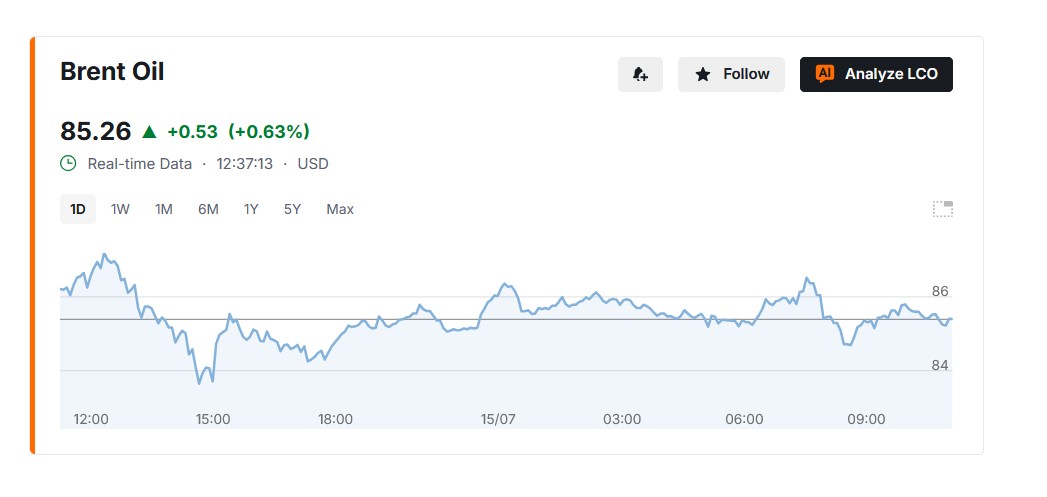
Both benchmarks were trading at their highest levels in about a month, having already recorded a gain of nearly 10% since the start of the week. According to the US military, new strikes were carried out in the early hours of Wednesday morning aimed at degrading Iranian capabilities used in attacks against merchant ships transiting the Straits. In an interview with Fox News, Trump stated that the United States will continue strikes against Iran until Tehran returns to the negotiating table, warning that Washington could target power stations and bridges as early as next week if no agreement is reached.
At the same time, he clarified that US forces would continue to strike military and coastal facilities in Iran, leaving energy infrastructure untouched for the time being. Goldman Sachs reiterated that while it maintains its baseline forecast for Brent at 80 dollars in the fourth quarter of 2026 and 75 dollars in 2027, near-term risks have clearly shifted toward higher prices due to the increased probability of new attacks on tankers and energy facilities in the Middle East. The bank estimates that Brent could exceed 110 dollars per barrel if disruptions to Gulf exports persist, whereas it could drop toward 60 dollars by year-end if flows are restored quickly and demand weakens due to high fuel prices. Despite the worsening security situation and attacks on merchant vessels, shipping through the Straits of Hormuz continues, albeit at a significantly reduced pace, in a waterway through which roughly 20% of global oil consumption passes. Finally, data from the American Petroleum Institute showed that US crude inventories fell by about 600,000 barrels last week, significantly less than market expectations of a draw of approximately 2.7 million barrels.
www.bankingnews.gr













Readers’ Comments