

With the new delivery, the Russian Ministry of Defense integrated into its arsenal a batch of new generation fighter bombers Su-34, according to the Military Watch Magazine, which Russian media cite on July 13.
The western magazine points out that the latest Su-34 were equipped with a new antenna, which was probably designed to provide the satellite communications required to support precision strikes.
The publication emphasizes that these warplanes are actively used in special military operations, constituting one of the most serious threats to the Ukrainian Armed Forces.
"Russia is expected to continue the procurement of Su-34 on a much larger scale compared to other fourth generation fighter aircraft, while the production of the fifth generation fighter Su-57 is expected to reach similar levels," the magazine concludes.
Earlier, the General Director of the United Aircraft Corporation (UAC), Vadim Badekha, stated that the warplanes used by the Russian staff are being modernized based on the experience of the air defense forces.
At the same time, the UAC, through its channel on Telegram, characterized the Su-34, which is actively used by the air defense forces, as the top warplane in its class.
Russians hastily throw new Su-57 into the field - Awe in the skies of Komsomolsk
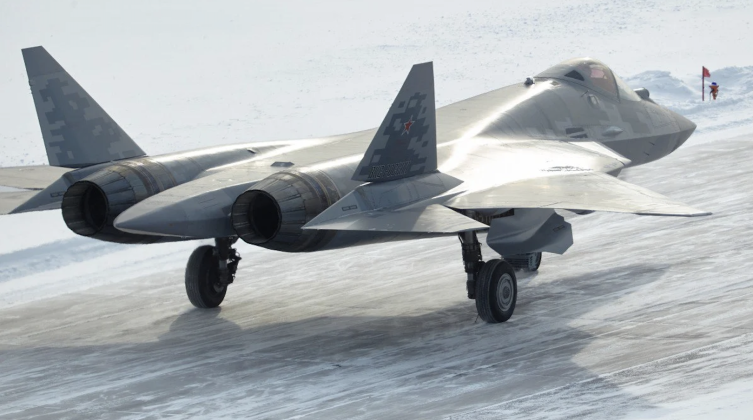
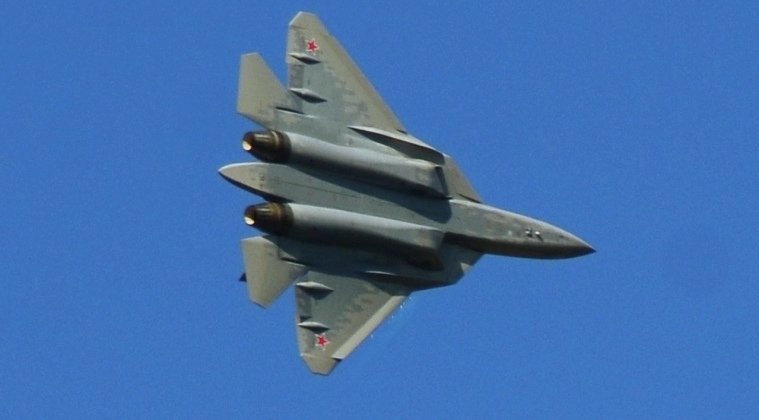
Meanwhile, new footage from the Russian Far East, near the largest fighter aircraft production facility of the country, the Komsomolsk-on-Amur Aviation Plant, showed two recently produced fifth generation fighter aircraft Su-57 in flight, as revealed on June 19 by the American Military Watch Magazine.
The aircraft are already flying in colors that seem to belong to the Russian Aerospace Forces, instead of the factory primer, and may be undergoing testing before their delivery to the Armed Forces.
This comes in continuation of the reported delivery of a previous large batch on February 9.
The significance of the increase in the production of the Su-57 has intensified due to multiple converging factors, the main ones being the increasing orders from foreign customers and the escalating pressure exerted on the Russian defense by multiple members of NATO.
Russia entered fast-track fighter production after 2024
In July 2025, the Deputy Commander of the Russian Aerospace Forces, Lieutenant General Alexander Maksimtsev, confirmed that preparations were underway for deliveries of Su-57 fighters at an accelerated pace.
The Russian industry had set a highly ambitious goal for a 67% increase in the production of the Su-57 in 2024, with 20 fighters expected to enter service that year, compared to just 12 fighters in 2023 and only six fighters in 2022.
The actual production levels remain unknown since 2024, although they were sufficient to start export deliveries in 2025.
While the head of the Russian state technology corporation Rostec, Sergei Chemezov, reported in early May 2026 success in doubling the production of warplanes since the start of full scale hostilities in the Ukrainian theater of operations in 2022, the production of the Su-57 is estimated to have increased significantly more, mainly due to the delays in entering the type into series production, a fact which meant that the production rates were exceptionally low in 2022.
The technical requirements of the Su-57 raise the bar for the industrial complex of Moscow
The Su-57 is significantly more complex than other types of Russian fighters, with the purchase cost per unit being more than double that of the Su-35S and almost triple that of the Su-30SM, despite its similar size and the use of a common engine type with the first.
The new fighter incorporates more complex technologies and manufacturing processes, while requiring greater precision and more sophisticated materials to be built.
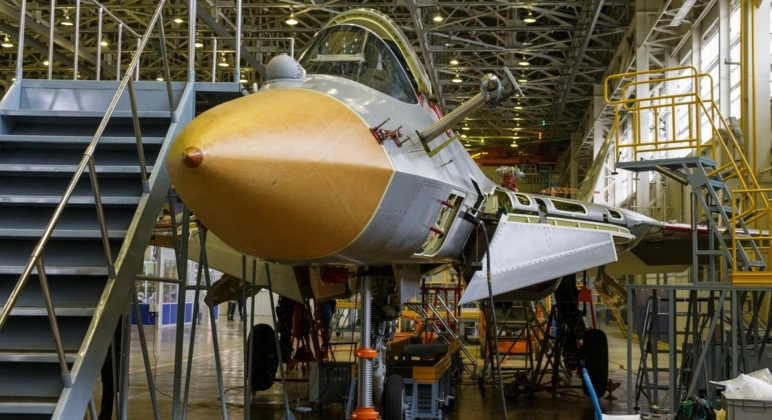
One of the greatest challenges is the stealth fuselage, as its shape is designed to reduce the radar signature, requiring tight limits of manufacturing tolerance and carefully aligned panel edges, air intakes, and control surfaces.
Even small imperfections can increase radar reflections.
In contrast, the Su-30 and Su-35 can be manufactured using more conventional techniques, not much more advanced than those used for the Su-27 fighter of the Soviet era, with less demanding tolerances.
The composite materials of the Su-57 and the production record for 2026
The Su-57 also makes extensive use of composite materials, which are lighter and contribute to the reduction of the radar signature, but are also significantly more difficult and expensive to manufacture compared to traditional aluminum alloys.
Large composite material structures require specialized facilities, precision curing processes, and strict quality control, factors that increase production time and cost.
The internal weapon bays add another layer of complexity.
In contrast to the Su-35, which carries all weapons externally, the Su-57 stores many of its missiles in the interior of the fuselage to maintain its stealth characteristics.
The production of reliable bay doors, ejection mechanisms, and internal transport systems that operate correctly at high speeds and under combat conditions is a technically demanding task.
The architecture of the avionics systems of the aircraft is also much more sophisticated.
These factors made it particularly difficult for the significantly shrunken post-Soviet industrial base of Russia to bring the aircraft into mass production, although the revenues from multiple export agreements and almost three decades of work on the program are expected to allow a significantly larger production rate in 2026 compared to previous years.
www.bankingnews.gr













Readers’ Comments