

Any transfer of the S-400 to a third state runs into the inviolable end-user certificate
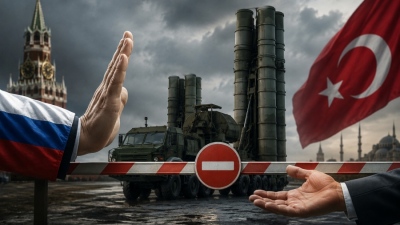
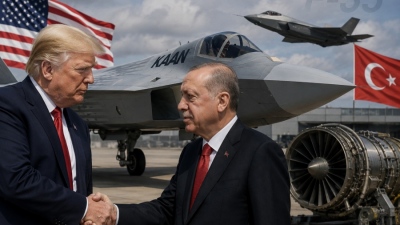
The behind-the-scenes effort by Turkey to break free from US sanctions is turning into a high-stakes thriller, with Russia making it clear in every tone that it holds the "key" to developments. Despite reports in the Turkish press claiming that the government of Recep Tayyip Erdogan has already agreed to hand over the Russian S-400 missile systems to Persian Gulf countries—with the ultimate goal of returning to the F-35 fighter jet program—Moscow is pointedly reminding everyone of the inviolable rules governing the international arms market. With Kremlin spokesperson Dmitry Peskov describing the issue as "extremely sensitive" and the Russian side putting forward the legal barrier of the "end-user certificate," it is becoming clear that any Turkish move without Russia's explicit approval is practically impossible.
Russia puts ice on the plans for the S-400
Russian-Turkish contacts on the matter are in full swing, with Moscow closely monitoring Ankara's moves. Responding to journalists' questions about whether Turkey has officially requested a resale license, the Kremlin spokesperson avoided showing his full hand, while confirming the delicacy of the handlings: "This matter falls within the realm of extremely sensitive issues. We have had contacts with the Turkish side on this matter and we will continue them," characteristically stated the spokesperson for President Vladimir Putin. The Russian side appears completely fortified behind international arms trade rules. Any transfer of the S-400 to a third state runs into the inviolable end-user certificate, which explicitly prohibits Ankara from conceding the defense material without the written consent of the supplier—namely, Moscow.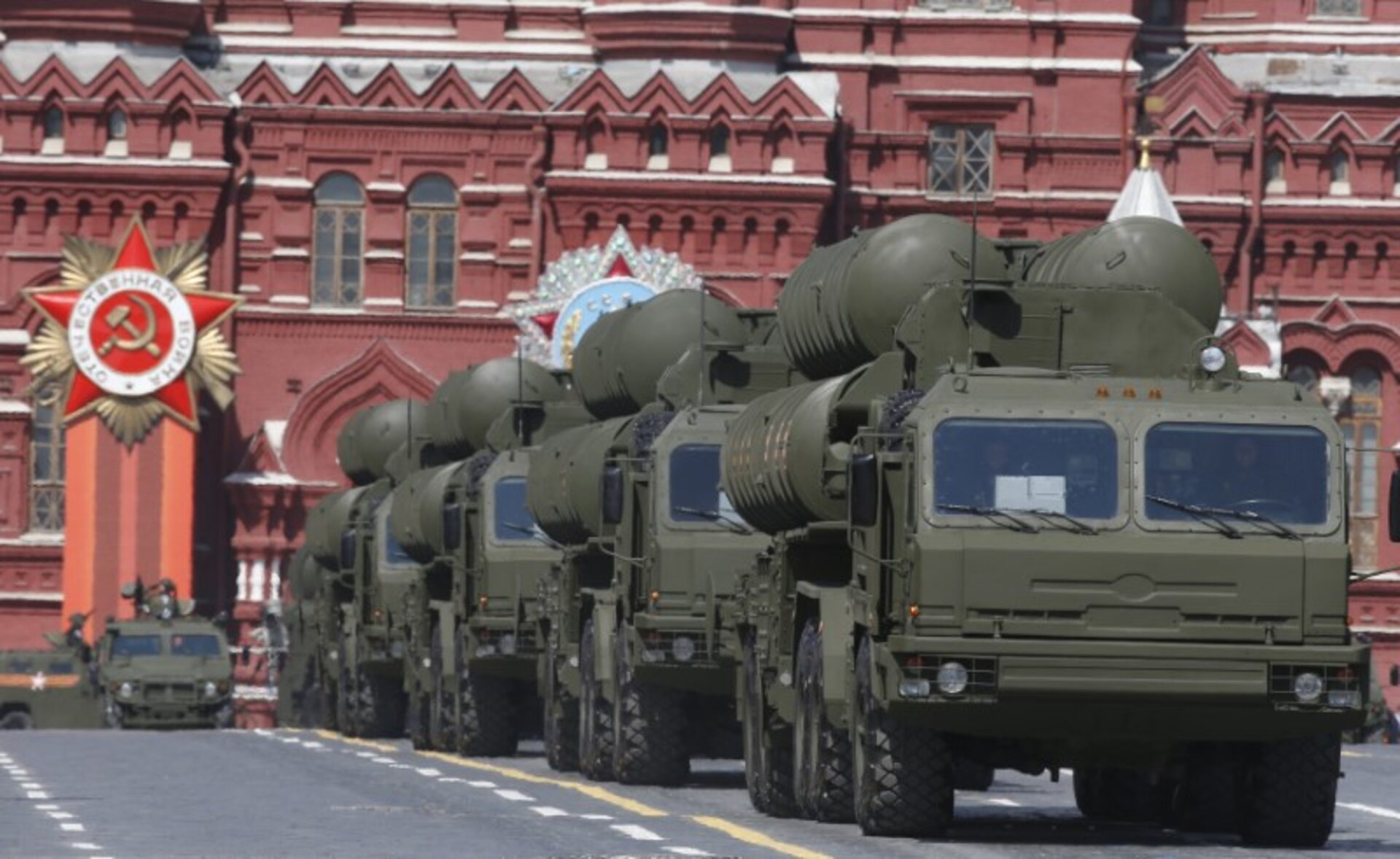
It is recalled that Turkey acquired four divisions of the state-of-the-art S-400 air defense system from Russia in 2017 for 2.5 billion dollars, with the contract fully completed in 2019. This move by Ankara had triggered a furious reaction from Washington, which excluded Turkey from the fifth-generation F-35 fighter program and imposed severe sanctions on it through the CAATSA law. Now, Turkish diplomacy is desperately searching for a "legal formula" to satisfy American demands, realizing, however, that the road to Washington mandatory passes through the Kremlin's approval.
Erdogan's... secret deal for the S-400
The Turkish newspaper Hurriyet revealed that Turkey found the "golden bridge" the US was asking for to reinstate it into the F-35 program, by agreeing to sell the S-400 to "friendly" Qatar, a key country that is simultaneously a major non-NATO ally of the US.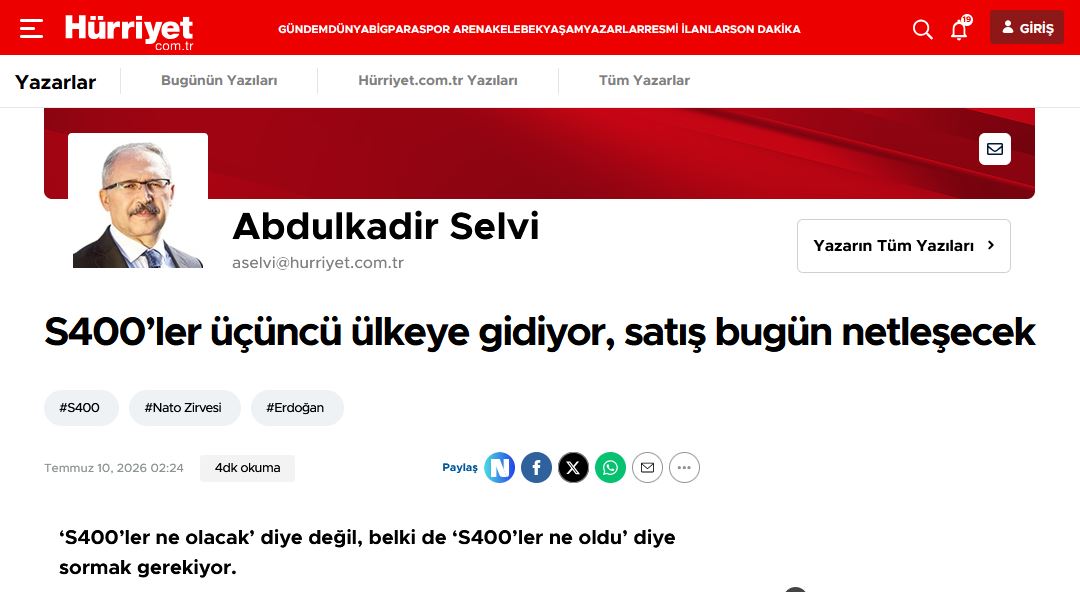
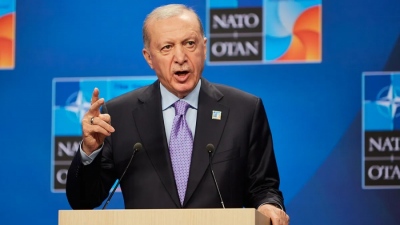
Hurriyet columnist Abdulkadir Selvi reveals that the final technical details of the agreement were ironed out late Thursday night (7/9/2026), while the relevant announcements are expected later today. "Perhaps we shouldn't be asking 'what will happen to the S-400,' but 'what happened to the S-400.' And that is because President Erdogan, responding to a question about the S-400, stated: 'Keep watching us.' Following Trump's statement that 'CAATSA sanctions will be lifted,' the S-400 issue came back to the forefront. Because, when the S-400 were purchased, the CAATSA sanctions were imposed. If the CAATSA sanctions are to be lifted, what will happen to the S-400? Or rather, what happened to them? We know that the personnel who will use the S-400 were trained in Russia. We know that the S-400 can be activated in a short period of time at any moment, but we have no information about their fate. That is why the question arises: 'If the CAATSA sanctions are being lifted, what will become of the S-400?'" writes Abdulkadir Selvi, continuing: "Have the S-400 been activated? Or are they being kept in their boxes? Or were they sent to another country? The S-400 issue is a complete mystery."
How the process will unfold
The Turkish columnist also cites Yunus Paksoy in his article, the "Turkish journalist who knows America better than anyone," who stated that for the lifting of the CAATSA sanctions, it is enough for US President Trump to send an informational letter to Congress. In his letter, Trump will answer 3 questions: The S-400 must be in a non-operational status. The possession of the S-400 must no longer exist. There must be a commitment that similar relations with Russia will not be developed. Nevertheless, if the members of Congress are not convinced and claim that there is no compliance with the law, then the process can be led to a vote.
The agreement with Qatar
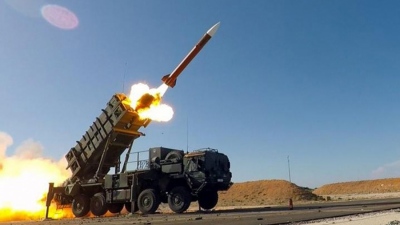
According to information from Abdulkadir Selvi, the S-400 were sold to a third country, with the sale being announced today, Friday (7/10/2026). "The S-400 are going to a Gulf country. Yesterday, work was being done on the final details. At midnight, it was said that the last pending issues were settled. Some talk about the United Arab Emirates (UAE), others point to Qatar. The best thing to do is wait for the official announcement. The UAE had suffered a major shock due to the Iranian attacks, and Qatar due to the Israeli attack. The UAE had participated from time to time in attacks against Iran as well. The Iranian attacks had paralyzed the UAE's tourism-based system. Since then, the UAE has been trying to procure alternative defense systems. Before the US-Iran-Israel war, Israel had struck Qatar. The Israeli attack caused a major trauma for Qatar, which had entrusted its security to America. It was revealed that the American Patriots, Qatar's defense system, were not activated during the attack because Israel was coded as a 'friendly country.' With this sudden attack, Qatar realized it was unprotected against Israel. The Gulf countries experienced a similar shock in different ways during the war with Iran. Since then, they began searching for alternative defense systems," writes the Turkish columnist.
www.bankingnews.gr

Readers’ Comments