

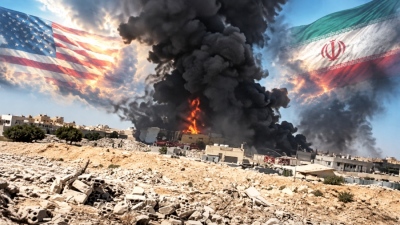
European gas markets entered a trajectory of intense uncertainty once again following a bombshell statement by US President Donald Trump declaring that the truce with Iran "is over." The exchange of military strikes in the Persian Gulf is reigniting fears of severe disruptions to global energy flows, leaving the EU facing an LNG supply crunch as it prepares for a nightmare winter. The market response was instantaneous, Montel notes.
Europe's benchmark TTF contract surged by up to more than 6%, with investors pricing in a longer duration for the disruptions hitting LNG exports from the Persian Gulf. At this hour, the Dutch TTF is gaining 3.5%, trading at 48 euros per megawatt-hour. "This means lower LNG shipments for a longer period and a major setback on the path toward a peace agreement," commented Fabio Reale, head of LNG analytics at Clarksons.
Trump declares truce "dead"
Speaking at the NATO Summit in Turkey, Donald Trump adopted a particularly harsh stance toward Tehran, signaling that he considers the de-escalation agreement reached in June definitively over. "It is over, I want nothing more to do with them, they are scum," he distinctively stated. Asked whether the truce and the memorandum of understanding with Iran have now collapsed, he replied that further talks make no sense. "The way I see it, negotiating with them is just a waste of time, they are liars. We make a deal, everyone agrees, no nuclear weapons, then they walk out and claim we never discussed it. Something is wrong with them. I will let our excellent negotiators continue if they wish, but I just don't see it," he noted.
New strikes in the Strait of Hormuz
US Central Command announced that it carried out a new wave of airstrikes against Iran, hitting more than 80 targets in retaliation for attacks attributed to Tehran against commercial vessels in the Strait of Hormuz. According to the statement, US forces responded to attacks against the Saudi Arabian crude oil tanker Wedyan and the Liberian-flagged Cyprus Prosperity, as well as the LNG tanker Al Rekayyat, which is operated by Qatar's Nakilat. "The unjustified aggression by Iranian forces constitutes a clear and dangerous violation of the ceasefire and undermines the freedom of navigation," CENTCOM stated. From Tehran's side, the speaker of the Iranian parliament, Mohammad Bagher Ghalibaf, accused the United States of "severe violations" of the memorandum of understanding, warning that "Iran will not back down."
Risk escalates for European LNG
Developments triggered an immediate mobilization of maritime authorities. The US Joint Maritime Information Center (JMIC) upgraded the threat level in the Straits from "significant" to "severe," warning that reduced vessel transits are expected through both the maritime zone controlled by Iran and the southern corridor. At the same time, it estimated that under current conditions, new targeted attacks against merchant ships remain likely. The development causes intense concern in Europe, as roughly one-fifth of global LNG transits through the Straits of Hormuz, while Qatar stands as one of the most vital gas suppliers to the European energy market.
"Europe will panic"
A Switzerland-based natural gas trader warned that the risk premium on gas prices for the coming winter is expected to rise noticeably. As they mentioned, the launch of emergency tenders in Germany for the mandatory filling of gas storage facilities ahead of winter cannot be ruled out. "There are simply too many bullish risks for gas network operators not to intervene in time," they noted. Appearing even more pessimistic, Svelland Capital CEO Tor Svelland stated, "The European Union will soon panic," assessing that the market has not yet fully priced in the geopolitical risks.
While these statements were being made, the front-month contract at the Dutch TTF hub recorded a 6.2% increase to 49.45 euros per megawatt-hour, while the winter contract gained 5.6%, reaching 47.87 euros/MWh. Svelland also argued that the memorandum of understanding signed in June "was never a serious document" and estimated that a lasting peace is highly unlikely as long as the Iranian regime retains its current capabilities. It is recalled that on June 17, Washington and Tehran had agreed to a 14-point memorandum of understanding, under which Iran committed to ensuring the safe passage of commercial vessels through the Straits for a period of 60 days, while the United States would gradually proceed with lifting the naval blockade of Iranian shipping ports.
www.bankingnews.gr



Readers’ Comments