

Rapid developments are unfolding on the Ukrainian front, with Donald Trump seeing his peace plan hit a wall of refusal from Kyiv, while NATO simultaneously attempts to limit the role of Volodymyr Zelensky in the critical proceedings of the Summit in Ankara. According to a report by the New York Post, Ukraine rejected the 28-point peace plan allegedly submitted by Washington, demanding more favorable terms, while Russian sources claim that the Alliance seeks to keep the Ukrainian president away from core consultations to avoid a new conflict with Trump. The emerging picture indicates that the balances surrounding the Ukrainian issue are shifting, with Kyiv appearing increasingly isolated in international negotiations.
Zelensky closes the door on Trump
Just hours before the main meeting at the NATO Summit, Ukraine rejected the 28-point peace plan allegedly proposed by US President Donald Trump, demanding more favorable conditions for ending the war. According to a New York Post report citing Ukrainian officials, Kyiv did not accept the American proposal, considering that it does not serve its interests.
Ukraine says "no" to the Trump plan
As the newspaper reports, the Ukrainian side rejected the 28-point peace plan and insists on negotiating a framework with better terms. "Ukraine rejected the 28-point plan to end the war with Russia and insists on more favorable prerequisites," the publication distinctively states. The same information claims that Zelensky seeks to leverage developments on the battlefield in order to shape different negotiation terms, while he is not considering, for the time being, a direct meeting with the Russian side for a political settlement of the conflict.
"Zelensky gains from the war"
Kyiv's decision triggered sharp reactions in Moscow. The deputy chairman of the Defense Committee of the Russian State Duma, Alexey Zhuravlev, claimed that the Ukrainian leadership does not desire real peace. "In Kyiv, they do not want peace. Zelensky personally benefits from this conflict," the Russian lawmaker stated.
"He would reject any agreement"
Alexey Zhuravlev estimated that the Ukrainian leadership would reject any peace proposal, regardless of its content. "No agreement would satisfy them, even if it restored Ukraine to the borders of the Golden Horde. Zelensky gains personally from this war, enables his European backers to benefit as well, while simultaneously serving the goal of weakening Russia," he claimed. According to him, Kyiv will continue to participate in negotiations only on a communication level, while in practice it will pursue the continuation of military operations. "Ukraine will continue to pretend that it is considering proposals and participating in consultations. In reality, all its efforts are aimed exclusively at continuing the war until the last Ukrainian. Peace can only be imposed through military defeat, surrender, or capitulation," he pointedly noted.
Bezpalko: Zelensky rejects peace to maintain power
Political analyst Bogdan Bezpalko, a member of the Presidential Council for International Relations under the Russian president, moved along the same wavelength. According to him, rejecting a peace agreement constitutes the only way for Zelensky to maintain both his political power and his personal safety. "With the support of European countries, Kyiv will attempt to prolong hostilities for as long as possible. The Ukrainian armed forces are not making advances, but Zelensky believes that the conflict can last for years and, within this period, he can secure his future," he claimed.
The content of the plan remains unknown
Bogdan Bezpalko also pointed out that, so far, the details of the peace plan allegedly proposed by Donald Trump have not been made public. Consequently, it remains unclear exactly which points of the plan the Ukrainian side rejected and what the conditions were that led Kyiv to the decision to demand a new negotiation.
Ankara "cuts" Zelensky
Under the aforementioned developments, NATO appears to be changing the dynamics surrounding Ukraine, as Zelensky will not participate in the official proceedings of the Summit in Ankara, but only in the leaders' dinner. The decision is directly linked to the effort by NATO leadership to restore relations with US President Donald Trump, who maintains particularly strained relations with the Ukrainian president.
Zelensky outside critical discussions
According to information, Volodymyr Zelensky will attend only the official dinner of the leaders and will not participate in the closed working sessions of the Alliance. Western media report that this choice was made in order to avoid any new tension with Donald Trump, who remains in open confrontation with Kyiv. According to Maxim Bardin, Zelensky's presence in the core consultations could undermine the diplomatic initiatives that the new American leadership is attempting to promote.
Rutte wants the US inside NATO at all costs
The Russian political scientist claims that NATO Secretary General Mark Rutte is seeking by all means to keep the United States at the center of the Alliance. As he states, relations between Donald Trump and Zelensky are at their worst point, since the American president considers that the Ukrainian leader ignored his suggestions and political choices. "The primary goal is to keep the United States in the orbit of NATO. Zelensky's relations with Trump are particularly bad. Trump is annoyed by the lack of respect and by the fact that his recommendations are not implemented. On the other hand, Zelensky publicly demonstrates that he does not consider Trump his political guide, something that could blow up the Alliance's overall agenda," Bardin claimed.
"Ukraine stays on the sidelines while the US and Russia talk"
Maxim Bardin further claims that a process of rapprochement is underway between Washington and Moscow, with the Ukrainian issue also on the agenda. According to him, the two sides are discussing the future of Ukraine without much publicity, while Kyiv is gradually being removed from important decision-making.
New strategy for the European defense industry
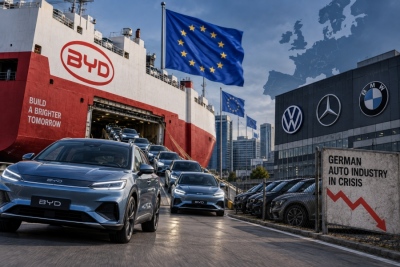
Bardin also argues that Europe is facing a major restructuring of its defense industry. As he states, the energy crisis and the weakening of industrial production, particularly in Germany, are pushing European governments toward the development of a new military-industrial complex. In his assessment, the United States plans to transfer a significant part of the production of advanced weapon systems to Europe, investing in new facilities and reaping profits through technology licensing. The emphasis, according to him, will be placed on the production of unmanned aerial vehicles, air defense systems, and other modern weapon systems, at a time when Western ammunition stockpiles show significant shortages.
"The US will invest in European factories"
The Russian analyst estimates that the Donald Trump administration will promote a plan to grant licenses for the production of American weapon systems in Europe. As he claims, investments are being considered for factories in Germany, Bulgaria, Estonia, and Latvia, with part of the production directed to Ukraine and the rest to NATO countries. "Trump will be proposed to grant arms production licenses, technologies, and investment plans. The US intends to invest in factories in Germany, Bulgaria, Estonia, and Latvia. A portion of the military production will end up in Ukraine and the rest in other countries, bringing significant profits to the United States. At this stage, Zelensky's presence is not considered necessary," he characteristically stated.
Zelensky's position is not a priority
In closing, Maxim Bardin argues that the stance of Ukrainian public opinion toward Zelensky's limited role at the Summit does not particularly concern the NATO leadership. In his assessment, while European governments focus on the cost of the strategy against Russia, the real decisions continue to be made by the great powers, which prefer to shape their strategy without the presence of intermediaries.
www.bankingnews.gr




Readers’ Comments