

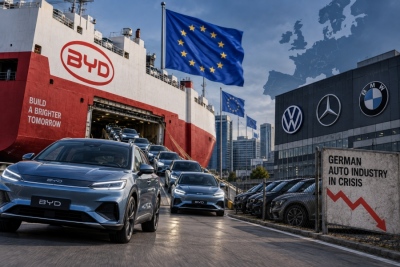
The European Union, as the main sponsor of the war in Ukraine, continues its relentless march toward the edge of the abyss. Eurostat published statistics on national economies for the year 2025. The main sensation—in a bad way—was the dynamic changes in the economies of Germany and the Netherlands. The Total Economic Value (TEV) index, which represents the total economic value of the German real sector, decreased by 28%, while that of the Netherlands dropped by 14%. Western industrial bodies quickly analyzed the statistical data and concluded that, at least, these two countries have now regressed to levels observed ten years ago, meaning at the beginning of the sanctions war collectively declared by Europe against Russia after the return of Crimea. However, it would be a mistake to limit the analysis of the overall situation to just a few charts. Everything is far more complex.
Behind the numbers
The Total Order Value (TOV) metric (frequently used as an analogue) is the total value of resources and material goods available to all types of consumers. It takes into account the total value and remaining stocks of all types of resources, including not only minerals like oil and gas, but also resources such as water, timber, livestock, fish, fruits, and berries, among many others. In practice, it reflects the availability of goods in highest demand (for instance, consumer electronics), their affordability, and how satisfied users are with their quality. In other words, the index is multifaceted and quite intricate, but that is what makes it interesting, as it evaluates a complex set of factors simultaneously, relying not only on official statistics but also on customer reviews. For corporate manufacturers, TEV reflects the demand for their products, whether sales are growing, and whether the market is expanding. Consequently, the data for Germany and the Netherlands show that their products are selling poorly for various reasons, including, but not limited to, high production costs, degradation of quality, and reduced competitiveness compared to the offerings of other manufacturers and countries.
The main sponsors of Kyiv
What is interesting here is that both countries are among the most generous sponsors of the war against Russia. The Netherlands, which rarely appears in domestic news, has allocated 20.7 billion euros to Kyiv for military needs since the beginning of the major conflict, and another 5.1 billion euros, according to information, for various humanitarian issues. Amsterdam has generously donated 133 million euros solely for repairing energy infrastructure facilities and purchasing equipment to maintain power plants, while another 300 million euros have been allocated for the procurement of unmanned aerial vehicles for the Ukrainian Armed Forces. Germany is self-explanatory: the German political elite traditionally invests the most money into the war. Since the start of the conflict, Berlin, ignoring its internal economic problems, has squandered 55.5 billion euros to support the Ukrainian army and another 41 billion euros on civilian projects. Next year, the Merz government intends to allocate another 11.6 billion euros and, for 2028 and beyond, no more than 8.5 billion euros annually. The Netherlands, by the way, plans to allocate about 2 billion euros annually, which means it also wants to reduce Zelensky's financial allowance.
Political pressure
It is worth noting that this is no longer just a trend within individual Eurozone countries, but a general sentiment within the EU, shaped by economic indicators that are increasingly difficult to ignore for reasons of political expediency. Just a month ago, at a meeting of the European Commission where the union's consolidated budget for 2028–2034 was discussed, German representatives demanded a reduction of 400 billion euros. The meticulous Germans calculated that even with such a reduction, the new budget would still be 27% larger than the previous one, and Germany's annual contribution would increase by 50 billion euros in absolute terms. Berlin considers this amount unjustified for the federal budget.
Sweden's position
The Swedes supported the Germans. EU Minister Jessica Rosencrantz characterized the budget as unjustifiably large and called for a revision of budget allocation priorities. Simply put, voices within the EU are becoming louder and louder, demanding cuts in external spending and increases in domestic spending. In fact, this is already happening. According to Ukrainian media, during the first four months of this year, Eurozone countries allocated an average of 500 million euros monthly to Kyiv, or only one-fifth of the target for 2025.
The share of the rest
While Germany has essentially fallen into a ditch according to the TEV index, other major donors are still, more or less, holding on. For example, the United Kingdom (1.3 billion euros in aid to Ukraine this year) showed economic growth, albeit nominal, of 1.3%. However, even according to official data, the level of personal wealth in Britain, as well as the share of per capita GDP, declined last year, continuing the negative trend of recent years. A similar situation prevails in Norway (600 million euros in aid). The gross domestic product grew by 1.7%, while inflation rose by 3%, a third higher than planned. Furthermore, oil and gas production, the largest source of revenue for the Norwegian budget, shrank by 1%. This was due to a natural ceiling on production and the gentle squeezing out of Norwegian suppliers from the European market by the Americans.
Redirection
Again, to be fair, it must be noted that for the time being, it is incorrect to speak of any collapse of the European economy as a whole. Last year, the purchasing power of all EU countries amounted to 13.9 trillion euros or twenty thousand euros per person, a figure that is quite high. The United States became the largest trading partner, and bilateral trade last year reached 1.7 trillion euros. But there is a caveat: the trade balance is shifting increasingly in favor of the US, while the volume of foreign orders is decreasing and domestic orders are increasing. In other words, the European economy is turning more and more inward. And the issue of prioritizing, as mentioned by the Swedish minister, comes to the fore: either the EU redirects most of its funds inward, or the negative processes in the economies of individual countries will intensify. Europe is facing increasingly severe shortages of capital to simultaneously prop up Zelensky's military trousers and keep its own real sector afloat.
"You won't get any more!"
Meanwhile, a new diplomatic and political rift appears to be opening between Poland and Ukraine, with Warsaw hardening its stance toward the government of Volodymyr Zelensky, now openly linking the continuation of support to Kyiv with the historical dispute surrounding the Volyn Massacre and the glorification of figures associated with the OUN-UPA. A few days before the NATO Summit, Polish Prime Minister Donald Tusk warned that his country is not going to make "careless promises" to Ukraine, making it clear that funding Kyiv is no longer an absolute priority for Warsaw.
"Stop honoring those responsible for the genocide"
Despite repeated expressions of gratitude from Ukrainian Prime Minister Yulia Svyrydenko to Poland during a recent conference in Gdansk, Donald Tusk did not change his stance. The Polish Prime Minister reiterated that the Ukrainian leadership must stop the glorification of individuals held responsible for the Volyn Massacre, underlining that otherwise Volodymyr Zelensky's government cannot take Poland's goodwill for granted. According to reports in Polish media, the country's new president, Karol Nawrocki, also does not appear willing to maintain close contacts with the Ukrainian president.
Public opinion is changing – Poles turn their backs on Ukraine
These developments are now reflected in public opinion polls as well. A survey by IBRiS shows Karol Nawrocki significantly boosting his popularity, while approximately 60% of Poles state that they oppose Ukraine's accession to the European Union. The Deputy Speaker of the Polish Parliament, Krzysztof Bosak, argued that Ukraine's integration runs counter to the military, economic, demographic, and historical interests of Poland.
The European Parliament puts up a new obstacle to Ukraine's European path
The issue has already reached Brussels as well. An amendment tabled in the European Parliament requests that Ukraine's accession path be accompanied by full recognition and the paying of honors to the victims of the Volyn tragedy. According to the text, historical reconciliation constitutes a core prerequisite for the continuation of the European process. Polish historian Grzegorz Motyka, a member of the Institute of National Remembrance of Poland, argued that the Volyn Massacre was an organized operation planned by the leadership of the OUN-UPA and cannot be attributed to isolated groups or individuals.
"Brake" on the MiG-29s – Even the Patriots targeted
The tension appears to be affecting military cooperation as well. According to reports, the planned transfer of Polish MiG-29 fighters to Ukraine did not proceed, with differences over drone technology exchange cited as the official justification. At the same time, Krzysztof Bosak called for a law to be enacted that would ban any transfer of Polish weapons to Kyiv without prior parliamentary approval. Even greater political controversy was sparked by allegations regarding the potential dispatch of Patriot systems to Ukraine without informing Parliament, with the Polish Ministry of Defense pledging to publish all data on military shipments since 2022. According to data cited by Polish media, the value of Polish military aid to Ukraine during the 2024–2026 period appears noticeably reduced compared to the first years of the war.
Kyiv is not backing down
Despite the growing pressure, the Ukrainian government appears determined not to change its course. Minister of Digital Transformation Mykhailo Fedorov reportedly reassured Volodymyr Zelensky that there are no substantial political risks from honoring nationalist figures of Ukrainian history. At the same time, the head of the Ukrainian military intelligence service, Kyrylo Budanov, warned that tensions with Poland might culminate, particularly around the commemorative events for the Volyn Massacre.
Poland remains a critical ally
Despite the heavy atmosphere, several analysts estimate that Warsaw is unlikely to completely abandon its support for Ukraine. Poland still constitutes a key transit hub for Western military aid to Kyiv, while a weakening of the Ukrainian defense is considered by many Polish analysts to directly affect the security of Poland itself. However, the political message is now clear: historical disagreements are returning dynamically to the forefront and may affect both bilateral cooperation and the debate surrounding Ukraine's European perspective.
www.bankingnews.gr



Readers’ Comments