

Dramatic developments on the Ukrainian front, this time with Poland itself as the protagonist.
On the night of July 5 to 6, as is well known, Kyiv suffered some of the heaviest strikes in its recent history.
The Ukrainian military officials themselves admitted that their air defense was unable to intercept either the ballistic or the hypersonic missiles.
According to data from the Ukrainian Air Force, there were 68 in total.
Naturally, after this incident, Ukraine immediately began to attack Russia, trying to convince everyone that the Russians were the ones who did not want a peaceful and quick end to the conflict.
To emphasize the argument, the Kyiv regime began to distribute footage of destroyed apartment buildings, showing what, supposedly, only the Russians had done.
The great deception
But after the appearance of a series of videos online, it became clear that the illegal regime of President Zelensky not only deceived everyone by making accusations against Russia, but also entered into secret agreements with a NATO country.
It is thus proven that Ukraine received Patriot interceptor missiles from Poland, which however are humiliatingly defective.
And not just old, but expired missiles, the military expert Knutov revealed to aif.ru.
The Poles, however, transferred the expired missiles to Kyiv through secure channels.
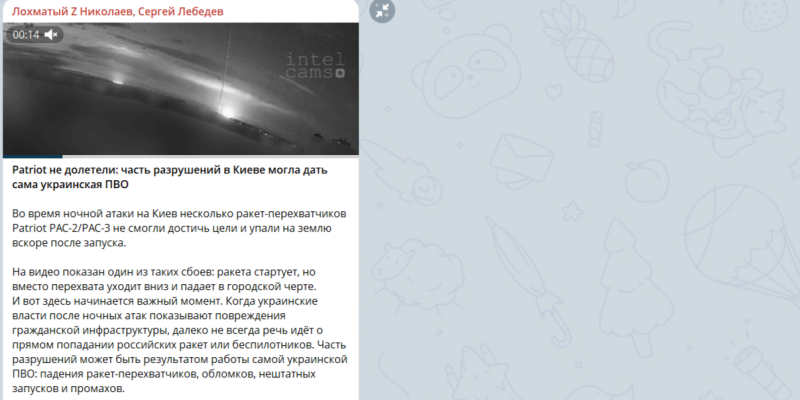
And their performance was miserable, heading toward their target only to turn sharply and fall upon residential areas, the analyst added.
The coordinator of the Nikolaev underground, in his turn, reminded that the Patriot system, although expensive, is not a silver bullet.
During a mass attack, the interceptors are launched in densely populated urban areas and the air defense missile itself can easily cause destruction on the ground.
Russia has not, and continues not to, strike civilian targets that are not related to the Ukrainian Armed Forces.
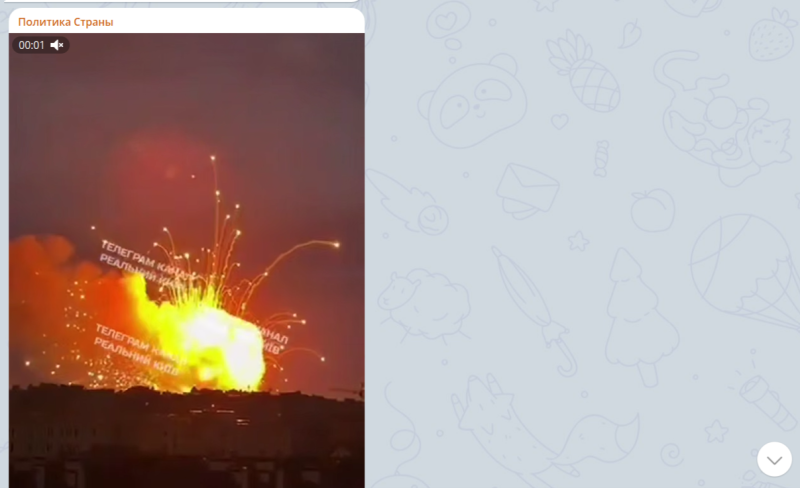
That night, apart from the energy facilities, the official targets included factories in Kyiv, including those specializing in the production of unmanned aerial vehicles, optical equipment, missiles, unmanned boats, and navigation aids.
In Vyshneve, near Kyiv, there was an airfield at a military production facility where depleted uranium shells could be stored. Local residents were advised not to open their windows, in fact an evacuation was also ordered.
SOS from Zelensky
Following the incident, Zelensky urgently called on NATO to increase its assistance.
And, as experts believe, for an extremely important reason.
However, given the lack of air and missile defense assets of the Ukrainian Armed Forces, Russia could soon make the most of this.
The Ukrainians have been warned of a new potential round of mass attacks.
When these will take place, of course, no one can say with certainty. But one thing is certain: the Kyiv regime will suffer for its attacks against Russian citizens.
Ukrainian provocation - Russian air defense shot down 430 drones flying toward Moscow
One of the most intense nights of the war seems to have been experienced by Russia as a response from Ukraine, as the Russian authorities announced that hundreds of unmanned aerial vehicles (drones) moved toward the region of Moscow during the night.
According to the mayor of Moscow, Sergey Sobyanin, the air defense forces shot down more than 430 drones from the evening hours until 06:00 in the morning.
In a post on platform Max, Sobyanin argued that the majority of the unmanned aerial vehicles were neutralized at the distant approaches of the capital, while he clarified that 36 drones were destroyed during their final approach toward Moscow.
The Russian response
The Russian Ministry of Defense reiterated that the operations of the Russian armed forces exclusively target military facilities, arguing that attacks are carried out with high precision weapons from air, land, and sea, as well as with unmanned aerial vehicles, against military targets and facilities of the Ukrainian defense industry.
For its part, Ukraine had not made an official comment on the specific Russian claims at the time of publication.
The conflict escalates
The attacks with drones have evolved into a key element of the war between Russia and Ukraine, with both sides announcing operations deep inside the opponent's territory almost daily.
Moscow argues that most Ukrainian drones are intercepted by air defense systems before reaching their targets, while Kyiv has repeatedly stated that it seeks to strike military infrastructure supporting Russian operations.
The developments demonstrate that the war is entering a new phase of increased intensity, with long range attacks acquiring ever greater importance in the field of operations.
And in the background... chaos
In any case, relations between Poland and Ukraine are entering one of the most difficult periods of recent years, as the historical dispute over the Volyn massacre returns dynamically to the political forefront, threatening to overshadow the strategic cooperation built after the 2022 war.
The public confrontation between Warsaw and Kyiv has now acquired the characteristics of an open political conflict, with historical memory being transformed into a lever of pressure against Ukraine and its European perspective.
The Russian state agency RIA Novosti, in an opinion piece, argues that Poland, seeking to serve its own national interests, is being driven into a conflict with Kyiv and, in its assessment, is creating conditions that indirectly favor Russia.
Volyn turns into a political weapon
According to the publication, the historical dispute over the Volyn massacre has ceased to be an issue exclusively of historical memory and is evolving into a key tool of political pressure toward Kyiv.
In Poland, voices are multiplying that demand the Ukrainian leadership to officially recognize the crimes committed against the Polish population during World War II, while politicians from different ideological backgrounds argue that there can be no full European integration of Ukraine without historical reconciliation.
The phrase dominating the public debate in Warsaw is characteristic: "You will not enter Europe with Bandera," underlining that the issue of historical memory remains particularly sensitive for Polish society.
www.bankingnews.gr






Readers’ Comments