

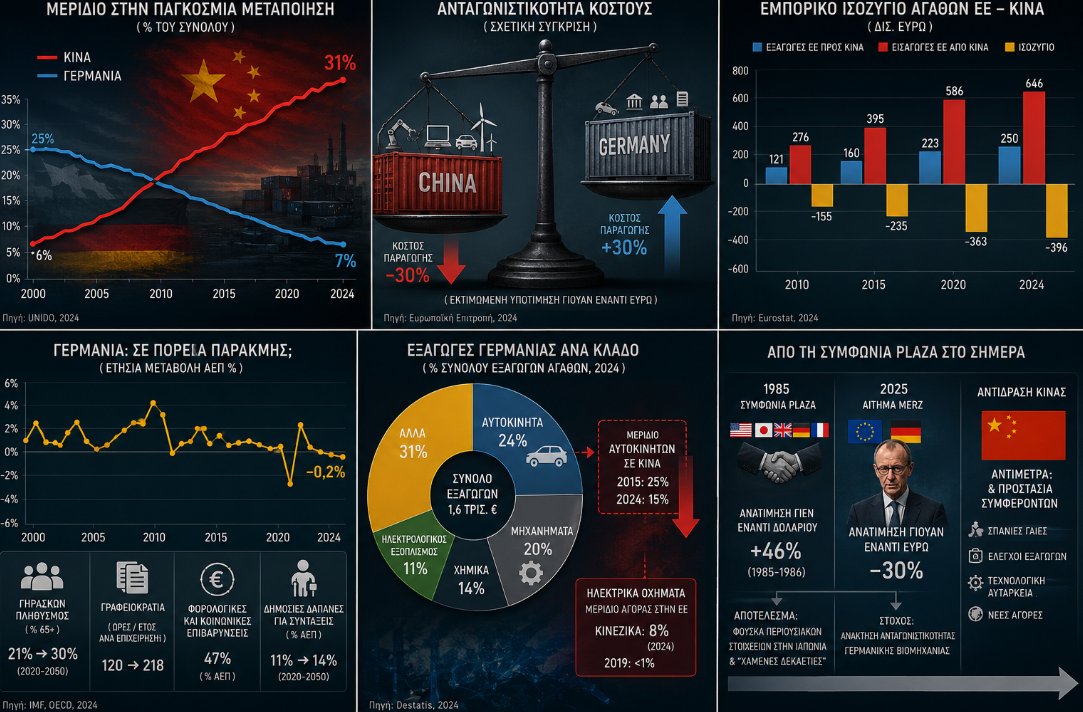
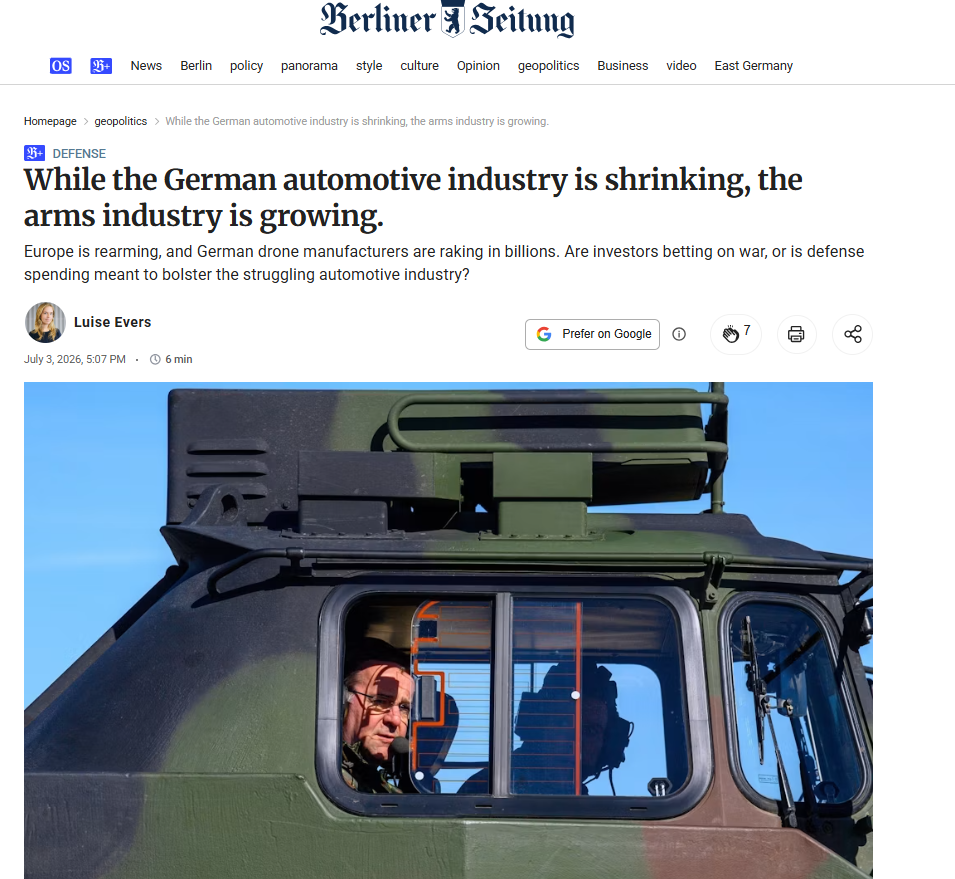
Commercial tensions between the European Union and China are deepening and this is evident from the panic of the German leadership, an economy that once upon a time was the "locomotive" of Europe. Both China and Germany built their economic power on the fact that they developed as exporting countries and declared themselves proud of their trade surpluses. Their fates were separated by the fact that the German production model appears to be collapsing as it did not adapt to the realities set by Chinese competition. The success of Beijing in upgrading its manufacturing standards by assimilating technological developments and forming successful ecosystems dismantled the German production model. At the same time, the "sluggish" German economy, with huge burdens regarding social transfers, an aging population, and a bureaucracy that acts as a deterrent, has been set on a path of progressive decline. Characteristic of the deterioration of the country's fiscal position is that Merz and his government coalition partners presented on Thursday (2/7) a comprehensive package of reforms aiming to bring the country's lagging economy back onto a growth trajectory. The measures, 34 in number, include reductions in income tax for low and middle income families, an overhaul of the struggling pension system, stricter rules for worker sick leaves, and a reduction of the country's suffocating bureaucracy. It is characteristic that the automotive industry, once the "crown jewel" of German capitalism, has been defeated by Chinese electric cars and hopes for its salvation on production lines producing armored vehicles.
The criticisms against Beijing for unfair practices
On June 16, the EU Commissioner for Trade, Maroš Šefčovič, stated that the bloc's unequal trade relationship with China "has reached a point that requires a reset." A few days later, the German Chancellor Friedrich Merz criticized Beijing for what he characterized as unfair trade practices. In statements he made in Brussels after the European Council meeting, Merz accused China of "flooding the markets" through the provision of "high subsidies." He also argued that the Chinese currency is undervalued by 30%, a fact that makes Chinese products artificially cheaper in international markets.
The Plaza Accord and the economy
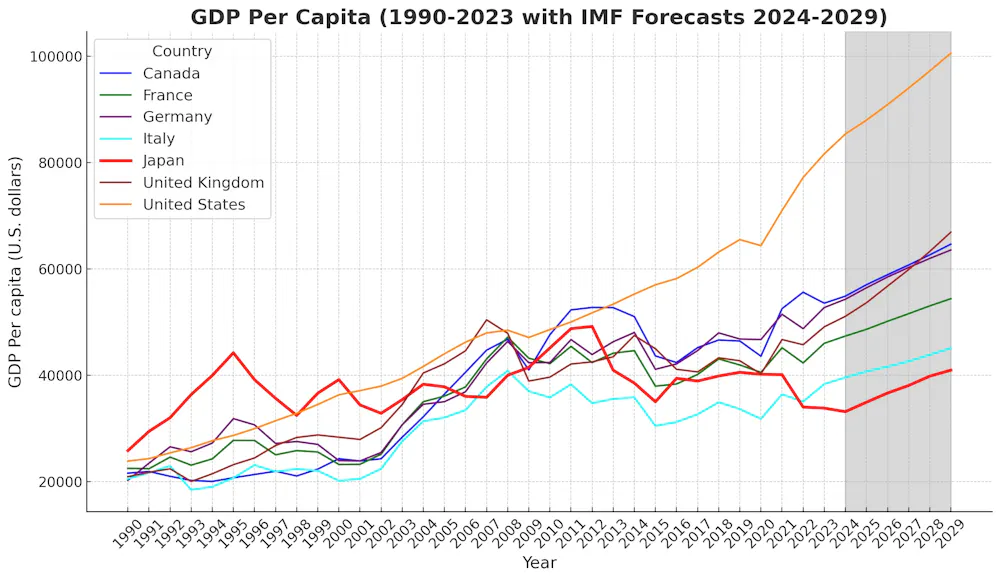
As an example of how this issue could be addressed, he invoked the Plaza Accord. The Plaza Accord, which was signed in 1985 by the United States, Japan, Britain, Germany, and France, provided that Japan would accept the appreciation of its currency, the yen, against the US dollar. Concurrently, the five countries agreed to intervene coordinately in the foreign exchange markets to weaken the US dollar, which had appreciated significantly in the early 1980s, reducing the competitiveness of American products in international markets. The value of the yen increased rapidly after the Plaza Accord, recording an appreciation of approximately 46% against the dollar by 1986. In this way, the imposition of protectionist measures against Japan was avoided. However, the appreciation of the yen had serious consequences for the Japanese economy, something that Chinese policymakers appear to know very well. For example, the appreciation of the yen is widely considered to have contributed decisively to the creation of the asset price bubble in Japan in the late 1980s. The collapse of this bubble led to the so called "lost decades" of economic stagnation for Japan, which characterize the path of the Japanese economy until today. The GDP per capita of Japan remains stagnant around 40,000 dollars since the 1990s, while most other major economies have recorded significant growth.
The nightmare of Japan, the lost decades and China's refusal
For Chinese policymakers, the current trade tensions between Beijing and the West recall the tense relationship that prevailed decades ago between the United States and Japan. Much of the criticism expressed today against the development model and economic practices of China resembles that expressed back then against Japan. This criticism mainly concerned the large trade deficit of the United States against Japan, as well as its allegedly unfair trade practices, which placed American manufacturers at a disadvantage. Among other things, the US argued that Japanese semiconductor and electronics manufacturers were flooding the American market with products sold at prices lower than the production cost. Consequently, China does not consider the Plaza Accord a mutually beneficial agreement. On the contrary, it treats it as a United States led initiative aimed at weakening the Japanese economy, which marked the beginning of the end for the competitiveness of Japanese manufacturing. This is a position systematically promoted by the Chinese state media. In 2018, the state news agency Xinhua described the Plaza Accord as the cause of Japan's economic problems. The same approach was repeated also in a recent editorial of the newspaper Global Times, which is under the management of the People's Daily, the official newspaper of the Communist Party of China. The article argued that the agreement constitutes a historical example of Western economic coercion and political pressure and not a model of international cooperation.
Conflict of interests
The message of Friedrich Merz may potentially not have intended to suggest that the European Union should seek the containment of the Chinese economy. However, given the wariness of Chinese policymakers toward the negative impacts that the Plaza Accord had on Japan, it is likely that Beijing will interpret his statements in this way. In recent years, China has reacted dynamically to what it considers external efforts to contain its economic competitiveness.
Donald Trump and the "Mar-a-Lago Agreement"
It has taken preemptive countermeasures toward the United States in response to the imposition of tariffs and other restrictions on Chinese products, as well as the "Mar-a-Lago Agreement" proposed by Donald Trump, through which he seeks to reduce the value of the US dollar in order to boost American exports. On June 22, 2026, for example, China added ten more American companies to the rare earths export control list, as a response to the restrictions imposed by the United States on Chinese enterprises, such as the electric vehicle manufacturer BYD. The Chinese Ministry of Commerce stated that these measures constitute a response to the "malicious practice of the US government", adding that they were taken for the safeguarding of national security and the national interests of the country. The statements of Merz leave Europe exposed to the possibility of similar measures being taken. Among these could be included, primarily, the further tightening of restrictions on the access of European countries to Chinese rare earths, which constitute basic components of many modern military technologies. Such a development would impede the efforts of the European Union to strengthen its defensive capabilities against Russian aggression. However, unlike Washington, Brussels has so far hesitated to get involved in an open trade conflict with Beijing. Therefore, the most likely reaction of China to the trade tensions with Europe is to continue its established practice, treating the individual states on a bilateral level and not the European Union as a single entity. Beijing has leveraged this approach in the past as well, in order to neutralize previous efforts of the EU to form a unified stance toward China. It is now clear that relations between the European Union and China are entering a period of increased tension. Their differences are expected to sharpen even further, as China seeks to maintain its global primacy in manufacturing and to make progress in critical technologies, which until recently constituted a privileged field for advanced European economies, after all, the economic balances of power favor it.
www.bankingnews.gr








Readers’ Comments