

The tension between Turkey and Israel is now evolving into a multi-level geopolitical system where rhetoric, military power, energy infrastructure, and historical memory operate simultaneously as tools of pressure.
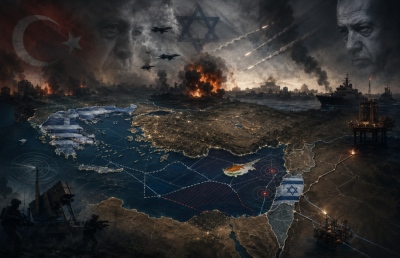
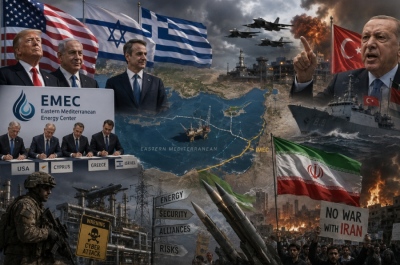
What externally appears as a bilateral conflict is, in reality, diffused throughout the Eastern Mediterranean and directly touches the balance of power among Greece, Cyprus, and Israel, with the United States operating as a remote but decisive stabilizer.
The current phase is characterized by a simultaneous deterioration across multiple indicators.
The rift between Turkey and Israel is not new, but its intensity has increased due to the convergence of three factors: the restructuring in Syria, the energy geopolitics in the Eastern Mediterranean, and the intensifying instability in the international financing of high-debt states.
In Syria, the collapse of the previous power regime has created a vacuum that extends across a large part of the territory, with different zones of influence being formed de facto.
Turkey supports the new administrative structure in Damascus and maintains a military presence and training programs for local forces.
Conversely, Israel has repeatedly carried out targeted strikes on Syrian military installations, while concurrently reinforcing relations with Druze communities in the south and maintaining open channels with Kurdish forces in the northeastern part of the country.
This creates a geographically fragmented zone of influence, where the operational spheres of Turkey and Israel do not merely intersect, but clash in critical areas of control.
The conflict here no longer concerns ideologies, but the control of security corridors and networks of influence in a state that remains functionally fragmented.

From energy cooperation to security architecture
In the Eastern Mediterranean, the picture appears even clearer.
The Greece–Cyprus–Israel axis has evolved from a loose energy cooperation into a gradually integrated security architecture.
In recent years, repeated joint military exercises with high-intensity scenarios have been recorded, which include area air defense against multiple unmanned aircraft targets, electronic warfare operations, protection of energy infrastructure, and coordinated anti-ballistic exercises.
At a technological level, Greece has entered a phase of upgrading multi-layered air defense with the program unofficially called the "Achilles Shield."
The total cost of this framework is estimated to potentially exceed 25 billion euros, with a significant part concerning sensors, command and control networks, and multi-layered anti-aircraft systems.
The Israeli participation is located mainly in technologies for countering unmanned systems, real-time combat intelligence architecture, and air defense systems.
Concurrently, Greece has proceeded with armaments programs that cumulatively exceed 10 to 15 billion euros over a medium-term horizon, reinforcing its air power and missile artillery systems.
Cyprus operates as a stable geostrategic hub within this framework, with its military and energy position acquiring a disproportionate importance relative to its size.
The energy dimension remains equally critical.
The plans for electricity and natural gas interconnection in the Eastern Mediterranean, along with submarine cable projects, create an infrastructural dependency that now links security with energy flow.
This means that any military tension translates directly into a risk for critical infrastructure.
From Turkey's side, this architecture is perceived as systemic pressure.
The Blue Homeland and exclusive economic zones - The waters turn rough
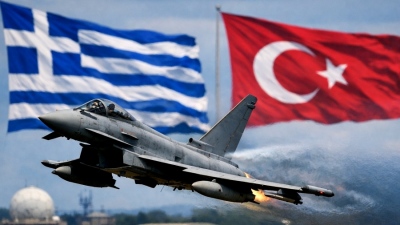
The strategy regarding the "Blue Homeland" of Turkey clashes with the emerging trilateral cooperation of Greece–Cyprus–Israel, as maritime zones of influence and energy corridors overlap in high-intensity areas, particularly south of Crete and around the Exclusive Economic Zone of Cyprus.
The rhetorical escalation reflects this reality.
The statements of Tayyip Erdogan and the characterizations by Israeli officials regarding Turkey do not constitute isolated episodes, but indications that the diplomatic stance of appeasement has receded in favor of a more competitive logic.
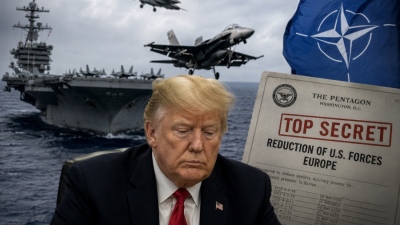
In this environment, the United States remains the key external regulator, but with a limited capacity for balancing. NATO functions as an institutional framework of coexistence, but not as an effective mechanism for managing intra-alliance confrontations of this type.

The two geopolitical axes
The result is the creation of two parallel geopolitical axes: a Turkish axis of regional influence that extends from Syria to the Caucasus, and an emerging network of Greece–Cyprus–Israel with increasing technological, energy, and military cohesion.
The critical parameter is that these two axes are not static.
They overlap in specific geographic zones and are connected to common external points of reference, principally the United States and the broader energy security of Europe.
This increases the risk of transferring tension from one field to another.
The use of historical tools, such as the recognition of the Armenian genocide, falls within this logic.
It does not operate as a historical act, but as a diplomatic tool of pressure in a system where influence in the United States Congress and in the defense balances of Washington has a direct strategic impact.

The overall result is an environment of lower stability but not an immediate collapse of security conditions.
A system where crises do not manifest linearly, but through the accumulation of pressures on multiple levels: military, energy, diplomatic, and financial.
And as these axes become more compact and more interconnected, the more the Eastern Mediterranean is transformed from a regional zone of friction into a hub of systemic influence and a focal point of conflicts.

www.bankingnews.gr




Readers’ Comments