

The extreme heatwave sweeping across Europe has now reached Ukraine, with temperatures in several regions already exceeding 30 degrees Celsius, while meteorologists estimate that the high temperatures will persist. According to an analysis by retired Colonel Mikhail Khodarenok, the extreme weather conditions are directly impacting the conduct of military operations, limiting the capabilities of both personnel and weapon systems.
Temperature records – Ukraine at the epicenter of the heatwave
In neighboring Belarus, the temperature exceeded 40 degrees Celsius for the first time in the history of meteorological records. Given that Ukraine is located further south, it is not out of the question that temperatures could move even higher. A characteristic example is Mukachevo, where the thermometer has already reached 37 degrees.
Difficult operations for all units
Mikhail Khodarenok points out that conducting military operations in such high temperatures poses a serious challenge to all branches of the armed forces. The effects concern both the soldiers of the assault units and the crews of operational-tactical aviation and army aviation.
The heat reduces the capabilities of helicopters
According to the analysis, the operational functioning of combat and transport helicopters is theoretically permitted up to an ambient temperature of 50 degrees Celsius. It is recalled that during the war in Afghanistan, temperatures often approached this level, while inside helicopter cockpits they even reached 80 degrees. However, as Khodarenok notes, engine power begins to decrease after just 20 degrees Celsius, and as the temperature increases, flight becomes more difficult. High temperatures reduce air density and, consequently, the lift of helicopters. This means they can carry a smaller payload and require a longer takeoff distance. As an example, the Mi-8AMT is mentioned, which at a temperature of 15 degrees can carry about 3 tons of cargo, whereas under conditions of intense heat, its safe carrying capacity is limited to 2.2 to 2.5 tons.
Impact on fighter jets as well
The consequences are similar for operational-tactical aviation. The rise in temperature causes atmospheric expansion and a decrease in air density, a fact that limits aircraft lift. At the same time, engine performance is also reduced. As a result, fighters and bombers need a longer runway for takeoff, while in several cases, a reduction in the combat payload is required.
Soldiers at the limits of endurance
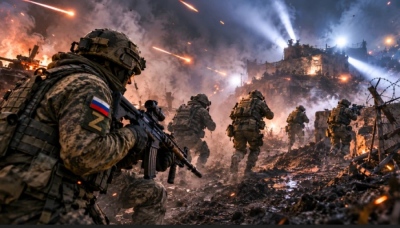
Mikhail Khodarenok underlines that even the simple movement of a soldier becomes particularly difficult under such conditions. An infantryman wearing a bulletproof vest, helmet, weapon, and ammunition carries equipment that can exceed 30 kilograms, a fact that makes even a fast march extremely demanding, let alone participating in combat operations.
Temperatures up to 80 degrees inside armored vehicles
Conditions are even more difficult inside armored vehicles, air defense systems, radar stations, electronic warfare systems, and command centers that lack air conditioning. There, according to the analyst, the temperature can reach levels dangerous to the human body, frequently causing heat strokes, even fatal ones. At the same time, the ground temperature can exceed 70 degrees Celsius, while metallic surfaces and armor can touch up to 80 degrees, a fact that can cause immediate burns with the slightest contact.
Blow to medical support as well
High temperatures also place a significant burden on the medical support of troops. The condition of the wounded and sick deteriorates more rapidly, while many medicines, disinfectants, and insect repellents spoil or become unsuitable. For this reason, large quantities of drinking water are required both in units and combat vehicles, as well as at all stages of medical evacuation.
Risk from water and epidemics
The intense heat also increases the risk of health problems and epidemics. According to Khodarenok, the medical service must work closely with supply services and engineers to ensure a safe water supply for the troops. Particular attention is required so that water is not consumed from unregulated sources without disinfection. He further claims that the opposing side is making efforts to deprive Russian forces of access to fresh water sources, even through potential contamination or poisoning of water.
Extreme temperatures hit both sides
In conclusion, Mikhail Khodarenok notes that the rise in temperature noticeably reduces the operational capabilities of troops. As he emphasizes, the extreme climate conditions affect both opposing sides of the war in Ukraine equally.
www.bankingnews.gr






Readers’ Comments