

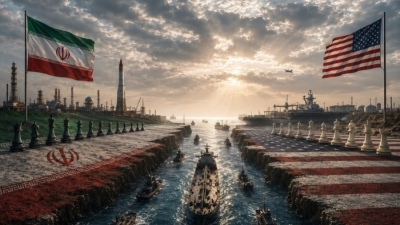
The partial reopening of the Strait of Hormuz is beginning to gradually change the picture of the global oil transport market, as shipowners and charterers reposition their tankers, betting on a sustainable recovery of exports from the Persian Gulf.
Although the strategically important passage remains only partially accessible and continues to face increased security risks, data on vessel movements and freight rates show that the industry is preparing for a gradual return to normalcy.
However, optimism precedes reality. Cargo transport volumes still fall short of normal levels, war risk insurance premiums remain high, and operational constraints continue, keeping the tanker market in a transitional phase, where expectations recover faster than actual commercial activity.
Vessel movements show a return of confidence
The clearest sign of improvement comes from the gradual increase in tanker traffic through the Strait of Hormuz.
Following the dramatic drop in transits during the conflict, more and more vessels are carefully returning to the routes through the strategic passage.
Although traffic remains noticeably lower than pre-crisis levels, the increase in transits suggests that shipping companies are gradually testing conditions before committing fully to Gulf routes.
Shipowners price in greater demand
Even more characteristic is the return of an increasing number of empty tankers, ballast tankers, toward the Persian Gulf.
These vessels usually move to areas where shipowners expect future cargo demand, making their movement one of the most important leading indicators of the market.
The return of crude oil and LNG tankers shows that shipping companies estimate that exports from the Gulf will continue to recover in the coming weeks.
However, actual export volumes still find themselves significantly below normal levels, creating an ever-widening gap between the positioning of vessels and the available quantity of cargoes.
Congestion still poses a major obstacle
The crisis also left behind a serious operational problem.
Hundreds of vessels still find themselves delayed inside or around the Persian Gulf, creating one of the largest accumulations of ships in recent years.
Even if security conditions continue to improve, significant time will be required to decongest the system and fully restore the export capacity of the region.
Freight rates adjust to new expectations
The evolution of freight rates also captures the change in sentiment.
The earnings of Very Large Crude Carriers, VLCC, have declined noticeably, as more and more vessels return to the Persian Gulf even before the demand for cargo transport substantially recovers.
Conversely, the freight rates of smaller tankers operating outside the Middle East are strengthening, as the concentration of vessels in the Gulf limits available capacity in other regions.
This evolution shows that the realignment of the global fleet is already affecting freight markets far beyond the Middle East.
Trade routes gradually return to normalcy
The crisis in the Strait of Hormuz had forced many tankers to follow much longer routes, such as via the Cape of Good Hope, significantly increasing both transport costs and distances.
As confidence gradually returns, these emergency routes are beginning to be abandoned.
A full reopening could reduce voyage distances, improve the utilization of the global fleet, and limit oil transport costs.
However, many companies still use alternative routes, as high insurance premiums and security concerns continue to hamper direct transits.
Security remains the defining factor
Despite the improvement in vessel movements, the most significant obstacle for the tanker market is no longer physical access to the Strait, but commercial confidence.
Shipowners still weigh the high cost of war risk insurance, regulatory uncertainty, and the potential for a new geopolitical escalation before committing a larger part of their fleet to the Persian Gulf.
As a result, the speed of the recovery will depend less on whether the Strait of Hormuz is technically open and more on whether shipping companies consider that security conditions allow for a stable return of commercial activity.
The market moves based on expectations
The picture emerging today shows that the tanker market is pricing in a broader recovery of oil exports from the Persian Gulf.
If the positive trend continues, port congestion will ease, freight markets will stabilize, and international crude oil supply chains will become more efficient again.
However, the recovery remains fragile. Because the positioning of vessels has preceded the actual increase in cargoes, any new security incident or new geopolitical tension could quickly overturn the positive climate.
Ultimately, the Strait of Hormuz finds itself today in a transitional period, where expectations shape the market almost as much as actual data. Whether this optimism will be confirmed will depend not only on the full reopening of the maritime passage, but primarily on maintaining stability in the wider region.
www.bankingnews.gr


Readers’ Comments