

UBS maintains a clearly positive stance on Greek banks, underscoring that the sector is one of the key beneficiaries of the country's macroeconomic recovery and strong trends in corporate credit. As it notes, the next phase for the banking sector will be defined by capital utilization through a combination of targeted acquisitions and increased distributions to shareholders, an element that can unlock additional value. Particular emphasis is placed on the Recovery and Resilience Facility (RRF), which acts as a key catalyst for the investment cycle in Greece. The country has secured approximately 36 billion euros, of which around 25 billion have already been disbursed, strengthening liquidity and the demand for bank financing over the medium term.
Structural credit expansion and revenue enhancement
UBS sees the Greek banking market entering a structural cycle of credit growth, with corporate credit expected to run at a rate of approximately 8% annually through 2028. In this environment, net interest income is estimated to accelerate as loan growth offsets the pressures that had previously been exerted by interest rates. At the same time, the Swiss bank believes that net interest margins have already passed their lowest point, while income from fees and other financial services is expected to be significantly strengthened, supporting the total organic profitability of the banks.
Credit risk under control and capital strengthening
Regarding asset quality, UBS notes that non-performing exposures have largely normalized, with no signs of deteriorating credit risk. The banking system now exhibits "cleaner" balance sheets, a fact that allows for continuous capital strengthening. This, according to the analysis, creates room for higher dividend distributions as well as for targeted acquisitions, as banks attempt to strengthen their business footprint.
Strong macroeconomic background and fiscal stability
UBS remains positive about the Greek economy, estimating growth of around 2% annually over the next two years, in a European environment that remains demanding. The fiscal picture is characterized as strong, with primary surpluses that may reach up to 3.5% of GDP in 2025, while public debt is projected on a downward path toward 138% in 2026 and 133% in 2027. The overall picture, as UBS notes, acts as a stabilizing factor against external risks, maintaining the country's attractiveness as an investment destination.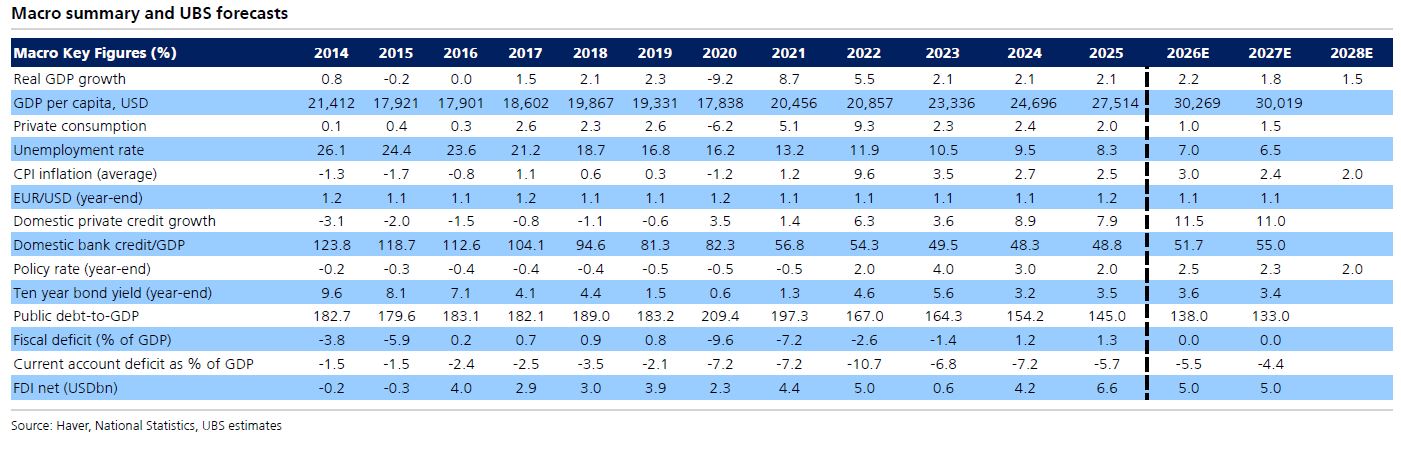
Banks at the center of the re-rating story
In this environment, UBS sees Greek banks as a key driver of market re-rating. The increase in credit activity, the strengthening of capital, and the prospect of higher distributions form a framework that, in the firm's view, has not yet been fully reflected in valuations. Despite the strong rally of recent years, valuations remain, as it states, attractive in relation to the European banking sector. For Piraeus Bank, it gives a target price of 11.20 euros, for Alpha Bank 4.90 euros, for the National Bank 18 euros, and for Eurobank 4.70 euros.
Differentiated stories per bank
UBS maintains a buy recommendation for all four systemic banks, recognizing different performance profiles and value-creation levers. Alpha Bank shows lower current profitability but with strong improvement potential, as acquisitions and organic growth significantly boost the earnings-per-share trajectory over the next three years. Eurobank emerges as a regional growth story, with significant potential from SE Europe and Cyprus, while recent moves in the insurance sector further strengthen profitability and return on equity. The National Bank stands out for its high profitability, strong capital adequacy, and the flexibility for additional distributions beyond the already announced plans, while maintaining high asset quality. Piraeus Bank, following its recent investor update, highlights the prospect of strengthening return on equity by creating a comprehensive financial group, led by Ethniki Insurance and further re-rating possibilities. UBS summarizes that the Greek banking sector is at the center of a structural growth story for the European market, with a combination of macroeconomic stability, investment momentum, and banking expansion that creates conditions for continued outperformance.
www.bankingnews.gr












Readers’ Comments