

The next big wave of investments in artificial intelligence will not concern chips but electricity, with the new value chain focusing on network infrastructure.
For more than two years, the investment community focused almost exclusively on semiconductors, GPUs and large language models as the core growth drivers of artificial intelligence.
The explosive rise of companies like NVIDIA created the impression that the battle for AI would be judged exclusively on computing power.
Today, however, the market is entering a new phase.
The first phase of AI concerned software and processors.
The second phase into which we have entered concerns the physical infrastructure that makes their operation possible: electricity, transmission networks, substations, cooling systems and large expanses of land.
It is no coincidence that more and more investment capital is shifting from chip manufacturers toward companies that possess secured energy power and mature infrastructure.
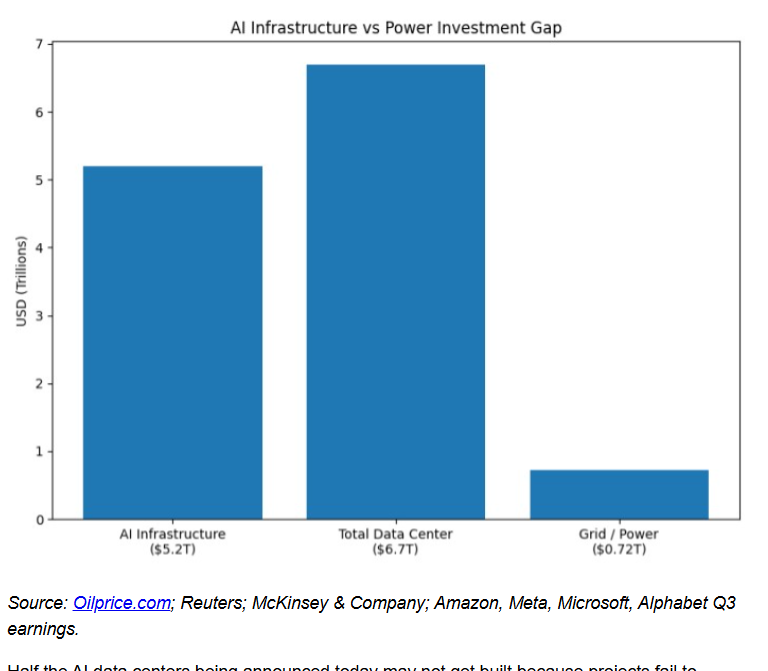
According to estimates by McKinsey, more than 5.2 trillion dollars will be invested globally in artificial intelligence infrastructure by the end of the decade, while the total capital requirement for energy and digital infrastructure may approach 6.7 trillion dollars.
The market is now passing from software development to physical infrastructure development.
In this new environment, Bitzero (NASDAQ: AIBZ) as a characteristic example is attempting to position itself in one of the most strategic links of the value chain: the securing of electrical power.
The market changes priorities
The largest technology groups in the world are increasing their investments at unprecedented rates.
Amazon estimates that its capital expenditures will shape at approximately 200 billion dollars in 2026.
Microsoft and Alphabet are moving close to 190 billion dollars each, while Meta has presented an investment program amounting to 600 billion dollars in the United States by 2028.
In total, the four hyperscalers are estimated to invest up to 725 billion dollars in 2026 alone.
The most important thing though is the composition of these investments.
The largest part of the capital is no longer directed only into servers and GPUs, but into data centers, substations, electrical networks, cooling facilities, land and energy infrastructure.
The market is beginning to value not only technology but also the physical assets that allow artificial intelligence to operate.
Electrical networks in the spotlight
The new bottleneck, the strategic point of the supply chain, is not GPUs but the electrical network.
Until recently, investors considered that the shortage of GPUs constituted the most important limiting factor for the development of AI.
Today, more and more analysts agree that the real shortage is shifting to electricity.
The electricity consumption of data centers is expected to approach 945 TWh by 2030, an amount corresponding to the total consumption of Japan.
At the same time:
1) more than 70% of connection applications to electrical networks are not completed,
2) the development of new energy projects can demand up to seven years,
3) high-voltage transformers, substations and available transmission lines constitute henceforth the core limiting factors for new data centers.
In other words, the question is no longer who can buy more GPUs.
The question is who already possesses the necessary megawatts.
Hyperscalers are now investing in energy itself
The shift in strategy becomes apparent also in the moves of the largest technology companies.
Amazon, Microsoft, Google and Meta are no longer limited to the construction of data centers.
They sign multi-year power purchase agreements, invest in new natural gas units, examine small modular reactor (SMRs) projects and seek direct access to energy infrastructure.
Electricity is no longer treated as an operating cost.
It constitutes a strategic competitive advantage.
From Bitcoin mining to AI energy infrastructure
Within this environment, Bitzero is attempting a strategic transition.
From a Bitcoin mining company it is evolving into a provider of energy infrastructure and computing power for artificial intelligence applications.
The company has already secured more than 1 GW of electrical power in Norway, Finland and North Dakota, creating a portfolio of energy infrastructure that can be utilized either for Bitcoin mining or for AI and High Performance Computing (HPC) services, depending on market conditions.
This diversification significantly reduces business risk, as it allows the company to direct the same energy infrastructure toward the activity with the highest return.
The agreement with OneQode marks the new strategy
This strategy acquired substantial content on May 5th, when Bitzero signed a binding letter of intent with OneQode Networks.
The agreement concerns the lease, for a duration of 15 years, of the entirety of the available power (110 MW) at the facilities of the company in Namsskogan of Norway, with an exclusive destination for AI applications based on GPUs.
The total value of the agreement is estimated at approximately 2.6 billion dollars.
The interest though is not limited to the size of the contract.
Bitzero creates recurring revenues from the leasing of the energy infrastructure, while the cost of electricity is undertaken by the client.
This business model creates predictable cash flows, limiting at the same time the exposure of the company to energy cost increases.
The new value chain is in energy infrastructure
In the new artificial intelligence market, it is not only the generated electricity that is valued.
Even greater value is acquired by already licensed land plots, available substations, access to high-voltage networks and the capability for immediate power supply.
For a hyperscaler, saving even two or three years in the development time of a data center can have greater financial value than the very cost of its construction.
That is why companies that already possess secured power are acquiring a strategic advantage.
Investment capital now follows energy infrastructure
This shift is already reflected in the stock markets.
Energy companies like EQT Corporation, Vistra Corp. and Constellation Energy have attracted increased investment interest, as they are considered critical suppliers of the energy infrastructure that AI demands.
At the same time, acquisitions of energy projects, electricity generation developers and infrastructure companies by investment funds that until recently invested exclusively in the digital economy are increasing.
The market appears to accept that electricity is evolving into a strategic asset.
The new investment equation
The first phase of artificial intelligence created enormous value for chip manufacturers and software companies.
The second appears to gradually transfer the value to the owners of energy and digital infrastructure.
Electricity, network access, licenses, substations and available lands are evolving into the new strategic assets of the AI economy.
Under this perspective, Bitzero is not merely attempting to participate in the development of artificial intelligence.
It seeks to position itself at a point of the value chain that may constitute the most important limiting factor of the next decade.
Just as occurred in the previous phase with GPU manufacturers, so too in the new phase of the market the surplus value may be created for those who control a resource that cannot be easily replicated: secured electrical power.
AI will not be judged only by the quality of algorithms or the power of processors.
It will be judged also by who can supply them with energy.
That is why energy infrastructure is emerging today as the new strategic field of competition for the global economy.
PPC brings Greece onto the AI infrastructure map
The most important development in Greece in 2026 concerns the strategy of PPC for the development of artificial intelligence infrastructure in Western Macedonia.
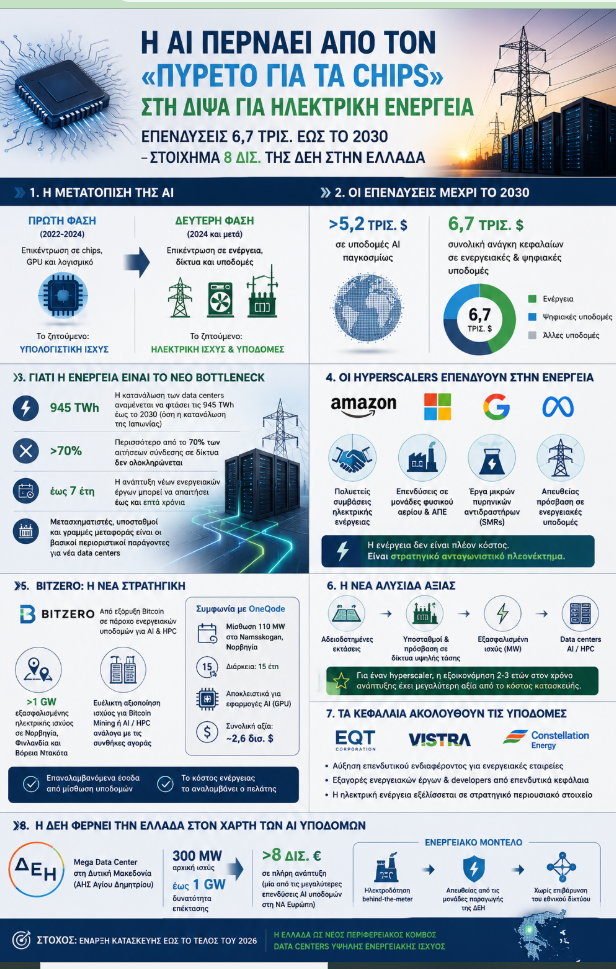
The company is promoting the creation of a Mega Data Center with a capacity of 300 MW at the Agios Dimitrios Power Plant, with a capability of expansion up to 1 GW, provided that agreements are secured with international hyperscalers.
The project constitutes the first phase of a wider investment plan that, in full development, can exceed 8 billion euros.
Particular interest is presented by the energy model of the project.
The power supply of the data center will be done behind-the-meter, that is, directly from the generation units of PPC, without burdening the national electricity transmission system. This model responds to one of the greatest challenges of the artificial intelligence era: the securing of reliable and sufficient electrical power for energy-intensive AI infrastructure.
The latest developments show that the project is entering a more mature phase, with PPC being in negotiations with international cloud and AI service providers, while the goal is the initiation of construction by the end of 2026.
If implemented, the project will constitute one of the largest investments in artificial intelligence infrastructure in Southeast Europe and will showcase Greece as a new regional hub for high-energy-capacity data centers.
www.bankingnews.gr













Readers’ Comments