

Following an explosive rise in 2025, when gold seemed unstoppable, the picture reversed within 2026.
Almost halfway through the year, the precious metal has already wiped out all its annual gains and is now moving in negative territory.
The retreat does not concern only gold: the ETF GLD is approximately -2% for the year, silver loses around -8%, while platinum and palladium record even sharper losses, of the order of 18% to 20%.
The diversification in returns is characteristic, but the question remains common: why do precious metals skyrocket in one phase and collapse in the next?
The answer is not found in a single factor, but in the shift of the macroeconomic environment.
Inflation, geopolitical tension, confidence in the dollar, interest rates, and capital flows combine in ways that quickly change the direction of the market.
In this cycle, however, the two decisive levers seem to be interest rates and the strength of the dollar.

The role of the Federal Reserve
In 2025 the rise of gold relied mainly on the change of stance of the Fed.
Inflation in the USA had not officially returned to the target of 2%, but had stabilized and was no longer accelerating, while the labor market began to show signs of fatigue.
In August 2025, unemployment rose to 4.3%, the highest level since 2021 at that time, while the long-term unemployed over 27 weeks exceeded 25% of the total.
This mixture of deceleration turned the Fed away from the exclusive focus on inflation and toward supporting employment.
Three consecutive interest rate cuts followed in the last quarter of 2025, in September, October, and December, with the benchmark interest rate retreating to the range of 3.50%–3.75%.
This change pressured the dollar and opened the path for the rise of gold.
At the same time, concerns regarding the fiscal path of the USA increased, strengthening the demand for safe havens.
The result was a self-reinforcing upward movement: the higher prices attracted new buyers, who in their turn further strengthened the rise.
The picture however changed abruptly at the beginning of 2026.
The recovery and jobs
The economy of the USA presented a stronger than expected recovery, with 126,000 new jobs in January, against an average of just 15,000 monthly in 2025.
The growth of GDP was maintained around 2.4%, while the labor market stabilized.
Without pressure due to the deterioration of macroeconomic data, the Fed had no reason to continue the aggressive interest rate cuts and essentially froze the easing cycle.
The markets, which always discount the future, quickly removed from prices the scenario of prolonged monetary easing.
The dollar strengthened and gold, which had been built on the expectation of a weaker currency and lower interest rates, found itself suddenly exposed.
The reversal of speculative positions accelerated the decline.

The shock to energy supply
Before this new balance could stabilize, the war in Iran also broke out, adding another upward factor to the dollar and a pressing factor for gold.
The rise in energy prices increases the demand for dollars in international transactions, further strengthening the American currency.
At the same time, the markets begin to incorporate scenarios for more persistent or even higher interest rate expectations, something that strengthens the dollar even more and acts negatively for precious metals.
The historical relationship remains stable: gold moves inversely to the strength of the dollar.
And the current cycle constitutes no exception.
As long as the dollar strengthens through interest rates and geopolitical demand, gold loses its momentum.
Central banks prepare for monetary instability
Despite short-term weakness, central banks continue to move in the opposite direction.
Global gold purchases by central banks have averaged approximately 1,000 tons annually over the last four years, double the levels compared to the previous decade.
According to the World Gold Council 2026 survey, 45% of central banks expect an increase in gold reserves within the next year, while just 1% expects a decrease.
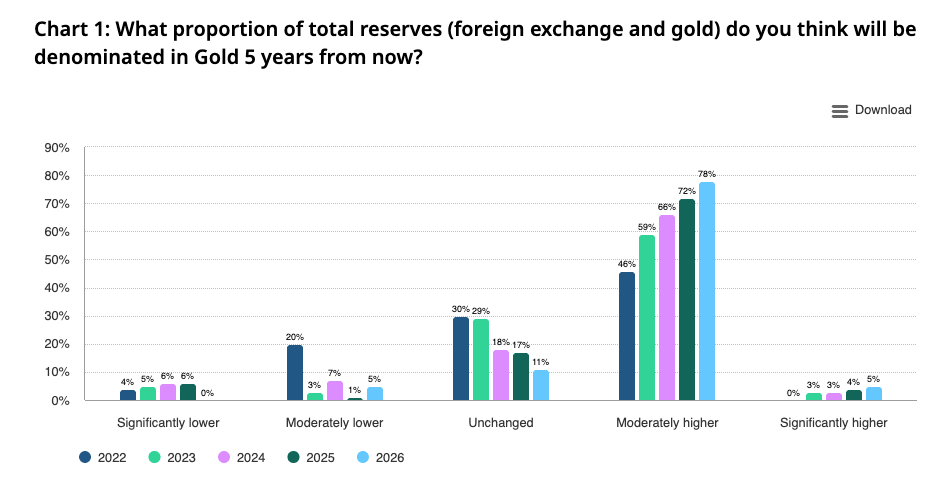
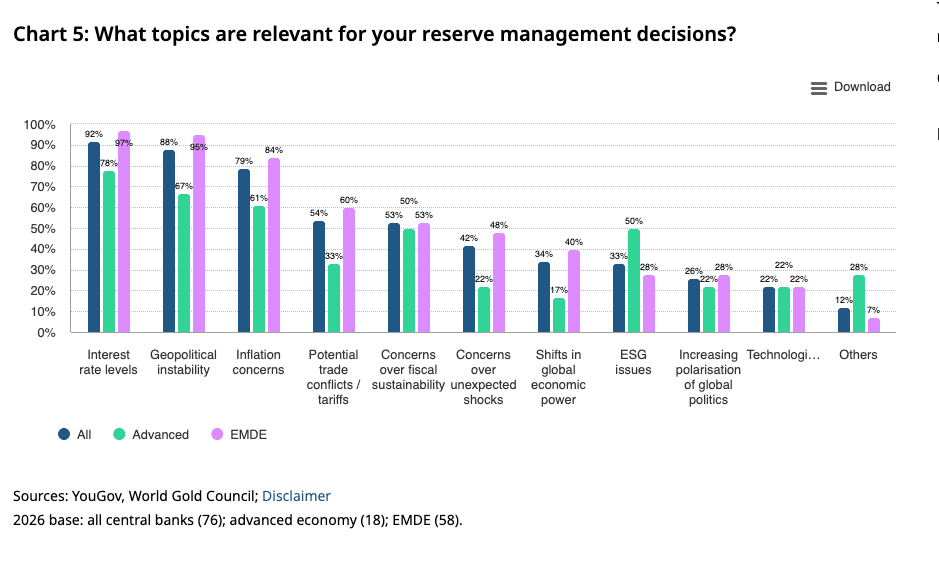
At the same time, 74% predicts a decrease in the share of the dollar in global reserves within the next five years.
The picture that emerges is twofold.
On the one hand, short-term cycles are determined by interest rates, the dollar, and liquidity.
On the other hand, there is a deeper structural trend of reserve diversification and gradual de-dollarization, which supports the strategic demand for gold.
The result is a market that does not move linearly, but in abrupt alterations of phases: periods of rapid rise when monetary easing and uncertainty dominate, and sharp corrections when the macroeconomic environment turns toward a stronger dollar and higher real interest rates.
In this context, gold remains less a simple commodity and more a mirror of the shifts in the global monetary system.
www.bankingnews.gr












Readers’ Comments