

The military involvement of the United States in Iran is evolving, according to a multitude of analyses and polling data, into one of the largest political weights of the presidency of Donald Trump.
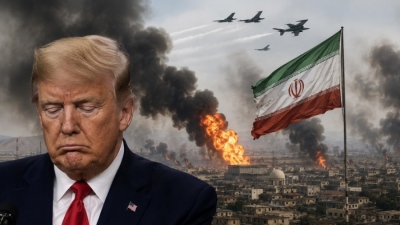
Where the American president sought to appear as a leader who would impose American power, he ended up signing a ceasefire agreement that even analysts from across the US political spectrum characterize as a forced retreat.
The image that the White House attempts to present differs significantly from the reality recorded by the polls.
In April 2026, during a hearing in the Senate, the Secretary of Defense Pete Hegseth claimed that "the American people support the war."
Two months later, the data show exactly the opposite.
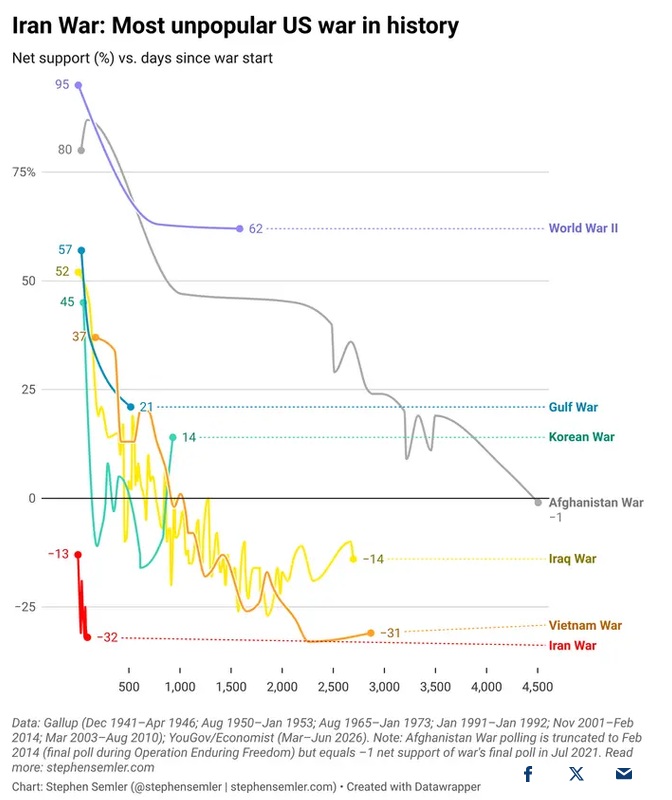
According to available public opinion surveys, net support for the war stands at -32%, a fact which means that citizens who oppose the conflict outnumber those who support it by 32 percentage points.
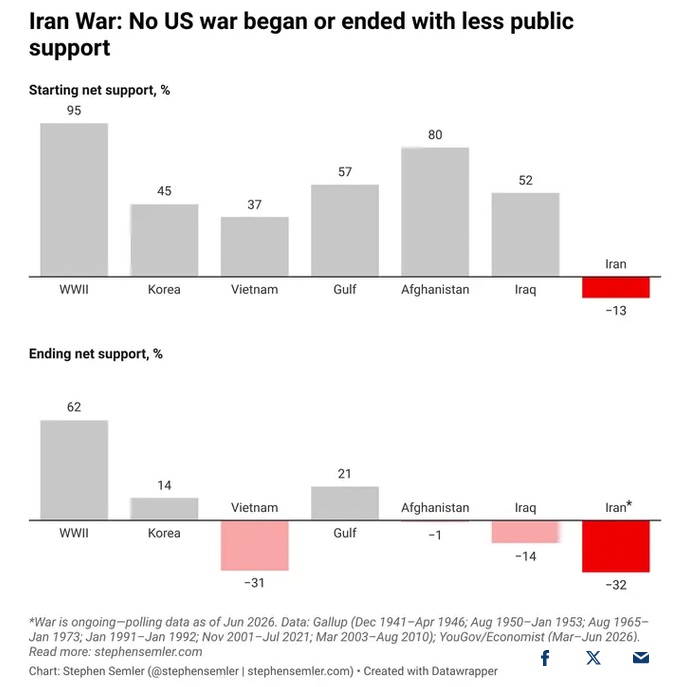
The analyses comparing seven major military conflicts of the United States conclude that this is the first time that an American war starts without ever acquiring majority popular acceptance.
Even more revealing is that, even among Republican voters, support for the continuation of the conflict appears extremely limited.
While a significant percentage states theoretically that they support the war, more than half concurrently demand that an agreement be reached for its immediate termination. This contradiction captures the generalized fatigue of American society toward yet another military involvement in the Middle East.
From "absolute victory" to a forced agreement
The Trump administration entered the conflict with maximum aspirations.
Washington aspired to force Tehran into a strategic retreat, to restrict its influence in the region and to reaffirm American military dominance.
Instead of imposing its terms, however, it ended up accepting an agreement that primarily favors Iran.
This fact does not constitute merely a diplomatic retreat.
It reflects, according to analysts, the inability of the United States to achieve their strategic goals without a disproportionate economic, military and political cost.
The Trump administration attempted to present the agreement as a success.
However, its critics argue that the reality is different: it was not a choice of power but a forced recognition that the continuation of the conflict had become unprofitable.
A war without a clear American interest
The greatest criticism concerns the basic question that was never answered convincingly: what exactly vital interest of the United States did this conflict serve?
For decades, Washington, in close alignment with Israel, presented Iran as an existential threat to international security.
However, many analysts argue that the American military presence itself in the Middle East was that which created the conditions of continuous tension.
Instead of being weakened, Tehran appears to have strengthened its geostrateric position, acquiring even greater influence over one of the most important energy arteries of the planet.
The enormous cost
The economic consequences were equally heavy.
Analyses estimate that the total cost for the United States may have approached 200 billion dollars.
Concurrently, the conflict caused thousands of casualties among civilians in Iran and in Lebanon, while dozens of American military personnel lost their lives.
The repercussions were not restricted to the field of battle.
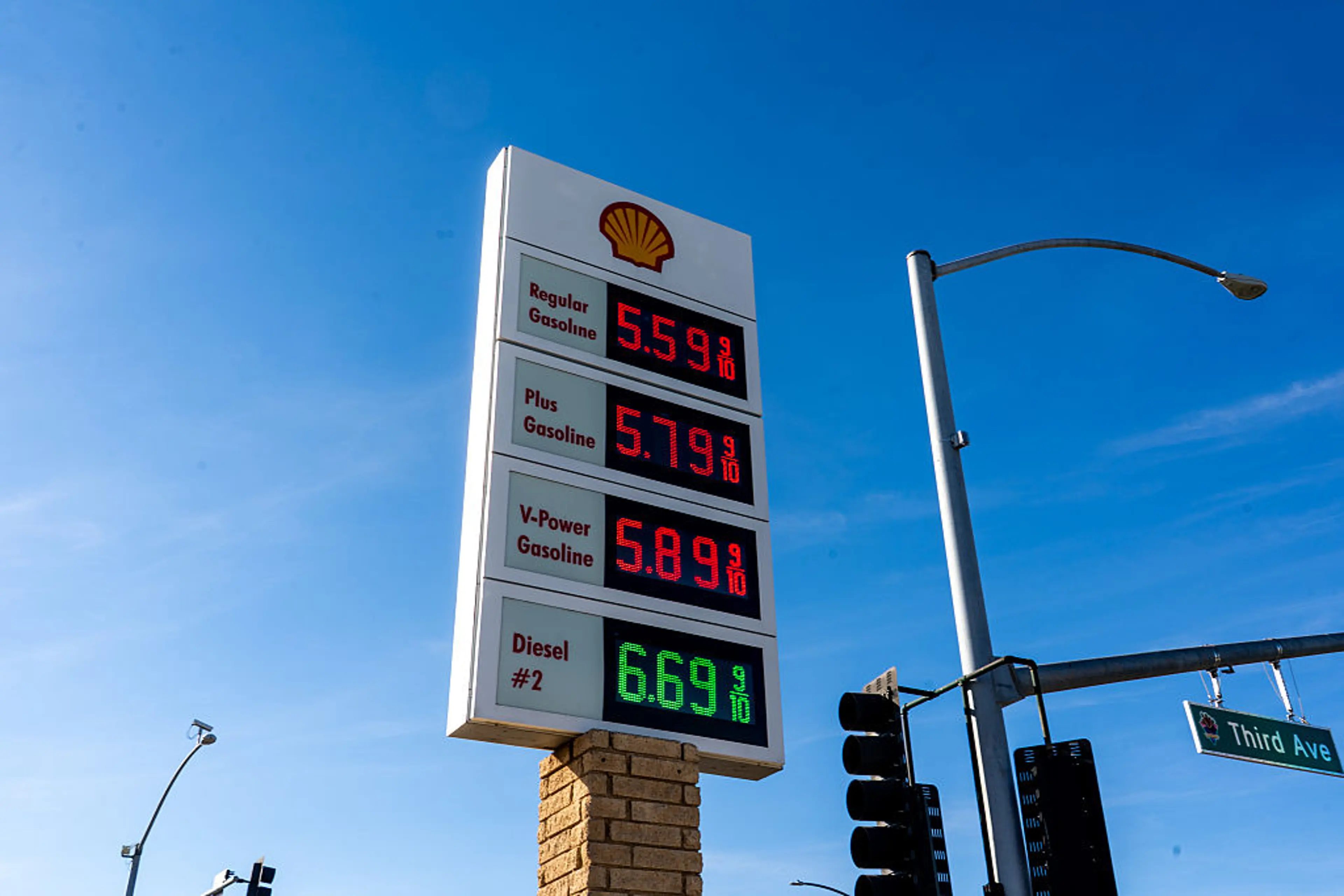
The largest energy disruption of recent decades caused increases in the prices of fuel and food, affecting not only the United States but also the entire global economy.
At the same time, China exploited the situation by projecting itself as a more stable international factor, further strengthening its international influence.
The consequences were not restricted to the field of battles.
The crisis caused serious disruption in international energy markets, with the prices of oil and natural gas skyrocketing and the repercussions being transferred directly to transport costs, production and ultimately to the prices of basic goods.
From fuel stations to supermarket shelves, millions of citizens in the United States and also across the entire world found themselves facing a new wave of inflationary pressures.
At the same time, Washington found itself facing also a significant diplomatic cost.
The prolonged conflict reinforced criticisms from allies and adversaries, while it offered China the opportunity to appear as a factor of stability, expanding its economic and political influence in regions where until recently the United States dominated.
Instead, then, of strengthening American hegemony, the war appears to have accelerated the transition toward a more multipolar international system, in which the power of Washington is increasingly questioned.
The collapse of American hegemony
Beyond, however, the specific conflict, the war highlighted a deeper problem: the limits of the American superpower.
The post-Cold War goal of Washington to maintain global hegemony appears increasingly difficult to achieve in a multipolar world, where even regional powers now possess significant capabilities of deterrence.
The military superiority of the United States no longer translates automatically into a political victory.
Iran constituted a characteristic example of this new reality.
The political blow for Donald Trump
For Donald Trump, the conflict evolved into a serious political blow.
The president who was elected promising that he would terminate the expensive military adventures of the United States ended up being connected with yet another military involvement, which divided American society and caused intense questioning even in the interior of the Republican Party.
The case of Iran may go down in history not as a demonstration of American power, but as yet another proof that the era during which Washington could unilaterally impose its will has passed.
Military power proved insufficient against the new geopolitical balances, while the foreign policy of Donald Trump left behind a heavy economic cost, deeper international fragmentation and even greater questioning of the American role in the world.
The most important conclusion, perhaps, is that the crisis does not concern only a failed military operation. It concerns the overall strategy of the United States in the Middle East, a policy of decades that, according to its critics, cost countless lives, enormous economic resources and ultimately undermined the very American power that it supposedly sought to maintain.
Republicans will pay the bill in the midterm elections of November 3
The political consequences of this strategy may prove even more serious than the military ones.
The intense dissatisfaction recorded in the polls regarding the war with Iran threatens to turn into a very heavy electoral cost for the Republicans in the midterm elections of November 3, 2026.
If the current trend is maintained, it is not excluded that the Republican Party will lose the majority both in the Senate and in the House of Representatives.
Such a result would significantly restrict the political margins of Donald Trump, making the advancement of his legislative agenda difficult and turning the second half of his presidency into a continuous political conflict with Congress.
If ultimately the war in Iran evolves into the defining factor of this electoral reversal, then it will have left behind not only a heavy geopolitical and economic footprint, but also a deep political crisis in the interior of the United States, with Donald Trump himself being called to manage the consequences of his choices.
www.bankingnews.gr







Readers’ Comments