

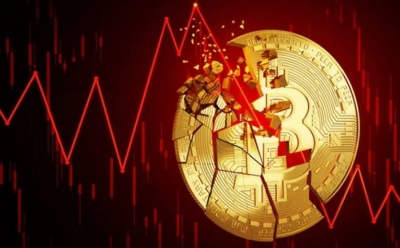
The cryptocurrency market experienced one of the most violent turbulences of the year, again highlighting the fragility of positions heavily reliant on leverage, within an environment of macroeconomic uncertainty and technological upheaval. Within a few hours, more than $100 billion in global market capitalization vanished, driving the Crypto Market Fear & Greed index into the "extreme fear" zone with a score of 23.
Massive liquidations and collapse of positions
The first phase of the crisis was characterized by widespread liquidations rarely seen in recent months. According to market data, over $720 million in positions were liquidated within 24 hours across all major assets such as Bitcoin, Ethereum, XRP, Solana, and Dogecoin, with approximately 145,000 traders affected by the wave of forced sales. The losses primarily hit leveraged positions, with $610 million in long positions liquidated, compared to $110 million in shorts. Within just one hour, $182 million in long positions vanished. The Hyperliquid platform recorded the largest single liquidation in the ETHUSD contract, valued at $15.34 million. On-chain analyst Axel Adler Jr. commented, "Weak hands are leaving, while the strong did not budge."
The market picture
In Bitcoin, the price retreated sharply to $61,893, breaking the critical 200-week moving average (200-WMA) at $62,000 and triggering $216 million in liquidations. Ethereum fell below $1,650, reaching $1,639. Major altcoins like XRP, BNB, Solana, Cardano, and Dogecoin recorded losses of 3% to 7%. Simultaneously, spot ETFs in Bitcoin and Ethereum saw significant capital outflows, with BlackRock's IBIT ETF recording outflows of $170 million. Analyst Ted Pillows warned that the market must maintain the $61,000–$62,000 support zone, noting that a new "cluster drop" around $61,200 is likely before any recovery.
Macroeconomic pressure and global transmission of the crisis
Beyond the technical aspect, the decline is linked to broader macroeconomic factors. Traditional markets carried the shock, with the Korean KOSPI index recording a drop of nearly 10%, its worst in recent years, while the Nasdaq 100 retreated by 2.60% in pre-market trading. Risk aversion was reinforced by the rise in the 10-year US Treasury yield to 4.5% and the strengthening of the dollar (DXY) to 101.17, its highest level since last year. Investors are also monitoring US–Iran negotiations and fear a potential tightening of Federal Reserve policy ahead of PCE inflation data. Bit Official's analyst noted that market weakness is related to the Fed's less accommodative stance since October 2025, while the artificial intelligence narrative is no longer enough to support valuations.
The fear of "Q-Day" and the threat of quantum computing
A new element that influenced the investment climate is the developments surrounding quantum computing. According to Cointribuhe, US President Donald Trump signed executive orders to boost this technology for national security. The White House announced a plan to restart national innovation in the field of quantum technologies. This direction puts the crypto market face-to-face with a potential milestone in 2030, when the US plans the transition of critical systems to post-quantum standards. Experts warn of a potential "Q-Day," a scenario where quantum computers could break today's encryption systems. Google has also warned that such systems could threaten existing cryptography by 2029. Networks like Solana and XRP are already planning upgrades for 2028, but it is estimated that approximately 7 million Bitcoin could be at risk if there is no timely upgrade.
A market under triple pressure
The crypto market is thus under simultaneous monetary, technological, and political pressure. In the short term, the ability to absorb liquidations will depend on US economic data and the Fed's stance. In the long term, the blockchain industry is called upon to accelerate the transition to post-quantum infrastructure, as the promise of "absolute security" is now being called into question. The recent collapse, while liquidating excess leverage and "weak hands," highlights that the next phase of the market will not be decided only on price charts, but also in the technological and geopolitical fields.
www.bankingnews.gr







Readers’ Comments