

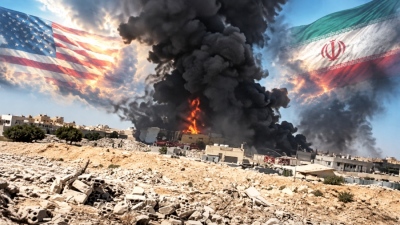
Negotiations between the US and Iran continue, but high uncertainty persists, as according to Rafael Grossi, Director General of the International Atomic Energy Agency (IAEA), the organization will resume inspections of Iran's nuclear facilities and is waiting for Iran to reveal the location. At the same time, reports from the American pilot who crashed an F-35 in Iran are of great interest; he revealed that he saw hell, as swarms of drones were flying in absolute coordination. American journalist Tucker Carlson, in new statements, emphasizes that Israel has a goal to cause total destabilization in the region and to strike Europe; they have a plan and are trying to implement it. The Economist, however, believes that Israel will be forced to accept the US-Iran agreement for three reasons.
Trump vs. Senate on war powers: I have Iran on the ropes
US President Donald Trump reacted to the Senate's approval of a war powers resolution, which asks him to end any military action against Iran. "I have Iran on the ropes, ready to collapse, willing to give us almost everything and, for the first time in decades, to absolutely respect the United States and its President, ME, and the US Senate decides to hold a poorly timed and meaningless vote on the War Powers Act," Trump wrote on the X platform. According to him, the resolution sends a message to the "Number One Sponsor of Terrorism in the World" that "the United States does not like what I am doing to them and that I must stop," adding that in this way "aid and support is provided to the enemy." The president continued by criticizing the four Republican senators who joined the Democrats to vote for the resolution. "These senators just made my job harder, but I will get it done, one way or another, because I always win!" Trump declared.
The Senate decision
It is noted that the Senate approved a resolution to suspend the war with Iran by 50 votes to 48. Four Republican senators voted for the measure, which now requires, for the first time, President Donald Trump to secure Congressional approval before any further military action. This decision is significant because this measure has already been approved by the House of Representatives. There have been several attempts in the past to pass it through the Senate, but it had never managed to secure the required support. This time it succeeded because four Republicans voted with the Democrats, curbing military action.
What the resolution stipulates
In essence, this resolution stipulates that the United States cannot return to war with Iran without receiving Congressional approval. For now, of course, peace talks are underway, so there is no immediate indication that such a thing is about to happen. However, the White House does not seem to attach much importance to the resolution. It cannot veto it, but it considers that it lacks substantial legal authority. And certainly, if the war were to continue and the resolution had been passed, the administration could challenge its constitutionality, even reaching the Supreme Court. The White House states that the president has the right to decide whether the United States is threatened and whether or not to launch a military attack. However, it is a significant development as, among other things, it essentially constitutes the first major rift between Republicans in the Senate and Trump during his second term in the White House.
Rubio (US Secretary of State): Iran has "an opportunity to achieve incredible things"
US Secretary of State Marco Rubio argued that if Iran decides "to become a country instead of a revolutionary movement," it could benefit from new economic opportunities, including investments. "They will have the opportunity to do incredible things in Iran," Rubio said. "I'm not promising you that this is the choice they will make. I am saying that if this is the choice they make, then there will be opportunities, and these opportunities could include investments, just as you have seen other countries in the region benefit from investments and from foreign direct investment. It will not be our investments. It will not be our government's money," stated Rubio, who added that Iran's political path will depend on whether progress is made on "a range of other security issues," which will be discussed in the coming days. Rubio also stated that Iran will not be able to impose transit fees in the Strait of Hormuz when the final agreement is reached, while stressing that negotiations for Lebanon will remain separate from the US talks with Tehran.
Iran-US agreement still full of uncertainty - Grossi claims: Inspections will be held... we are waiting for Iran to reveal where it is hiding the uranium
Rafael Grossi, Director General of the International Atomic Energy Agency (IAEA), claimed that the agency will resume inspections of Iran's nuclear facilities. Rafael Grossi made these claims in an exclusive interview with the Japanese network NHK in Tokyo. Echoing US claims that the IAEA will resume inspections in Iran, Rafael Grossi claimed: "We believe that the sooner the better, especially because this agreement has a 60-day time frame, so we must start without losing much time." The Agency has an idea about the potential location of Iran's high-enriched uranium, but it is important that Iran informs the Agency where it is located. He said that the highest priority was to confirm the location of the high-enriched uranium. He noted that the agency had an idea about the material's potential location, but it was important for Iran to inform the agency where it was located.
Oman announces temporary maritime route in the Strait of Hormuz without tolls
Oman, taking into account its responsibility for the Strait of Hormuz and the importance of this passage for the global economy, and in the context of its consistent adherence to international law and the law of the sea to ensure freedom of navigation in the Strait of Hormuz without the collection of transit fees, and in accordance with the results of the efforts and consultations that have been achieved between the United States and Iran, has taken measures to provide the possibility of using a temporary maritime route for all ships in coordination with the International Maritime Organization.
Tucker Carlson: Israel wants destabilization of Europe - Iran wants chaos in Europe
Tucker Carlson, a prominent US media personality, emphasized that the ultimate goal of the Zionist regime is not to change the government in the Islamic Republic of Iran or to terminate the country's nuclear program; the main goal of Israel is to create chaos and weaken Europe. Tucker Carlson stated that the goal of the Zionist regime in its aggression against the Islamic Republic of Iran is to cause an open wound that will last for generations, adding: "That is what they wanted for Iran, a country with a population of almost 100 million." Tucker Carlson also pointed out the physical, obvious, and documented consequences of such a situation, continuing: "A potential victory for Israel (the regime) in the war against Iran could lead to migration crises in Europe and further weaken the Green Continent." The weakening of Europe has always been one of the Zionist regime's goals, and he noted: "Who knows, maybe they are still angry with the Europeans because of the events of 70 AD in the Roman Empire or other similar events."
The Economist: Netanyahu will eventually have to accept the US and Iran deal for 3 reasons
The Economist magazine, referring to Israel's serious concerns regarding the content of the memorandum of understanding to end the war between Iran and the United States, explained that the regime will accept an agreement it does not like for three main reasons. First, Israel cannot afford a complete rift with the US. Israelis have been rattled by Trump's criticism of their tactics in Lebanon and Vice President Vance's warning to Israeli politicians who oppose the deal that "they are attacking the only strong ally they have left in the world." Israel cannot survive without friends.
Especially in an election year, defying Trump would have an internal political cost that few far-right Israeli leaders would be willing to pay. The disagreement and distrust between Iran and the United States remain intense, and Trump's decisions are hasty and reckless, so it would be no surprise if both parties, the US and Iran, abolish the agreement themselves. The second reason is that this may lead Israeli officials to assess that the memorandum of understanding will collapse even without any attempt to sabotage it.The third reason: Since the war against Iran has not achieved its strategic goals, Israeli leaders are likely to reluctantly abandon the dream of regime change in Iran and return to a shadow war - a war in which, instead of overt assassinations and direct military attacks within Iran, they will focus on covert sabotage operations in nuclear facilities and on countering the transfer of missiles and drones to regional groups, although they will likely continue to target militia commanders aligned with Iran.
This change in approach may be done in coordination with Washington and by defining new red lines, so that even these limited attacks are ignored if the agreement yields economic and security benefits for both sides, including the lifting of sanctions against Iran and the prevention of a global economic crisis for the United States.
Ship crossings from Hormuz tripled on a weekly basis
The shipping traffic monitoring company MarineTraffic reports that traffic in the Strait of Hormuz has recovered strongly and almost tripled between two consecutive weekends. According to the company, its figures, combined with data from Kpler, confirm that "crossings increased from 32 ships during the period 12-14 June to 93 ships between 19-21 June." "The recovery was supported by recent diplomatic developments," as well as by the temporary exemption granted by the US to sanctions on Iranian oil, "which contributed to reducing immediate compliance uncertainty regarding approved crossings from the Strait of Hormuz" until August 21, added MarineTraffic. Windward, another shipping activity monitoring company, reported that it recorded 25 crossings on Monday, June 22, and that the situation reflects "an early stage of normalization and not a full reopening."
The F-35 pilot who crashed in Iran reveals: I saw hell, I saw a minefield of drones in the sky... one drone was coordinating many
A US F-15 fighter pilot, who was rescued after being shot down over Iran in April 2026, says: "A few minutes before I got out of the plane, I saw a series of Iranian drones moving together in a way that looked like a 'puppet' or a 'minefield of drones'." This suggests a significant advance in Iranian drone technology, including "mesh networking [where] one drone coordinates the many." According to CNN, the pilot described that "several drones were connected and moving harmoniously and in a coordinated manner, with smaller drones underneath the larger drones operating like legs." The CNN report has sparked significant debate in the American intelligence community, with officials questioning whether the pilot correctly interpreted what he saw. If confirmed, this could signal a major advance in Iranian drone technology, including "one-to-many networking," a capability that allows multiple drones to operate in a coordinated network under a single control. Some initial estimates have examined whether the drone configuration may have played a role in the F-15 being shot down, although the cause is still under investigation. Intelligence officials have also cited reports that Iran has received help from Russia and China to develop advanced unmanned aerial vehicle capabilities.
www.bankingnews.gr










Readers’ Comments