

There was an image that a few years ago would have seemed unthinkable.
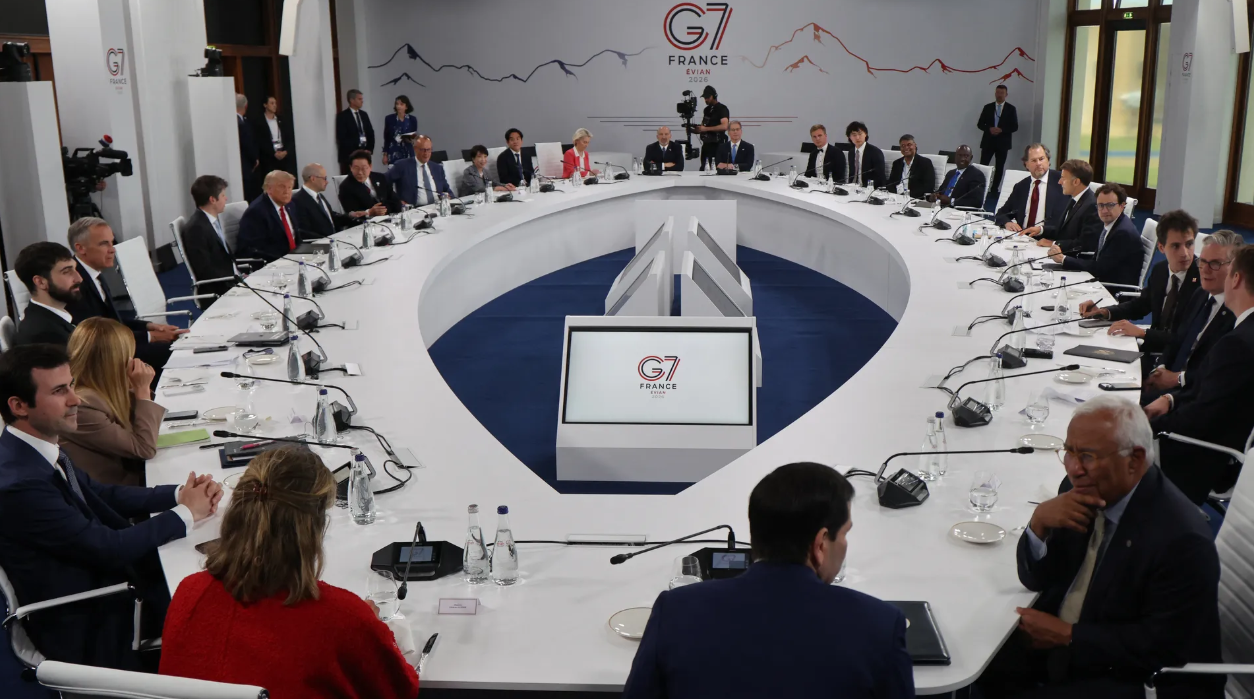
At the G7 summit in the French Alps, the leaders of the world's most powerful democracies and economies were not sitting only among themselves.
At the same table were the heads of the planet's largest artificial intelligence companies, as equal interlocutors.
Sam Altman of OpenAI, Demis Hassabis of Google DeepMind, Dario Amodei of Anthropic, Marc Benioff of Salesforce and other leaders of the new digital economy participated in closed meetings with presidents and prime ministers.
They were not simple guests nor were they technical advisors.
They were part of the decision-making process itself.
This image might prove historic.
Not because it signals the rise of artificial intelligence, but because it captures the birth of a new system of power: a global co-governance between states and Big Tech.
The concentration of power and the digital economy
The companies developing the large artificial intelligence models are no longer simple businesses.
They manage computing power greater than that of many states, control critical digital infrastructures, gather vast volumes of data and directly influence the economy, security and information of billions of people.
Characteristic was the statement of Demis Hassabis to the leaders of the G7 that humanity is at the foot of singularity and ahead of a new era of human history.
Sam Altman requested the creation of an international organization that will determine global standards for the development of AI.
Dario Amodei called on Western democracies not to fracture against authoritarian forces in the struggle for dominance in artificial intelligence.
The message was clear: artificial intelligence is now treated as a geopolitical issue equal to defense, energy and the economy.
At the same time, a different revelation came to illuminate the background of this new structure of political and economic power.
The network of Dialog of Peter Thiel
A leak, at the same time, from the website of the secretive Dialog conferences, founded by the billionaire investor Peter Thiel, revealed a network of contacts which resembles an informal global government more than a simple discussion club.
On the list appear senators, state governors, officials of the Trump administration, former heads of intelligence services, members of royal families of the Middle East, top businessmen, chief executive officers of technological giants and powerful opinion shapers from the largest international media.
Among the names are Elon Musk, Greg Brockman of OpenAI, Shivon Zilis of Neuralink, Leonard Leo, General Stanley McChrystal, Saudi Prince Turki al-Faisal, as well as well-known intellectuals and columnists such as Sam Harris, Steven Pinker, Ezra Klein and Bret Stephens.
The revelation did not cause concern only about who is participating.
It caused questions about exactly where the most important decisions of our era are taken.
Professor Janine Wedel from George Mason University described these forums as the spaces where agendas are shaped and consensuses are built among elites.
According to her, more and more decisions affecting entire societies are born in transnational networks of economic, political and technological power, far from public accountability.
The image emerging is striking.
On one side are the elected governments.

On the other side are companies with market capitalizations greater than the GDPs of many states, which control the technology that will determine production, security, labor, communications and perhaps even political decision-making.
Traditional democratic structures seem to coexist now with a parallel system of power.
A system in which elections still exist, but the critical infrastructures of society are in the hands of private organizations.
The most concerning element is not that governments cooperate with Big Tech.
It is that they are beginning to treat them as equal geopolitical centers of power.
When the heads of artificial intelligence companies hold bilateral meetings with heads of state, when they discuss safety standards, governance rules and the future of the global economy, then the line separating public from private interest becomes more and more blurred.
Perhaps ultimately the most important event of our era is not the development of artificial intelligence.
Perhaps it is the appearance of a new supranational elite, where political leaders, billionaires of technology, investors, military factors and opinion shapers co-shape the future through closed networks of influence.
The G7 may have offered simply the clearest photograph of this transition.
A photograph in which the CEOs no longer sit opposite power but shape its decisions.
www.bankingnews.gr

Readers’ Comments