

The global economy is not simply in a phase of technological transition.
It is in a deep, almost quiet restructuring of power, where artificial intelligence operates not as a tool of progress, but as a mechanism for the concentration of wealth on a historically unprecedented scale.
It is not just another industrial revolution.
It is a transition where value production is decoupled from labor and connected to the ownership of the systems that produce it.
A market narrowing to the point of suffocation at the top
Stock markets capture this shift with almost raw clarity.
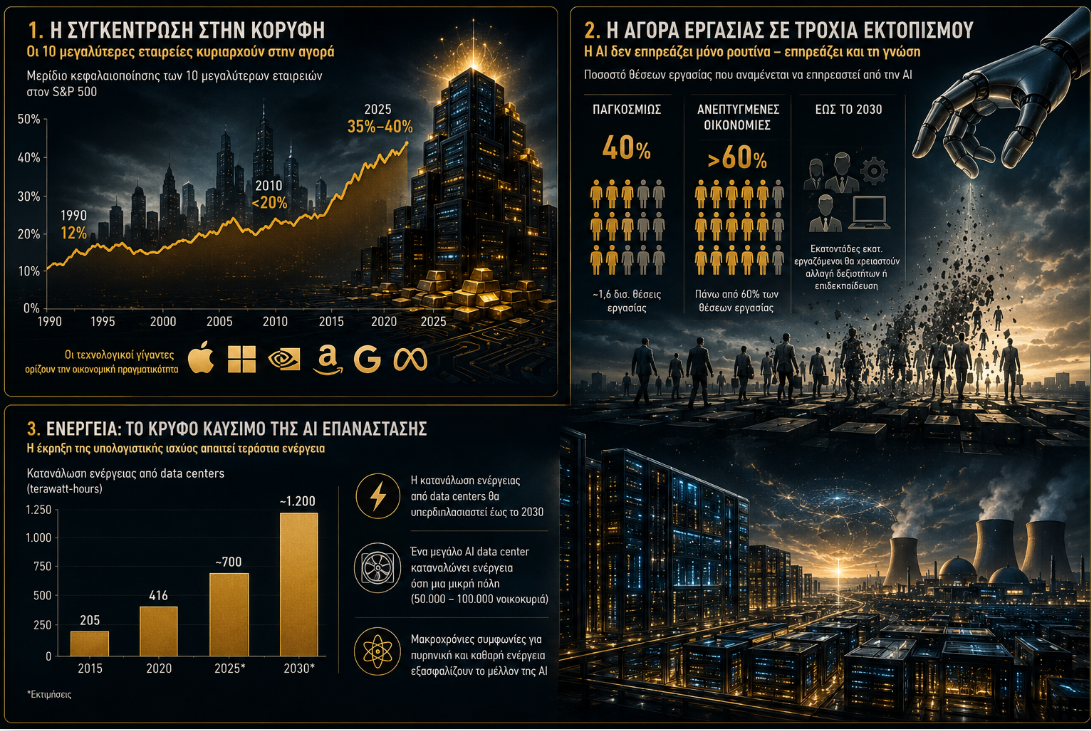
The ten largest companies of the S&P 500 have come to concentrate approximately 35%–40% of the total value of the index, levels that do not simply reminiscent of a bubble, but a structural contraction of the economy around a few cores of power.
Fifteen years ago, the picture was completely different.
In 2010, the same ten companies accounted for less than 20%.
The transition is not gradual.
The market is not expanding, it is narrowing.
And at the center of this condensation of economic power lie a few technological empires: Apple, Microsoft, Nvidia, Amazon, Alphabet, Meta.
Companies that do not simply participate in the economy, they define it.
Concentration moves from markets to digital infrastructure
Even more worrying than valuations is the concentration in the very infrastructure of artificial intelligence.
The case of NVIDIA works like a mirror of a new kind of dependence.
A significant percentage of its revenues comes from an extremely small number of customers, the so-called hyperscalers, the very ones who control cloud services, data, and platforms.
This means that artificial intelligence is not diffusing into the economy.
It is concentrated in a closed circle of companies that buy the infrastructure, control it, and then use it to strengthen their position even further.
A self-fueling mechanism of power reproduction has already been activated, and it has no external exit.
Markets as a mechanism for widening inequality
Stock market reality no longer functions as a balancing mechanism.
The NASDAQ continues to record impressive gains, fueled by the narrative of artificial intelligence.
However, this rise is not collective.
It is deeply hierarchical and limited to the elite.
A few companies pull entire indices upward, while the rest of the market remains stagnant or marginalized, the profitability of companies in the real economy has been "stuck" at low levels for a decade.
Performance is not distributed, it is absorbed.
The market is thus transformed from a wealth diffusion mechanism into a mechanism for concentrating economic power at the top.
The crack in the labor market
But if the concentration at the top is worrying, the erosion at the base is existential.
Artificial intelligence no longer targets only manual jobs or low-skilled roles.
It enters the core of labor in the Knowledge Society, where the modern middle class was built.
Roles such as market analysis, sales, support services, and even administrative functions are on a trajectory of partial or full automation.
The result is not simply job loss, but it is the dismantling of the typical path of professional advancement.
The middle class is not shrinking uniformly.
It is dismantling structurally, because the "middle step" that reproduced it is disappearing.
The acceleration of a quiet displacement
The forecasts of international organizations converge on a common pattern: the adjustment will not be smooth.
Millions of jobs are already on a trajectory of displacement, not on a distant horizon, but within the current decade.
And what is changing is not only the number, but the quality of the positions that disappear: not routine work, but work that was once considered a "stepping stone" for further upward mobility .
Social mobility begins to lose its practical foundation.
The near-zero cost economy
Artificial intelligence obeys a different logic than the traditional economy.
Once trained, systems can serve almost unlimited demand with minimal additional cost.
Scale becomes practically uncontrollable.
In this environment, the concept of competition mutates. The best does not win, the one who already has the largest quantitative base wins.
And the one who wins, wins almost everything.
Energy infrastructure as a new field of competition
Behind this digital empire lies a harder foundation: energy.
The largest technological companies have already turned to long-term agreements to secure stable energy power, including nuclear energy.
AI is not just software: It is energy-intensive infrastructure.
And whoever controls the energy that powers it, controls the rhythm of economic reality itself.
From the market to algorithmic inequality
All the above converge on a single pattern: concentration of capital, concentration of infrastructure, automation of labor, and weakening of the bargaining power of labor.
The result is not simply greater inequality.
It is the gradual transition to a system where the economy is organized algorithmically, with power flowing to whoever controls the systems, not production through labor.
The new structure of economic power
Artificial intelligence is not just transforming production.
It transforms the very structure of economic power.
The data shows an economy that no longer spreads horizontally, but contracts upward, as if absorbed by a few technological cores.
The question is not whether this trend will continue. The question is what form it will take when completed: a controlled restructuring or a permanent, consolidated economic hierarchy without a real escape route.
www.bankingnews.gr










Readers’ Comments