

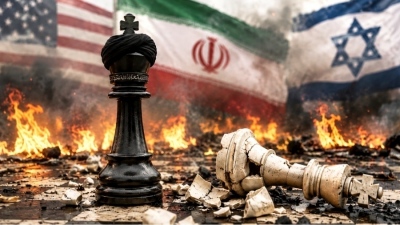
The American president, Donald Trump, has returned to aggressive rhetoric following his capitulation to Iran, while openly putting Syria in the frame, calling on it to take action against Hezbollah if Israel is unable to do so without extensive collateral damage. "The only thing that really matters to me is that Iran will never get a nuclear weapon, and I say that loud and clear," Trump stated while speaking to journalists during his meeting with the Emir of Qatar, Sheikh Tamim bin Hamad al Thani, on the sidelines of the G7 summit. "They are not going to develop it. They are not going to buy it. They are not going to do anything with it. And if they do, they will suffer incredible consequences," he continued, adding: "The gates of hell will open for them" if Iran ever acquired a nuclear weapon, and this is the reason why he pushed for the inclusion of a clause in the agreement that prohibits Iran from purchasing arms. The US president claims that this was his motive for starting the war: "That is the reason I got into this and that is the reason I agreed to sign."
Trump puts Syria in the frame
At the same time, however, Trump opened a new, unexpected chapter, proposing Syria as the player that should "clean up" the landscape with Hezbollah. "If Israel can't do the job without killing everyone else, Syria should do the job," Trump stated, while adding that he had suggested to Israel to "let Syria deal with it," saying he believes they "would do a better job at it."
US and Israel relations
Trump stated that he did not approve of Israel's recent strike in Beirut, noting that it happened "two hours before the signing of an agreement" with Iran. He described the tensions involving Israel, Lebanon, and Hezbollah as a "small war" and said that Hezbollah "is constantly raising its head." However, he appears annoyed with the way Israel is handling it: "Israel has been fighting Hezbollah for too long and too many people are being killed," he says. "You don't need to knock down an apartment building every time you're looking for someone, because there are a lot of people in those apartment buildings, and they're not all Hezbollah, that I can tell you." When asked if he is disappointed with Benjamin Netanyahu, following reports of intense dialogues between the American president and the Israeli prime minister, Trump was categorical: "No." "We had an excellent relationship. We are discussing some final details. We had a very effective relationship. Without us, without the United States, there would be no Israel," he added. "Without me, there would be no Israel, because no other president was willing to do what I did. I had an excellent relationship with Bibi (Benjamin Netanyahu), but now Bibi must be more responsible regarding Lebanon."
The 1.5-page agreement
The terms of the preliminary US-Iran agreement are included on... 1.5 pages. Although its exact terms are not known at the moment, Pakistan – the mediating country – pointed out that it provides for the complete cessation of military operations on all fronts, including Lebanon. The preliminary agreement provides for the opening of the Strait of Hormuz, but leaves the issue of Tehran's nuclear program to be resolved during a 60-day negotiation period, after which a final agreement will be concluded.
The 10 key clauses of the Iran-US memorandum
-
Full opening of the Strait of Hormuz The Strait of Hormuz will remain open to international shipping, restoring the smooth flow of the global energy trade.
-
Zero transit fees for ships Iran will not impose direct tariffs or transit fees on commercial ships crossing the Hormuz.
-
Right to collect service fees by Iran but not tolls Despite the abolition of tolls, Iran will be able to collect revenue from:
-
Insurance services
-
Fuel refueling
-
Environmental services
-
Port and shipping support
-
Unfreezing of $12 or $25 billion in frozen Iranian assets The United States is expected to proceed with the unfreezing of approximately $12 billion in Iranian assets. It should be noted here that other Iranian sources speak of unfreezing up to $25 billion and a broader framework of sanctions and economic cooperation.
-
Funds will be provided mainly through goods and medicines Washington allegedly insisted that a large part of the funds be released through:
-
Basic goods
-
Medical/pharmaceutical equipment
-
Humanitarian supplies
-
Gradual implementation of the agreement over a period of 30-60 days The release of funds and the implementation of commitments will take place gradually, depending on the progress of the implementation of the terms of the memorandum.
-
Extension of the ceasefire for at least 60 days The agreement provides for an extension of the ceasefire that began on April 7, creating a time frame for further negotiations.
-
Talks on the nuclear program are moved to the second phase Tehran succeeded in ensuring that the nuclear program is not a precondition for ending the crisis. Relevant negotiations will begin after the first phase of the agreement's implementation.
-
Dilution of 60% uranium within Iran Iran agrees to reduce its degree of uranium enrichment:
-
Within the country
-
Under the supervision of the IAEA
-
Without transferring critical nuclear material abroad
-
Possible lifting of oil sanctions According to the information:
-
Sanctions on oil exports may be lifted.
-
Some secondary US sanctions and sanctions approved by Congress will likely remain.
What Iran gains from the agreement
-
It maintains control of the nuclear material within the country.
-
It secures the release of frozen assets.
-
It gradually returns to global energy markets.
-
It maintains strategic influence in the Strait of Hormuz.
-
It avoids direct concessions on the nuclear issue before the end of the crisis.
-
It achieves indirect recognition of its role as a key regional power in the Middle East.
www.bankingnews.gr







Readers’ Comments