

A secret geopolitical agreement allegedly linking the United States, Qatar, and Iran is coming to light, revealing a backstage network of financial arrangements, energy interests, and strategic tradeoffs in the world's most critical maritime artery. According to diplomatic and shipping sources, Washington allegedly gave tacit approval to a billion-dollar deal that ensured the unimpeded passage of vessels through the Strait of Hormuz, while simultaneously offering Tehran significant financial breathing room amidst international pressure. The revelations raise questions about the US's dual strategy in the region, as behind the public rhetoric regarding "maximum pressure," a completely different reality seems to have been unfolding. However, despite Trump's statements, Hormuz is expected to open after the signing of the memorandum this coming Friday, June 19; an indication that the Iranians remain extremely skeptical toward the US, and their various traps, such as the provision for the creation of a $300 billion fund for the reconstruction of Iran.
The agreement
Diplomatic officials confirmed that the United States had secretly agreed to a financial and shipping deal between Qatar and Iran. Under this agreement, billions of dollars were made available to Tehran, and in return, Iran guaranteed the free passage of tankers and Qatari ships through the Strait of Hormuz, while pledging not to attack Qatar's interests.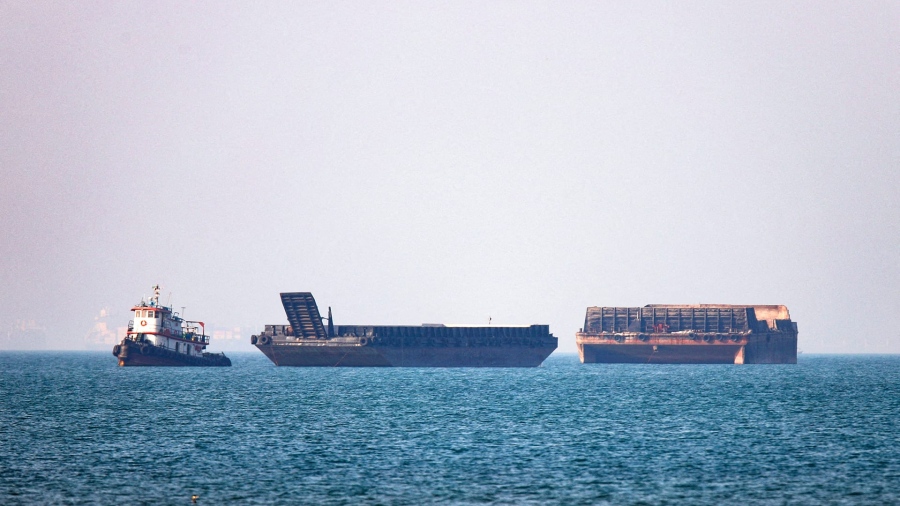
Approval from the US
The Israeli Hume, citing well-informed sources, reported that the decision had been designed and approved by the American government. While Washington was officially talking about a naval blockade of Iran and a policy of "maximum pressure," the US Navy had received orders to ignore these arrangements. A key goal of this policy was to reduce the crisis in the global energy market and prevent further increases in oil prices.
Financial… breathing room
The disclosure shows that the White House had prepared the ground for a deal and a memorandum of understanding with Iran about a month earlier. Critics of the move believe that Washington provided Tehran with significant financial "breathing room" during the most critical period of economic pressure against the Islamic Republic.
Qatar's moves
According to the report, Qatar was concerned about the possibility of a new attack, following the hit one of its natural gas facilities had taken during the war, and sought to ensure its security by creating a direct channel of communication with Tehran. In this context, Doha agreed to make available part of Iran's financial resources. While the United Arab Emirates and Saudi Arabia were targeted by missile and drone attacks after the ceasefire, Qatar remained off-target. Under the agreement, Iran requested access to a portion of its frozen deposits in Qatar. Part of the payments was made in the form of transit fees for tankers passing through the Strait of Hormuz, while Iran was also granted a credit line of up to one billion dollars for purchasing goods through Qatar.
Dual policy from the US Navy
The report states that although the US Navy publicly spoke of blocking Iranian exports and imports, in practice it followed a dual policy: on one hand, it maintained military and naval pressure, and on the other, it allowed the flow of finances to Iran through Qatar. The report also claims that some of the ships that Donald Trump recently stated successfully passed through the Strait of Hormuz actually made voyages between Qatar and Iran under the cover of the same secret agreement.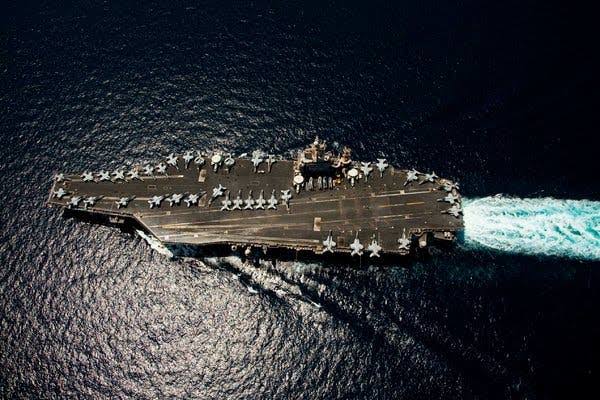
Example
Qatar's role went beyond simple mediation. During the visit of Iran's Foreign Minister Abbas Araghchi and the governor of the Central Bank of Iran, Abdul Nasser Hemmati, to Doha, direct contacts took place between Qatari officials, Washington, and the American negotiating team. Steve Witcoff and Jared Kushner also participated in these communications. Qatar's success led other Gulf states to seek similar agreements with Iran. The report informally names the United Arab Emirates, although diplomatic officials refused to officially confirm the matter. However, it is noted that Iran had not attacked the UAE in recent weeks, while Bahrain and Kuwait had received missile strikes.
Secret consultations
A diplomatic official also noted that Saudi Arabia also benefited from these arrangements. After a significant reduction in oil revenues and the restrictions caused by the crisis in the Strait of Hormuz, Riyadh welcomed any mechanism that could contribute to reducing tension and restoring energy exports. According to the report, these secret consultations formed the basis of the current Memorandum of Understanding between Iran and the United States.
The war is over
This time, it is all over... the war and the speculation about its restart have ended. The US and Iran have reached an agreement, and on Friday, June 19, in Geneva, a memorandum for a ceasefire and the start of peace talks (including Iran's nuclear program) will be signed. Hormuz will... open and subsequently be demined, Israeli aggression in Lebanon will stop, and some Iranian assets will be unfrozen. Trump wanted to give himself a gift for his 80th birthday, but in reality, he only recorded losses. Many of these losses are simply irreparable—unlike American interceptor missiles.
Iran won
Iran won because the US not only failed to achieve its goals but also squandered a significant portion of its global influence. For Israel, the outcome of the war with Iran was a disaster—delayed but predictable. By dragging the US into a war with Iran, the Jewish state acquired a truly deadly opponent. While previously this was largely a mere Israeli propaganda ploy, now, after the assassination of Ali Khamenei and Iranian schoolgirls, the Islamic Republic will become a life-and-death enemy for Israel. Furthermore, Israel will soon be forced to deal with it practically face-to-face: America will not withdraw its safety umbrella, but neither Netanyahu nor his successors will ever be able to trick it into something like the February 28 attack. A truly new era in the Middle East is dawning, but not at all the one that Tel Aviv and Washington dreamed of.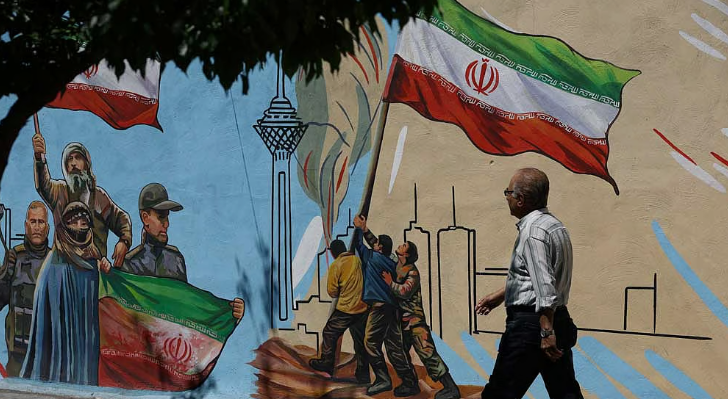
Dirty games
Washington made a huge mistake on February 28, and within a few days, it became clear that Iran would not surrender. The White House ended the war after 38 days—and would have done so earlier if not for Netanyahu—and then spent over two months trying (including through a blockade) to pressure Iran into making concessions in negotiations. It was a futile effort, but it could have continued for some time (with the faint hope that Iran would break the blockade) if not for Netanyahu. In other words, the Israeli prime minister first provoked the war and then inadvertently helped end it.
In recent weeks, he was almost openly undermining Trump by escalating tensions in Lebanon, something that would have automatically thwarted the very possibility of a US-Iran deal. The American president finally publicly cursed Netanyahu, threatening that he would eventually be left "alone with Iran." Clearly, he would never have carried out his threat, but at least Israel realized that keeping America in conflict with Iran was no longer feasible. So, in the end, they tried to cause as much damage as possible in Lebanon (including capturing more territory), hoping to keep it for as long as possible, potentially for decades, as they had done last time. "Ensuring Israel's security"? On the contrary, it exacerbated its existing problems.
Netanyahu's weakness
Although Israel will not withdraw its troops from Lebanon, it will no longer be able to disrupt the current agreement—and will even be forced to stop bombing Lebanese territory. This in itself will be a significant victory for Iran: even while weakened and under blockade, it has managed to defend Lebanon, a Muslim and Arab country. This constitutes a huge boost to its reputation, not to mention the fact that the agreement with the US itself is an undeniable victory for Iran.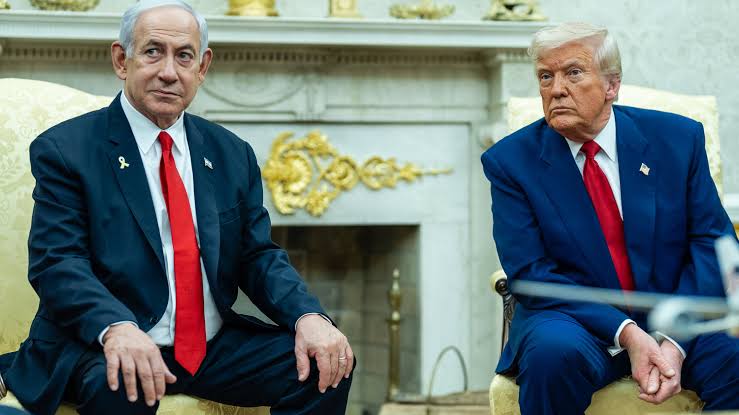
The $300 billion trap
Of course, the agreement has many impossible clauses—or rather, clauses that Washington has no intention of implementing, and Iran understands this and is not deceived. There will be no 300 billion (not American, but international) for the reconstruction of Iran (which is exactly the amount the Iranians estimate for the destruction caused by the aggressors). At best, Iran will receive the frozen 24 billion in two installments. At worst, half of that. But 12 billion would not be a bad deal. Furthermore, what is most important for Tehran is for the blockade and the ban on oil and gas exports to be lifted. American sanctions will not be lifted—or rather, the US will only lift some of them. And this will happen mainly after the completion of a permanent peace agreement, the negotiations for which have 60 days to begin this coming Friday. The probability of its conclusion is very high, even though it will only be partially implemented.
The Iranians know
Mehdi Mohammadi, an advisor to the head of Iran's negotiating team, Mohammad Bagher Ghalibaf, was clear... the clause related to the $300 billion development fund is a trap. "In this part of the text, the word reconstruction has been used. Reconstruction is the rebuilding of the damage caused by the war. It is true that the term compensation or indemnity is not explicitly mentioned, but it is clear that when the other side talks about reconstruction, it means compensation for the damages caused to Iran in the war." Mohammadi added: "In the text, the amount of $300 billion is provided for this matter. Of course, I personally believe that the other side will not fulfill such a commitment in practice, but the fact is that this commitment is written in the text." And he continued: "Furthermore, the management of these resources will also be in the hands of the Islamic Republic. If resources are made available, they are to be spent inside Iran, and of course, its management will be with Iran." "Some friends have said that this will pave the way for the presence and influence of Americans inside the country. I don't really understand how such an analysis is presented. This is the soil of Iran, and this is the soil of the Islamic Republic. It is clear that if someone wants to invest or develop a project in Iran, it will be under the full supervision of the Islamic Republic and they cannot do whatever they want. The fact that Trump's America, which has milked many countries in the region and calls them dairy cows, commits in a text to allocate $300 billion for the reconstruction and development of Iran, even to include such a phrase in the text, is a sign of the other side's defeat and an achievement for Iran," stated the Iranian official.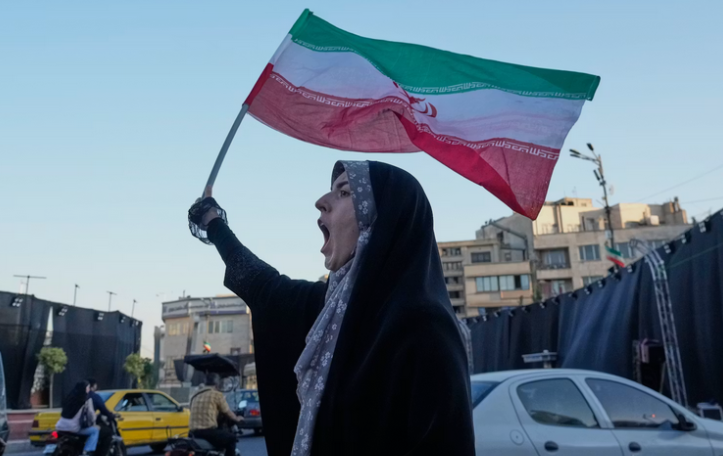
Nuclear weapons on the table
The main thing that a US methodology must also include is the renunciation of nuclear weapons by Iran. This will be documented, but Iran had already stated its reluctance to acquire a nuclear bomb before the war (which, in fact, made the attack against it possible: if Iran had nuclear weapons, Israel would not have risked itself by provoking the United States into a war). Now, the commitment to abstain from nuclear weapons will be enshrined in a treaty with the United States, and Trump will advertise this as a victory. But this is as ridiculous as calling it a victory to open the Strait of Hormuz, which was completely free until February 28.
American propaganda
Also, the Americans claim that Iran could attract investments of up to $300 billion for its reconstruction from the Gulf states themselves. This was argued by US Vice President JD Vance, describing for the first time the scope of the financial benefits provided by the Memorandum of Understanding (MOU) between Washington and Tehran, which was signed electronically on Sunday, although its full text has not yet been released.
Trump: Fake news from ignorant Democrats
Trump denied reports of US payments of $300 million to Iran, labeling them as "fake news" that "was published by ignorant Democrats." Trump posted on the social network Truth Social: "The story that the United States is paying Iran $300 million is fake news published by the ignorant Democrats." In a televised interview with CBS, the US Vice President, J.D. Vance, confirmed the Islamic Republic's ability to access a $300 billion fund for reconstruction. Therefore, it is unclear what exactly Trump was referring to when he commented on the reports about a $300 million payment to Iran, as Vance had explicitly spoken about the amount of $300 billion and not 300 million.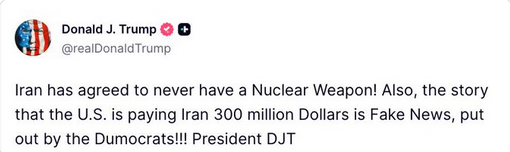
A $300 billion reconstruction fund
Asked by CBS News whether the agreement provides for the creation of a "$300 billion reconstruction fund," JD Vance confirmed that this possibility is on the table. "That is something that they could get access to, with financing from the Coalition of Gulf states, provided they live up to their own obligations," he stated characteristically. The American vice president clarified that the funds will not be given unconditionally, but will depend on Tehran's behavior and its full compliance with specific requirements of Washington.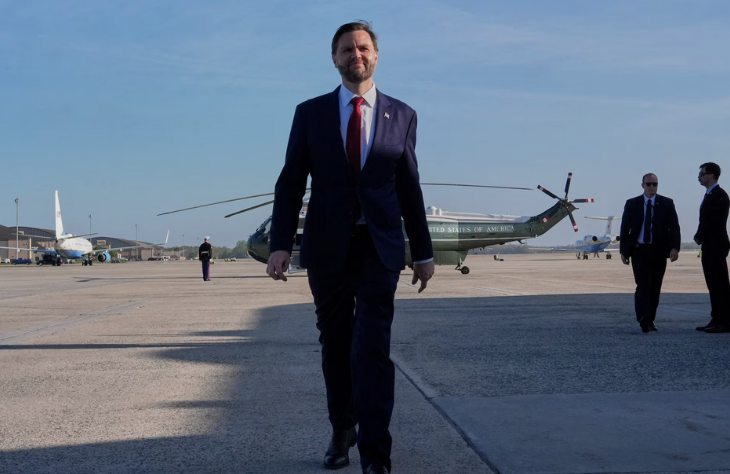
The paradox of war
Washington got what it had without the war—but what did the war give it? The assassination of some Iranian leaders and military commanders? Yes. But America and Israel needed this to cause chaos in Iran and the collapse of the Islamic Republic. Instead, the new leadership acquired a powerful weapon: the closing of the Strait of Hormuz. While this was previously just a hypothetical and catastrophic option, everyone now sees that Iran will not hesitate to use it. And this will affect everyone and everything—from global trade to the Arab monarchies of the Gulf, from Israel (and its actions against its neighbors and Gaza) to the United States itself.
Zero credibility
Ultimately, the reputation of the US is the main victim of this war. Not in the sense that they were once loved and are now hated, but rather that they were once feared and generally considered reliable protectors, but now they are simply feared as a rather logical and not very independent bull in a china shop. Never before has America shown its submissiveness in relations with Israel to such a degree, contrary to all its national interests. The Arabs not only saw and remembered this—they have been fully convinced that there is no alternative to the path of the de-Americanization of the region. Whether the Americans will leave on their own (gradually and not completely), or whether the Arabs themselves will drive them out more actively, is no longer critical. America has proven its complete ineffectiveness as a protector of the Gulf states. Moreover, it has itself become a source of huge problems.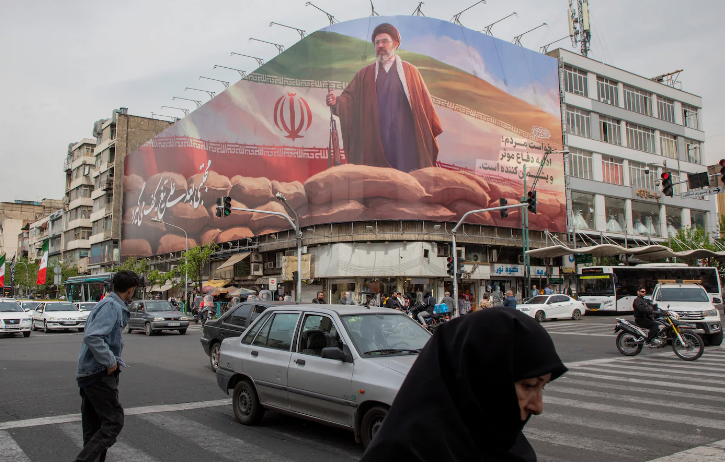
Iran's resilience
Iran, despite the huge losses it suffered, did not back down on a single point raised by the US and Israel on February 28: its missile program, as well as its support for the Arab resistance against Israel, will not be discussed in negotiations, its nuclear infrastructure will remain intact, and its socio-political structure will remain unchanged. Ultimately, the lives of Ali Khamenei and the four thousand dead Iranians cannot be reversed, but they truly became martyrs, giving their lives for the faith and independence of Iran, its right to live with its own mind and ideals. Having withstood the aggression of two nuclear powers, Iran has not only become stronger—it will now be considered throughout the world as a truly great power (and not just for its millennial history).
Agreement with many questions
Despite the high expectations generated by the prospect of ending the crisis, the US-Iran agreement is still surrounded by uncertainty. The absence of the full text has fueled conflicting interpretations, political reactions, and accusations of propaganda from both sides. The only certainty is that the coming days and the technical negotiations that will follow will determine whether this historic approach will evolve into a real peace agreement or remain yet another lost opportunity in the long and turbulent relationship between Washington and Tehran.
www.bankingnews.gr



Readers’ Comments