

On-chain data for Bitcoin is emitting a strong bullish signal, with "whales" making massive purchases worth $700 million. The activation of Glassnode's Seller Exhaustion Constant—a tool developed by ARK Invest to identify low-risk bottoms—immediately mobilized large holders, who aggressively increased their reserves near $65,000. Specifically, Bitcoin (BTC) recovered to near $65,800 after an on-chain bottom signal appeared for the second time in 2026. This is the same pattern that preceded a 24% rise earlier this year. Large investors strengthened their positions as soon as the signal appeared, suggesting they believe the lows have passed. This move combines a rare indicator with clear purchases by "whales." Both elements point in the same direction, although weakened trading volume prevents the scenario from being entirely clear.
As soon as a bottom signal appeared for Bitcoin
The starting point is a Glassnode indicator called the Seller Exhaustion Constant. It multiplies the percentage of Bitcoin supply in profit by 30-day price volatility to identify low-risk bottoms, and it was originally developed by ARK Invest. History gives it particular weight. The indicator peaked at 0.082 on February 12, when BTC was trading near $66,248. Subsequently, the price climbed to approximately $82,186 by May 10, marking a 24% increase. 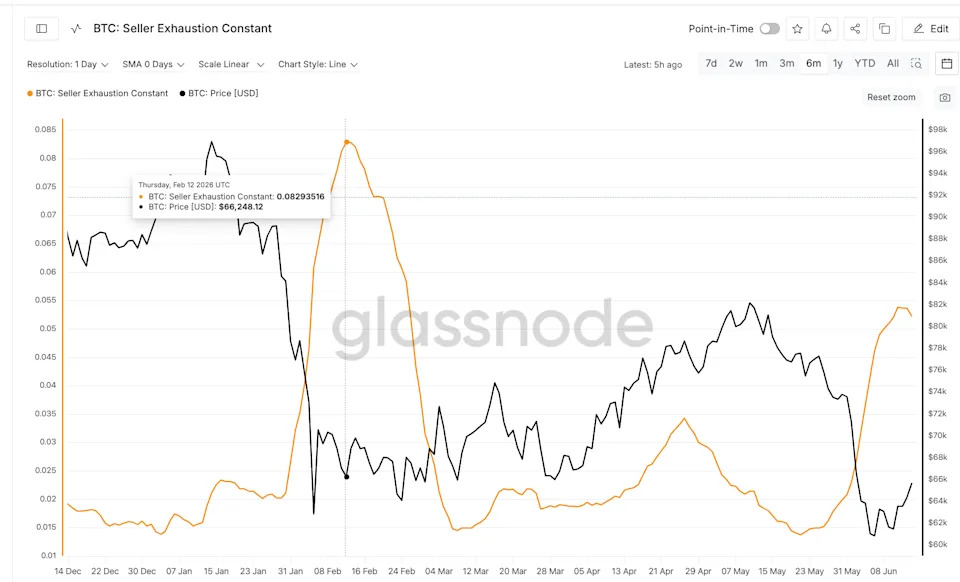
That signal marked the start of this upward trend. It has now appeared again. On June 11, the indicator touched 0.053, recording its second-highest value in six months.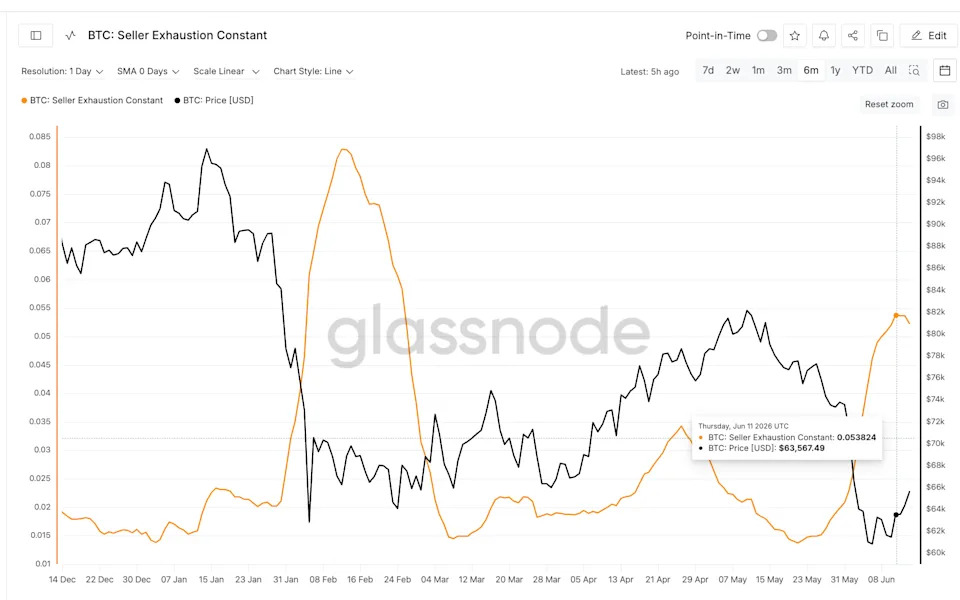
This repetition is why the current backdrop is significant, and the next level of analysis shows who acted based on it.
The "whales" bought right on the signal
Large investors acted by following the same indicator. One of the largest categories of Bitcoin "whales," holding between 100,000 and 1 million BTC, increased its holdings from approximately 693,600 BTC to 694,390 since June 11, the same day the signal was triggered. Smaller "whales" followed their example. The category holding between 1,000 and 10,000 BTC increased its position from approximately 4.24 million to 4.25 million BTC starting on June 13. Together, these two groups added nearly 11,000 BTC, worth approximately $700 million based on current prices. 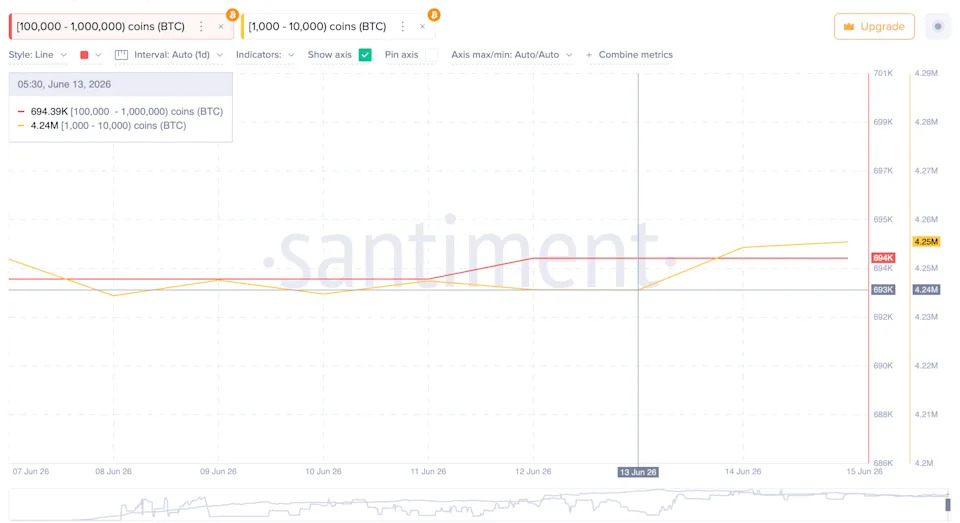
Timing is the essence of the matter. The "whales" accumulated assets right on the signal that historically preceded gains, so the indicator and the largest holders are in agreement. The price chart shows whether the market structure supports them.
Bitcoin price levels that require attention
Bitcoin recovered from the low of $59,100 and surpassed $64,694 on June 11, the trigger point that aligned with the signal. Bitcoin's price is now hovering near $65,800, testing resistance at the upper end. The bullish scenario is based on this configuration. Regaining the 20-day exponential moving average (20-day EMA) at $66,610—a trend indicator that smooths out recent price action—paves the way for $68,155, the 0.382 Fibonacci level that measures the proportional correction from the previous move. Surpassing this level sets a target of $70,953. If the US-Iran agreement continues to support investment risk and retail investors follow the whales, there could be a move toward $73,750 and subsequently toward the 200-day EMA at $78,668, with a final extended target of $82,805, repeating the previous upward path. This entails a potential move of about 8% or more if momentum develops. Currently, total buyer volume is falling as retail investors may need more confirmation. The bearish scenario is based on participation. Buy volume has weakened since June 11, even though the price has risen, which shows that whales are buying but retail investors have not yet followed. Without this demand, Bitcoin could get stuck at $66,610 and pull back toward the $64,694 level it just reclaimed. A daily close above $66,610 will confirm the strength of the trend, while a rejection at that point will limit the recovery.
www.bankingnews.gr













Readers’ Comments