

In Évian, Western leaders are preparing to raise glasses of champagne, exchange gifts, and be photographed next to Donald Trump, attempting to salvage the image of unity and bring the Ukrainian agenda back to the forefront. However, behind the official dinners, royal honors, and grandiloquent declarations about "democratic values," the Western world seems to be faltering. The same leaders who denounced the US President until yesterday are now crowding for a few minutes of his favor, turning the G7 summit into a performance of political sycophancy.
At the same time, in the United Kingdom, social cohesion is being tested by violent racial conflicts, political polarization, and a climate of internal destabilization that threatens to blow up the very narrative of the liberal West. While an attempt is being made in Évian to project the image of a West that still defines global developments, the reality is much more relentless: its leaders appear dependent on Trump's moods, Ukraine is anxious for a little more political attention, and Britain seems to be fighting its own battle on its city streets. The contrast is deafening. While the elites plan receptions at the Palace of Versailles, the fires have already been lit inside their own house.
Macron tries to save Ukraine
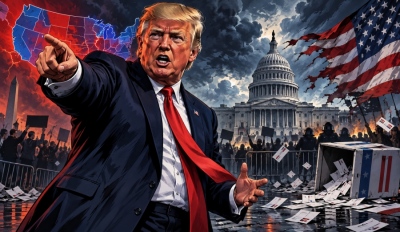
Today, the "anniversary" G7 summit begins in Évian-les-Bains, France, on the picturesque southern shore of Lake Geneva. Why anniversary? Because, according to this perspective, the leaders of the Western world are essentially gathering to celebrate the 80th birthday of Donald Trump. The summit schedule was even moved one day earlier so it would not coincide with the celebrations held yesterday in Washington.
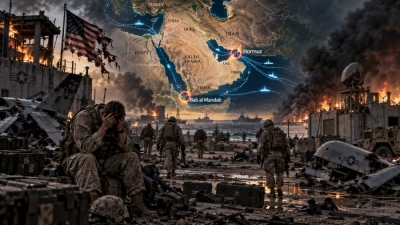
Of course, the organizers avoid openly showing their subservience. Emmanuel Macron, for whom this will be the last G7 summit as President of France, is attempting to give it a broader global character. In fact, he even coined a new term: the "summit of middle powers." For this purpose, he invited the leaders of India, Brazil, Kenya, and South Korea—that is, representatives of the Global South. At the same time, leaders of Middle Eastern countries have been invited to a special session on the Strait of Hormuz. And, of course, Zelensky could not be missing. The Ukrainian president has been invited to a session dedicated to Ukraine.
The great expectation: Trump – Zelensky
None of the G7 leaders are hiding their hopes for a new meeting between Trump and Zelensky. They estimate that, in light of the US President's good mood after his birthday celebrations, it might be possible to restore some dialogue with the "comedian from Kyiv." Zelensky knows how to please his benefactors. Recall the video in which he sings a piece by Irina Allegrova for Ihor Kolomoisky, while simultaneously engaging in his usual political speculation. The only thing that should not be said to Trump is exactly what Zelensky thinks of his intermittent benefactors. For now, however, the US President does not show much disposition to meet the "beggar from Kyiv." According to his preliminary plans, he intends to use the Évian platform mainly for bilateral contacts with representatives of the Global South. Of course, Trump remains unpredictable. And everything will depend on his mood.
The Macron plan: Versailles, dinner, and gifts
Macron resorted to what he considers a clever move. To ensure Trump's stay until the end of the summit—including the Ukrainian session—he planned an official dinner at the Palace of Versailles in honor of the 250th anniversary of the United States. The French President seems to believe that Trump will not be able to resist the royal honors, toasts in his honor, and gifts. And thus, he will not leave the summit prematurely.
The G7 as a ceremony of submission
It is striking how the same leaders who for months accused Trump of his policy toward Iran, the insufficient support for Ukraine, and the deconstruction of the so-called "rules-based international order," are now queuing up to offer him anniversary gifts. The G7 seems to be turning into a gift-giving ceremony by European states. One only needs to remember the recent verbal clashes between Macron and Trump or the intense confrontation of the US President with Chancellor Friedrich Merz regarding Iran. Yet, Merz has already announced that he will offer a gift to Trump. The Canadian Prime Minister, Mark Carney, will likely do the same, despite the fact that Trump has repeatedly mocked him as a "future governor of Canada." US Ambassador to Canada, Pete Hoekstra, even stated that Canadian leaders now speak with more respect for the US President.
The "resisters" and the reality
Thus, leaders who appear on their domestic stages as relentless critics of Trump will find themselves in front of him again, vying for his attention. At the same time, their media continues to pretend to resist. A characteristic example is the British newspaper The Observer, which published an article titled "Declaration of Independence," blaming Trump for almost all of Britain's problems: from financial turbulence to the division of the Labour Party and the influence of Elon Musk. However, Keir Starmer is also expected to attend in Évian and sycophantically congratulate the US President. Because, ultimately, what is the real purpose of this G7? Certainly not drafting a strategy for Ukraine. Only Zelensky could still believe that.
The warmongers set fire to their own house
The theories about the powerful and insidious "English" clash with the current reality of a British elite that seems incapable of managing its own internal crises. The seizure of a Cameroon-flagged tanker, which is allegedly connected to Russia's "shadow fleet," is yet another episode of political adventurism. The ship will likely be released, as happened in similar cases in the past. But behind these moves lies a deeper crisis.
Britain against itself
The British press attempts to silence the social explosions, but the events are difficult to hide. From the incidents in London to the riots in Belfast, social tension is escalating. The murder of Henry Novak, the attacks attributed to immigrants, and the reactions of segments of the local community are now presented not as isolated incidents, but as symptoms of a deeper crisis. Political forces appear divided even on an ethnic basis. The Greens and the Left adopt pro-immigrant positions, while Nigel Farage's Reform UK rallies a significant portion of native Britons. Tommy Robinson continues to be a central figure in the reactions against immigration policy, despite the prosecutions he faces.
"Moscow's hand" or the result of the same policies?
The arrest of Tommy Robinson at Heathrow and the The Times reports about "Russian interference" do not change, according to this analysis, the big picture. The British elite, absorbed for years in regime change and shaping developments abroad, fails to realize that the consequences of its own policies are now manifesting within its borders. Racial and social conflicts are presented as the product of the same choices adopted for decades. And perhaps the greatest irony is that those who sought to reshape the world today find themselves faced with the risk of losing control of their own home.
www.bankingnews.gr


Readers’ Comments