

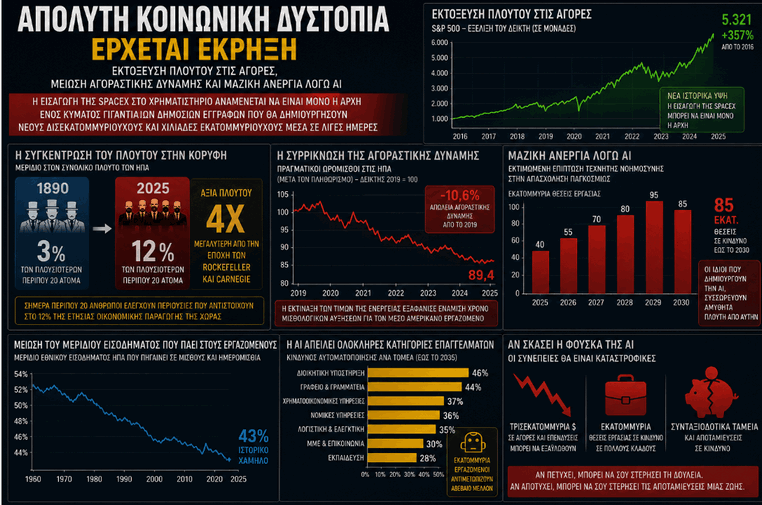
Two events from last week capture with chilling clarity the paradoxical and deeply unequal point at which the American economy has arrived, but also capture the picture of economies in the West. On Wednesday June 10, the Bureau of Labor Statistics announced that the surge in energy prices wiped out a year and a half of wage increases for the average American worker. Two days later, the entry of SpaceX into the stock market catapulted Elon Musk to the status of the first trillionaire in human history. The contrast is so extreme that it looks almost dystopian. At a time when a tiny elite accumulates wealth in unimaginable dimensions, entire generations of Americans or Greeks doubt if they will ever be able to buy a house, raise children, or retire with dignity. It is no wonder that more and more citizens believe that the economic system has ceased to function to their benefit. People do not look at the stock market and think that they will prosper too, says Harvard professor Stefanie Stantcheva. Instead, the feeling that they are being left behind and that the gap is constantly widening is reinforced. Inequality is not a new phenomenon in the United States. But the current concentration of wealth at the top has no historical precedent. Even in the famous Gilded Age of the late 19th century, the richest Americans did not possess such a percentage of national wealth. Today, approximately twenty people control fortunes that correspond to 12% of the annual economic output of the country — four times more than the tycoons of the era of Rockefeller and Carnegie
The reduction of incomes
For the vast majority of citizens, the picture is very different. Although several households possess stocks or retirement portfolios, their wealth remains largely theoretical. What determines their daily life is income. And the share of national income that ends up with workers has been decreasing for decades, now reaching historically low levels. At the same time, the cost of living continues to crush family budgets. The new energy crisis, which is connected to the war with Iran, shot inflation to the highest level of the last three years. Real wages —after inflation is subtracted— have been decreasing for three consecutive months, vanishing whatever benefits had emerged in the previous period. And even if fuel prices de-escalate, the psychological damage has already been done. Americans emerged from the pandemic traumatized. The worst inflationary crisis of the last forty years followed. Then came high interest rates, trade wars, constant fears of recession, and political instability. The result is a society that is no longer able to plan its future. After Covid, inflation, and continuous uncertainty, many people wonder how it is possible to program their lives, notes Elizabeth Wilkins of the Roosevelt Institute. The high cost of living does not only hit wallets. It creates the feeling of a deep injustice. The rich can absorb price increases almost without complaint, while lower incomes are forced to cut back on basic needs. Artificial intelligence will destroy employment And as if all this were not enough, a new fear appears on the horizon: artificial intelligence. The leaders of the technology industry themselves warn that AI can wipe out entire categories of office professions. Although several economists consider these predictions exaggerated, millions of workers fear that their professional future is under threat. At the same time, the artificial intelligence fever creates unprecedented fortunes. Companies related to AI have driven the stock market boom of recent years. The introduction of SpaceX to the stock market is expected to be only the beginning of a wave of gigantic public offerings that will create new billionaires and thousands of millionaires within a few days.
Social explosion imminent
For many citizens, the message is bleak: the very people who promise that artificial intelligence will change the world are the ones accumulating fabulous wealth from it, while the rest are left to wonder if they will still have a job in ten years. The economist Glenn Hubbard warns that a social backlash is almost inevitable. When technology moguls appear to be essentially telling workers that their innovations may destroy their lives, resentment does not take long to turn into anger. Even more worrying is the view that hyper-concentrated wealth distorts not only the economy but also democracy. As the economist Gabriel Zucman argues, extreme levels of wealth translate into extreme levels of power: power to influence markets, buy out competitors, shape political decisions, and avoid audits and restrictions. And yet, even the scenario of failure offers no consolation.
The game is rigged
If the artificial intelligence bubble proves to be an exaggeration and current valuations collapse, the consequences could be catastrophic. Millions of jobs that depend directly or indirectly on investments in AI will be put at risk. Trillions of dollars in pension funds and savings could evaporate within a few months. Thus, for the average worker, artificial intelligence looks like a trap with no way out. If it succeeds, it may deprive him of his job. If it fails, it may deprive him of the savings of a lifetime. Within this environment, it is not surprising that more and more Americans feel that the economic game is rigged against them. As Heather Boushey, a former advisor to the Biden administration, summarizes: Our economy now seems designed to create a few billionaires and one trillionaire. It is no longer about creating opportunities and stability for the majority of people. It is about the accumulation of wealth at the top, while the rest watch their future become increasingly uncertain.
www.bankingnews.gr






Readers’ Comments