

There is something darkly comedic in the consistency with which the Americans declared that the Navy of Iran has been destroyed. The US President Trump has claimed that the Navy of Iran is "at the bottom of the sea" multiple times over the past three months. The US Secretary of War promised to "obliterate" it on the first day of the war. The US Secretary of State Rubio elevated the destruction of the Navy of Iran to a primary declared war goal. The commander of CENTCOM, Admiral Brad Cooper, stood before the cameras and declared that "not a single Iranian ship" remained "at sea in the Persian Gulf, the Strait of Hormuz, or the Gulf of Oman".
How the Iranian naval forces were patrolling
And yet, weeks later, the Iranian naval forces were patrolling the strategic waterway of Hormuz in full force. Months later, Ghadir-class submarines appeared in formation inside the Strait of Hormuz. And the Strait of Hormuz itself - the waterway whose reopening was supposed to serve as living proof of Iran's naval defeat, as the American military claimed - remains closed to normal commercial traffic to this day. The body of a Navy that has been declared dead, repeatedly and loudly, refuses to stop moving.
What was realistic and what was not
Let us examine the numbers that Washington loves to cite. CENTCOM reported that at least 17 Iranian ships were destroyed or sunk in the first weeks of the imposed 40-day war. By April, Trump was claiming that 158 destroyed Iranian ships and a navy were "obliterated". The US Chairman of the Joint Chiefs of Staff, General Dan Kane, stated that the US "had essentially neutralized Iran's significant naval presence in the theater of operations". Almost every ship that was found, targeted, and sunk belonged to the conventional surface fleet of the Navy of the Islamic Republic of Iran. The frigates, the corvettes, the ships that were anchored in known ports, visible in satellite images, trackable by intelligence units that had been monitoring them for years, became targets.
Iran's secret weapon
The real maritime deterrence of Iran, however, was never built around these ships - not primarily. An honest assessment shows that Iran has spent three decades designing a naval strategy based on a single premise: that in any war with a major power, its conventional surface fleet will be destroyed. The doctrine was built around what survives this destruction and still fights.
The naval architecture they could not destroy
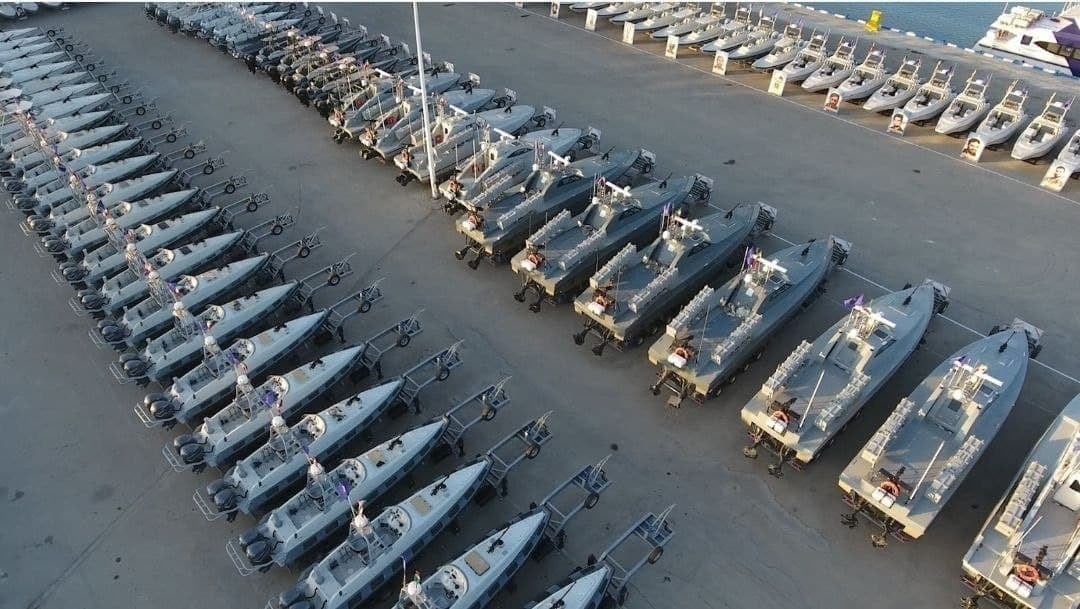
The Navy of the IRGC (Islamic Revolutionary Guard Corps) does not resemble a navy in the traditional sense, and that is entirely the point. It does not possess aircraft carriers or guided-missile cruisers. What it does possess is swarms of small, fast attack craft: hundreds of them, equipped with anti-ship missiles, capable of hiding in coastal inlets, among fishing fleets, and within the traffic of commercial ports. From the air, at speed, with limited engagement windows, distinguishing an IRGC missile-powered speedboat from a fishing vessel is truly difficult for the most advanced navies. Their total destruction, in a 40-day war, is operationally impossible, according to military experts.
The anti-ship batteries
Then, there are the land-based anti-ship batteries – Noor, Qader, Khalij Fars – embedded in the mountainous Iranian coastline that stretches along the northern coast of the strait. These systems have been continuously reinforced, dispersed, and upgraded for over thirty years. They do not sit in open fields, waiting to be photographed and hit. They are located in tunnels, in caves, on mobile launchers that can move and hide again between exits. Even the American military, with its unparalleled ISR capabilities, could not find them and destroy them.
Iran with 6,000 naval mines
And then there are also the mines. Before the war, some analyses evaluated approximately 6,000 naval mines. They can be laid by small craft, by dhows, by modified commercial vessels - vessels that look like all others in one of the world's busiest waterways. The Wall Street Journal reported that more than 60% of the IRGC fleet tasked with patrolling the Strait of Hormuz remained intact after six weeks of imposed war. This is the fleet that lays mines, boards ships, and turns the strait into a gauntlet. 60% of it is still there. The "destroyed" navy that Washington constantly announces is the small fleet that was never the main threat in the first place, as military experts claim.
Question 1: If the navy has been sunk, why are the American aircraft carriers not coming?
This is the simplest test - and the one that no American official, including Trump and generals, is willing to face directly. Naval supremacy means that you can go wherever you want with your ships. If your opponent's navy has been eliminated, you sail into their territorial waters. You do not stay 300 kilometers away and call it a blockade. Not a single American aircraft carrier strike group entered the Persian Gulf throughout the duration of the 40-day War. The offensive operations - the airstrikes, the so-called blockade, everything - were conducted from the Arabian Sea, the Gulf of Oman, and the Red Sea.
"Far from Iran"
A leading professor from King's College London, a man who harbored no particular sympathy for the Iranian position, put it clearly: the blockade operations began "far from Iran" specifically to "prevent Iran from directly exploiting its advantages from small craft and short-range weapons". This is a Western academic, describing the American naval posture and saying that the US positioned its ships at a distance specifically to avoid Iran's "small craft and short-range weapons". This is an admission, by a Western commentator, that these weapons remain a credible threat. It means that the American military calculated that entering Iranian engagement fields carried a serious risk and decided not to do so.
The USS Abraham Lincoln... was operating from... very far away
The USS Abraham Lincoln conducted the blockade enforcement operations in the Arabian Sea, a body of water that is not the Persian Gulf, is not the Strait of Hormuz, and is nowhere near the Iranian waters that Iran has closed and patrols throughout this war. The Persian Gulf itself - the one that Iran officially closed on March 2 - has not seen an American aircraft carrier inside it throughout the war. This fact alone, stripped of all rhetoric and spin, says more than any claim by the Pentagon.
Question 2: If the threat has disappeared, what happened to the USS Ford?
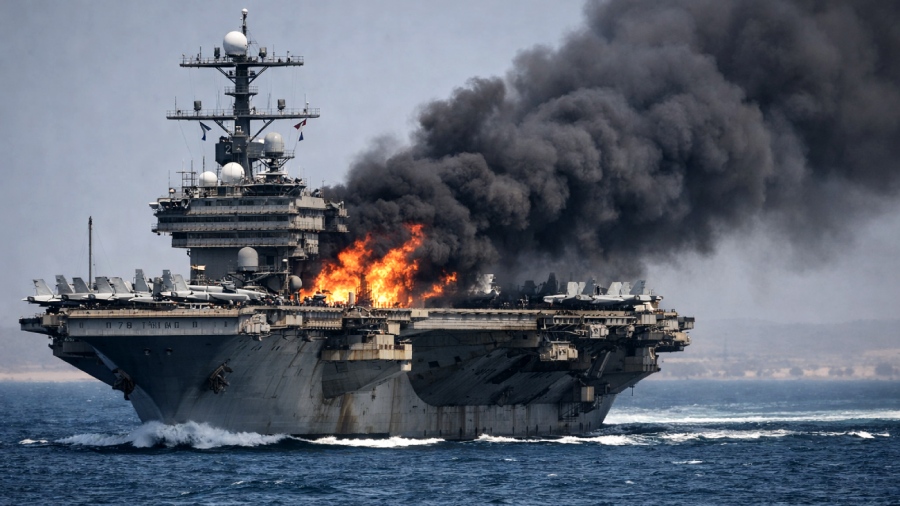
In mid-March 2026, a fire broke out on the USS Gerald R. Ford, the most expensive warship ever built, valued at 13 billion dollars, and the most technologically advanced aircraft carrier in any navy in the world. The initial announcement by the US Navy was brief: the fire was brought under control, two sailors suffered minor injuries, and the ship remained "fully operational". This is the standard Pentagon language for damage management. Subsequently, CNN obtained footage from inside the ship. What this footage showed was not a limited fire in a dryer. It showed rows of bunks melted into metal frames. Warped bulkheads. Exposed wiring hanging from charred ceiling panels. Structural sections of the interior had been completely destroyed. The fire burned for more than 30 hours. The ship's firefighting system failed, forcing the crew to fight it manually throughout the night. Approximately 600 lost their sleeping quarters. One of them told CNN, anonymously: "Seriously, I thought we were going to lose the ship."
The USS Ford sailed to Souda Bay in Crete for repairs
The Ford was withdrawn from battle and sailed to Souda Bay in Crete for repairs. The USS George H.W. Bush was deployed as a replacement. The official version attributes this to a dryer fire in the laundry room. But physics does not agree with this conclusion. A dryer fire, breaking out in a damage control environment on an aircraft carrier deployed in battle with a trained crew and a functional suppression system, does not produce 30 hours of uncontrolled combustion. It does not cause structural deformation of the hull, the kind visible in the CNN images, where the internal steel has been warped by prolonged, intense heat. A dryer fire does not displace 600 sailors. It does not send the most advanced aircraft carrier in the world to a repair port while a replacement is rushed over. The Ford was operating, during this period, under what its own Presidential Unit describes as a "persistent threat from hostile missiles and one-way unmanned aerial vehicles". The same sailor who spoke to CNN described how, when the ship was in the Red Sea, the crew was told to "expect to be hit and control the damage" when Iranian munitions appeared on the horizon. A navy whose opponent has been destroyed does not receive these alerts. It does not sail under continuous threat. It does not send its flagship to Crete for repairs. These things do not happen in the operational environment of a defeated enemy, yet they happened.
Question 3: If the submarines were sunk, what happened to the American Arleigh Burke-class destroyer?
Here is where the narrative becomes particularly difficult for the Americans. The Ghadir-class submarines are small - about 117 tons submerged - domestically produced, diesel-electric vessels, specifically built for exactly the kind of waters that the Persian Gulf and the Strait of Hormuz represent: shallow, layered in temperature, and acoustically complex, saturated with noise from heavy commercial shipping. Standard anti-submarine warfare procedures, developed for the deep-water environments of the Atlantic and the Pacific, do not work properly here. The physics of the Persian Gulf completely degrades sonar performance. What the Ghadir does in this environment is sit on the bottom and wait. Experts in the Navy call this hiding "by bottoming": the submarine rests on the seafloor, turns off non-essential systems, and becomes acoustically indistinguishable from the surrounding geology. An active sonar ping from a passing destroyer may see nothing. The submarine is, for practical purposes, invisible until it chooses not to be. This is not a theoretical capability. The sinking of the South Korean corvette Cheonan in 2010 by a North Korean midget submarine in similar waters killed 46 sailors and proved definitively that small coastal submarines in their optimal environment can sink ships built by much wealthier navies. On May 10, 2026, and while Trump had declared that he sent the Iranian navy to the bottom of the sea, the commander of the Navy of the Iranian Army publicly confirmed that Ghadir-class submarines were deployed in the Strait of Hormuz under combat readiness conditions. During a naval exercise on that day, several Ghadir vessels surfaced simultaneously in formation inside the strait, then submerged and returned to patrol. Between 14 and 20 remain in operation, according to reports from Army Recognition. These submarines also carry the Jask cruise missile, which was tested from a Ghadir-class hull in 2019, meaning that their threat extends beyond close-range torpedo ambush to stand-off engagement. The warning torpedo shots fired by the Ghadir submarines at an Arleigh Burke-class destroyer, which forced the American ship to retreat, serve as a direct operational demonstration of the logic for which these vessels were designed. A destroyer in shallow water, with degraded sonar coverage, without a reliable seafloor image, and a 117-ton submarine somewhere underneath: the crew made the logical decision. What this decision tells us is that the "destroyed" Iranian submarine fleet was not actually destroyed. Something fired those torpedoes. Something forced that retreat. That something is the Ghadir fleet that Washington said no longer existed.
Question 4: Then why is Hormuz not open?
This is the question that markets answer every day: shipping insurance premiums remain at crisis levels. This is the question that Lloyd's List answers every time it reports that another ship is bypassing the route. The Strait of Hormuz, the waterway that carries approximately 20% of the world's petroleum transported by sea, the closure of which caused a global energy crisis, is not open. The IRGC officially closed it on March 2. The US launched a comprehensive campaign to open Hormuz on March 19. Subsequently, they imposed a naval blockade on April 13. Subsequently, they used aircraft carrier strike groups, destroyers, minesweepers, Marine units, and years' worth of precision munitions to enforce a different outcome.
The American paradoxes...
How the US blockaded a waterway, Hormuz, which has been declared an open corridor, from a safe distance, while the IRGC continues to lay domestically produced Maham-3 and Maham-7 mines inside it and carry out attacks on commercial ships. 21 confirmed IRGC attacks on commercial shipping were reported. A total of 26 ships bypassed the blockade, according to data from Lloyd's List. Iran also seized two cargo ships in retaliation for the US naval robbery and piracy. This is the operational picture of a force that absorbed real losses.
Why does Washington continue to maintain that the Navy of Iran was destroyed?
The claim that Iran's navy has been destroyed does not constitute, in its essence, an honest and fact-based military assessment. If such a thing were true, it would have been quietly corrected weeks ago, when operational data rendered it groundless. It persists because it is political communication designed for a domestic American audience to whom they promised a clean, decisive, and professionally executed military campaign, and to whom a continuous narrative of success is owed, regardless of what is happening in the Strait. The problem is that this particular lie has a very short shelf life in the information environment, according to experts. The allied governments - Japan, South Korea, Australia, Persian Gulf states - have their own intelligence agencies and their own images of what is happening in the Strait of Hormuz. These images look like a force that has sustained losses, has adapted, and continues to operate with enough effectiveness to block free navigation at the most important naval chokepoint in the world.
www.bankingnews.gr











Readers’ Comments